

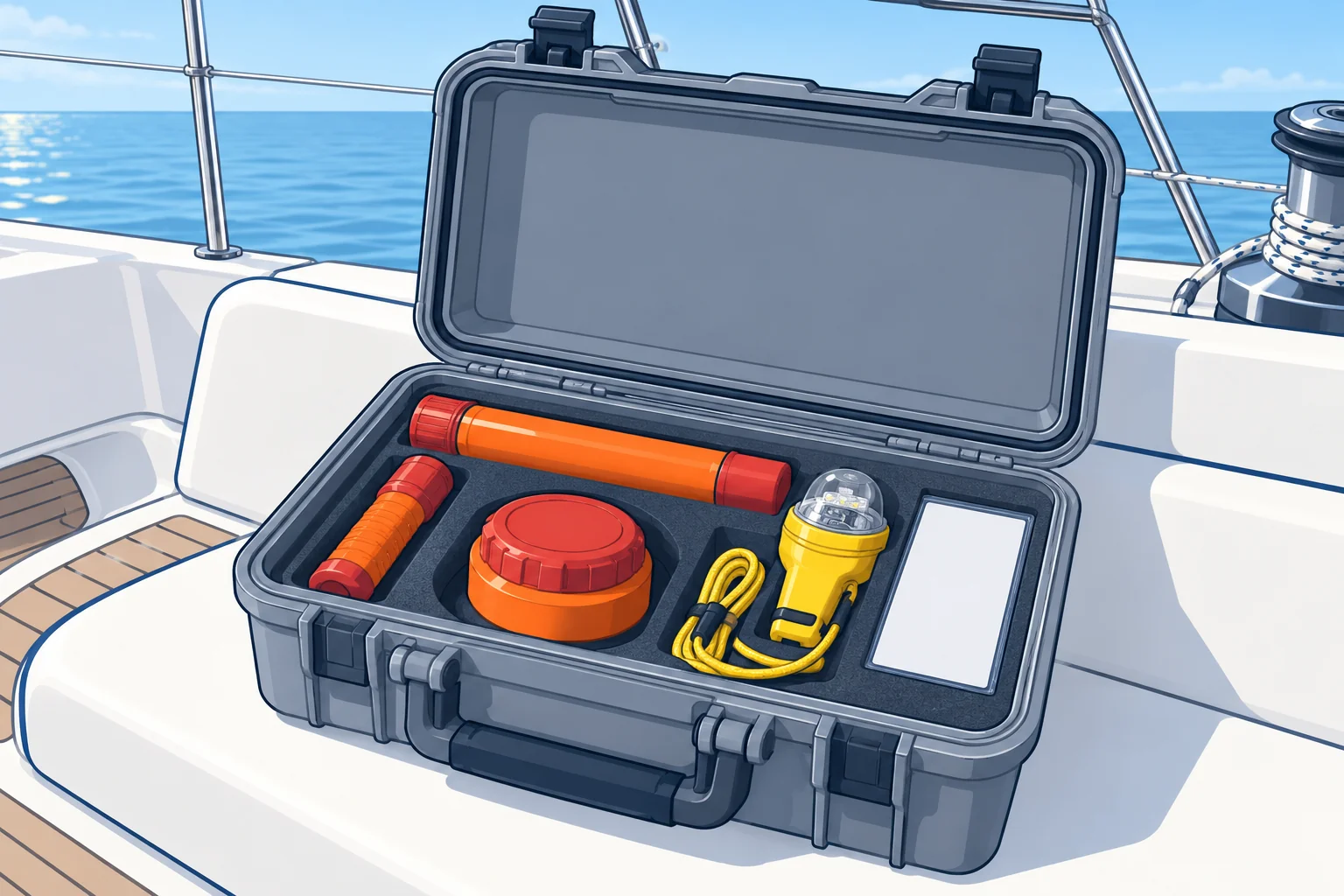
Distress pyrotechnics: which flare for which job
1The lesson in plain words
Rockets raise the alarm from far away; hand flares and smoke show rescuers exactly where you are. Choose the flare for the job.
Signals in the rules
Annex IV of the collision regulations lists the internationally recognised distress signals; see COLREG: distress signals and the site's distress signals page. Here you learn the pyrotechnics a yacht carries and when to use each. Performance figures below are the SOLAS minimums for ships' flares; yacht flares are often similar.
Red parachute rocket
A red parachute rocket climbs to at least 300 m and releases a bright red flare that drifts down on a parachute for at least 40 seconds. Seen from far away, often beyond the horizon, it raises the alarm when nobody knows you are in trouble. It points to your general direction but not your exact position, especially in low cloud.
Red hand flare
A red hand flare burns very brightly for at least a minute, held in your hand. It is seen over a shorter range than a rocket. Use it to pinpoint your position when you can see a ship, lifeboat or aircraft, or when rescuers are searching close by. It works by day and night but is most visible at night.
Orange smoke
An orange smoke signal makes a thick cloud of orange smoke. A buoyant smoke canister floats and smokes for at least 3 minutes; a hand-held one lasts about a minute. Use it by day to show nearby rescuers, especially aircraft, where you are and which way the wind blows. Strong wind can flatten and disperse the plume, reducing visibility, but it may still help nearby aircraft locate you and judge the wind. Use it as the aircrew direct.
Choosing
Far from help and nobody aware: rocket, ideally after a radio distress call. Rescuers in sight: hand flare at night, orange smoke by day. Helicopter close: smoke or hand flare only, never a rocket. Keep some flares back for when the rescuers arrive. White hand flares are not distress signals: they warn other vessels of collision risk.
2Key data
- Red parachute rocket (SOLAS)
- At least 300 m high; burns at least 40 s
- Red hand flare (SOLAS)
- Burns at least 1 minute
- Buoyant orange smoke (SOLAS)
- Smokes at least 3 minutes; floats
- Use
- Rocket: raise the alarm; hand flare and smoke: pinpoint
- White hand flare
- Collision warning, not a distress signal
- Spanish terms
- Cohete con paracaídas; bengala de mano; señal fumígena
3Key points
- 1
A red parachute rocket raises the alarm from far away.
- 2
A red hand flare pinpoints you when rescuers are in sight.
- 3
Orange smoke works by day and shows the wind to aircraft.
- 4
Never fire a rocket near a helicopter.
- 5
White hand flares warn of collision; they do not mean distress.
4Frequent mistakes
Wrong: Fire all your flares at once to be sure someone sees them.
Right: Use them as the situation needs and keep some back to pinpoint you when rescuers arrive.
Wrong: Orange smoke is a good signal at night.
Right: Smoke is a daytime signal. At night use a red hand flare or a parachute rocket.
Wrong: A white flare shows rescuers you need help.
Right: A white flare warns another vessel of collision risk. Distress flares are red, or orange smoke.
5Practice case & exam keys
Your yacht is sinking slowly 15 miles offshore at night. The DSC distress alert went out but no reply has come. Later you see the lights of a ship about 5 miles away, and later still a lifeboat searching close by. Which pyrotechnics do you use, and when?
Show the answer
With no reply, use a red parachute rocket to raise the alarm. When the ship is in sight, a rocket or a hand flare can draw its attention. When the lifeboat is close and searching, use a red hand flare to pinpoint your position. Keep at least one hand flare in reserve.
Exam keys
- Parachute rocket: at least 300 m, at least 40 s: raises the alarm at long range.
- Red hand flare: at least 1 minute: pinpoints your position near rescuers.
- Buoyant orange smoke: at least 3 minutes: day signal, shows the wind.
- No rocket near a helicopter; white flares are collision warnings.
Finish this unit
When you've read it, answer three questions. Get all three right to finish the unit; opening the page alone doesn't count.
My notes for this unit
No notes