
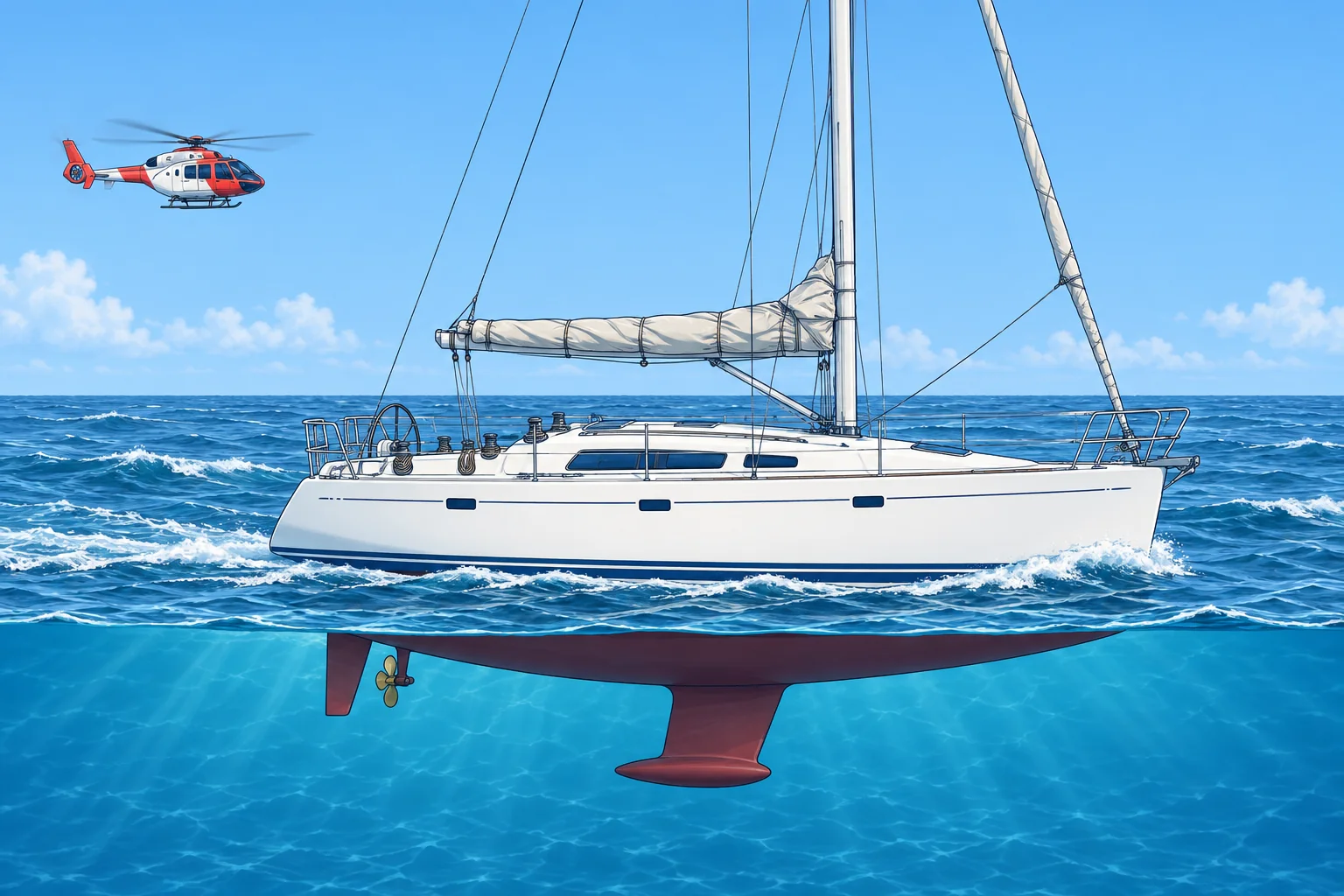
Before the helicopter arrives: radio and boat preparation
1The lesson in plain words
A helicopter rescue goes well when the boat is ready before the aircraft arrives. Talk on the radio, clear the deck and steer exactly as the aircrew ask.
Who decides
The rescue coordination centre (RCC) sends the helicopter; see Search and rescue. On the way, the RCC or the aircrew call you on VHF, often on Channel 16, then move you to a working channel they name. Keep a handheld VHF at the helm so the person steering hears every instruction. Near the aircraft the noise is huge, so agree simple hand signals in advance.
What they need to know
Give your position, the number of people aboard, the casualty's condition and the boat's description: type, length, hull and sail colours, and mast height. Report the wind and sea at your position. Mention hazards such as a tall mast, a backstay or an aerial arch. The aircrew decide the method; follow their instructions exactly.
Help them find you
By day, an orange smoke signal shows your position and the wind direction. By night, use a red hand flare or a bright torch, and only when the aircrew can see where to look. Never fire a parachute rocket when a helicopter is near: it can hit the aircraft or dazzle the crew. Point any light down at your deck, never at the cockpit.
Clear the deck
Rotor downwash, the air blown down by the rotors, can be stronger than a gale and very noisy. Lash or stow everything loose: cushions, sail covers, the dinghy, buckets. Lower and lash the sails and secure the boom, unless the aircrew want you to keep sailing. Clear the area the aircrew name for the transfer, often the cockpit or after deck. Everyone wears a lifejacket.
Steer as briefed
The aircrew will ask for a steady course and speed. A common request is to motor slowly with the wind about 30° on your port bow, which suits the aircraft's approach. Without an engine they may ask you to sail close-hauled on port tack under small sail. Put your best helm on the wheel and tell them to steer by compass and never look up.
2Step by step
Helicopter coming: prepare the boat
- 1
Lifejackets on everyone; harnesses for those on deck.
Downwash and spray can knock people over.
- 2
Lash or stow all loose gear; lower and lash sails unless told otherwise.
Loose items can fly into the rotors.
- 3
Clear the transfer area the aircrew name.
The winchman needs a clear space to land and work.
- 4
Put the best helm on a steady course and speed as briefed.
The pilot holds position on a boat that moves predictably.
- 5
Give the helm a handheld VHF; agree hand signals.
Instructions must reach the person steering through the noise.
- 6
Have the agreed visual signal ready; use it when asked.
It helps the aircrew locate you without a dangerous rocket.
3Key data
- First contact
- Often VHF Ch 16, then a working channel the RCC names
- Common course request
- Steady, slow, wind about 30° on the port bow
- Mark your position
- Orange smoke by day; red hand flare or torch at night
- Never
- Fire a parachute rocket near a helicopter
- Spanish terms
- Helicóptero de salvamento; evacuación; corriente descendente del rotor
4Key points
- 1
Keep a handheld VHF at the helm and agree hand signals before the aircraft arrives.
- 2
Give position, people aboard, casualty, boat description and mast height.
- 3
Mark yourself with orange smoke by day; never fire a parachute rocket near a helicopter.
- 4
Lash everything loose and clear the transfer area: downwash can exceed gale force.
- 5
Steer the course and speed asked for, by compass, without looking up.
5Frequent mistakes
Wrong: Stop the boat so the helicopter has a still target.
Right: Keep the course and speed the aircrew ask for. A boat moving steadily is easier to hold position over.
Wrong: Fire a parachute rocket so the helicopter can find you.
Right: A rocket can hit the aircraft. Use orange smoke by day and a hand flare or torch at night.
Wrong: Watch the winchman from the helm to see how it is going.
Right: The helm steers by compass and never looks up. Another crew member watches and passes on signals.
6Practice case & exam keys
Twenty miles offshore, a crew member is seriously ill and the RCC tells you a helicopter will arrive in 40 minutes. You are sailing in 15 knots with full main and genoa. The engine works. What do you do before it arrives?
Show the answer
Put lifejackets on everyone. Furl the genoa, lower and lash the main, and secure the boom. Stow or lash everything loose and clear the cockpit or after deck. Give the helm a handheld VHF and agree hand signals. When the aircrew call, report your position, wind and mast height, then steer exactly as briefed.
Exam keys
- Contact via the RCC on VHF; handheld at the helm; hand signals agreed.
- Deck cleared, sails lowered and lashed, loose gear stowed: downwash.
- Steady course and speed as briefed; often wind about 30° on the port bow.
- Orange smoke by day; never a parachute rocket near a helicopter.
Finish this unit
When you've read it, answer three questions. Get all three right to finish the unit; opening the page alone doesn't count.
My notes for this unit
No notes