
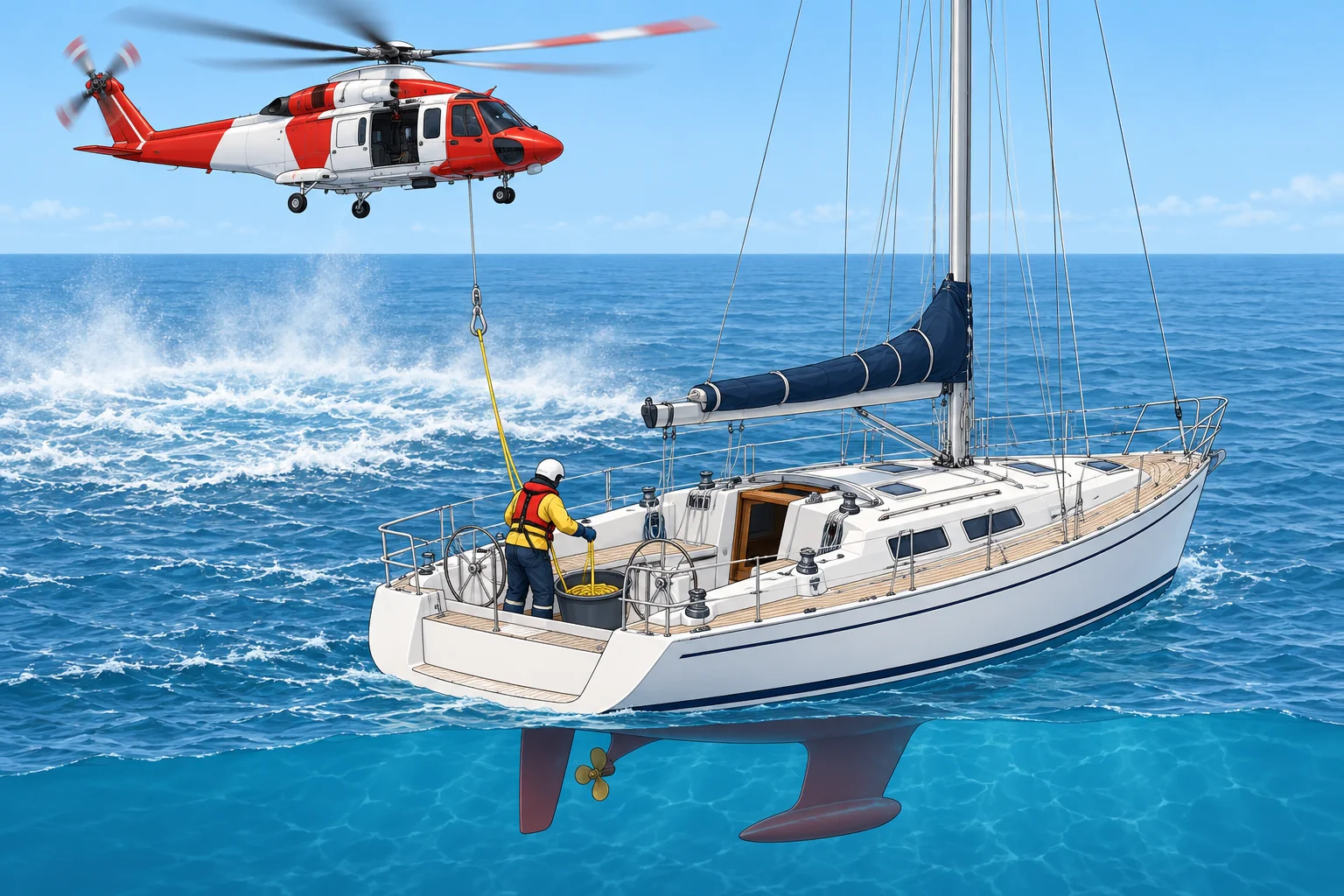
The transfer: hi-line, static, strop and other methods
1The lesson in plain words
Let the conductive lifting gear earth first, never tie the hi-line to the boat, and follow the winchman. A dinghy or liferaft transfer may be needed.
Static first
A helicopter can build up a strong charge of static electricity. Follow the aircrew’s directions. Let the conductive winch hook or earthing wire discharge into the sea before touching it or the person being lowered. A synthetic hi-line or fibreglass deck is not a reliable earth. Follow this precaution on each lowering.
The hi-line
In wind or with a mast, the aircrew often use a hi-line: a light line with a weight, joined to the winch hook by a weak link designed to break under excessive load. Choose someone who can handle the line safely and follow instructions. Wear gloves. Never tie the hi-line or the winch wire to the boat: a snag can endanger the aircraft. The weak link reduces risk; it cannot guarantee safety.
Guiding the winchman
Take in or pay out the hi-line as the aircrew direct. Keep it clear of the propeller, rig and people’s feet. Never wrap it around your hand or body. Flake it: lay it in loose folds in a clear bucket or cockpit area so it can run freely. Keep hands and feet clear of loops. Let it run when directed during the lift. Once aboard, the winchman directs the transfer.
Lifting a person
A rescue strop is a padded loop over your head and under your armpits, with the toggle pulled down to your chest. Keep your arms down by your sides: raising them can let you slip out. In a double lift the winchman goes up with the casualty. Report suspected hypothermia, a dangerously low body temperature, or serious injury before the lift. The winchman can arrange a supported horizontal lift, for example in a stretcher. Follow their instructions.
Other methods
If the rig makes a lift from the deck too dangerous, the aircrew may ask you to put the casualty in your dinghy or liferaft and stream it astern on a long line, to be lifted from there. In the worst case they may ask people to enter the water, wearing lifejackets, one at a time. Never jump in until the aircrew tell you.
2Key data
- Static
- Conductive hook or earthing wire: earth in sea as aircrew direct
- Hi-line
- Weighted line with weak link; loose folds, never tied
- Never
- Make the hi-line or winch wire fast to the boat
- Strop
- Under the armpits, toggle down, arms by your sides
- Double lift
- Winchman and casualty lifted together
- Alternative
- Dinghy or liferaft streamed astern; water only if told
3Key points
- 1
Let the conductive hook or earthing wire discharge as briefed; a hi-line touching a fibreglass deck is not proof.
- 2
Lay the hi-line in loose folds; keep loops off people. Never tie it or the winch wire to the boat.
- 3
Once aboard, the winchman is in charge.
- 4
In a strop keep your arms down by your sides.
- 5
The aircrew may ask for a dinghy or liferaft transfer; enter the water only if told.
4Frequent mistakes
Wrong: Tie the hi-line to a cleat so it does not blow away.
Right: Never tie it to the boat. Lay it in loose folds so it runs freely. A snag can endanger the aircraft despite the weak link.
Wrong: Grab the hook as soon as you can reach it.
Right: Let the conductive hook or earthing wire discharge into the sea as the aircrew direct. A synthetic hi-line or fibreglass deck is not a reliable earth.
Wrong: Raise your arms in the strop to hold the wire.
Right: Keep your arms down by your sides. Raised arms can let you slide out of the strop.
5Practice case & exam keys
The helicopter is overhead and lowers a weighted line towards your cockpit in 20 knots of wind. A crew member reaches for it as it swings past, and another wants to tie it to the backstay so it cannot blow away. What do you say?
Show the answer
Follow the aircrew’s directions. The conductive hook or earthing wire must discharge into the sea before you touch it or the person being lowered; a synthetic hi-line touching the deck does not earth it. Handle the hi-line with gloves as directed. Never tie it to the backstay or anything else. Lay slack in loose folds, clear of people, propeller and rig. Take in or pay out as directed; let it run when asked. Once aboard, the winchman directs the transfer.
Exam keys
- Static: earth the conductive hook or earthing wire as briefed on each lowering; rope or fibreglass deck contact is not proof.
- Hi-line: weak link; flaked loose; never secured to the boat.
- Winchman in charge once aboard; strop under the armpits, arms down.
- Alternatives: dinghy or liferaft streamed astern; water only on instruction.
Finish this unit
When you've read it, answer three questions. Get all three right to finish the unit; opening the page alone doesn't count.
My notes for this unit
No notes