

Lifeboats: types, protection and equipment
1The lesson in plain words
Cargo ships usually carry enclosed lifeboats on each side or a stern free-fall boat, plus rafts. Some tanker cargoes require air support and fire protection.
Types
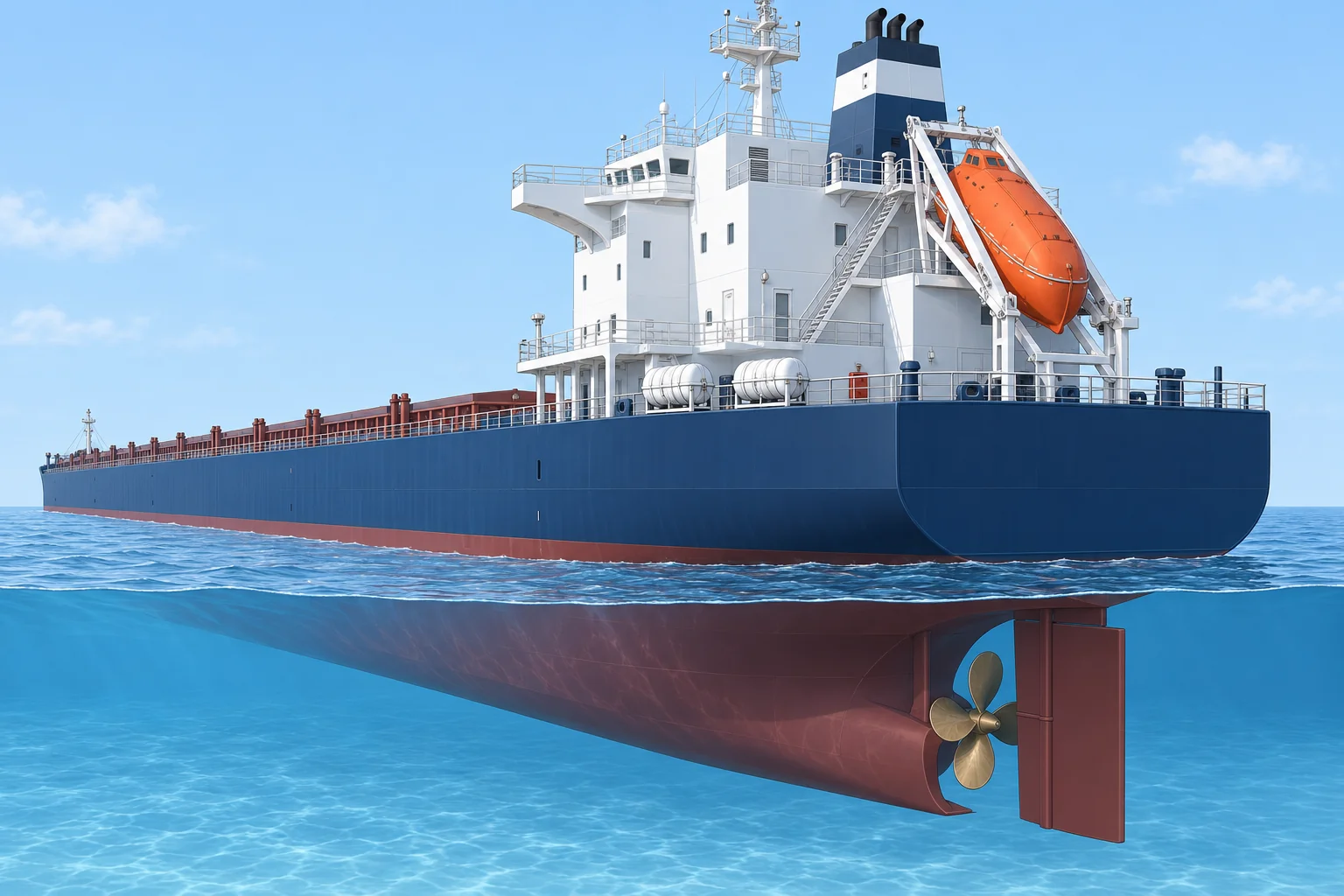
A lifeboat is a rigid survival craft. Partially enclosed boats have rigid covers at bow and stern and a folding canopy between; they are used on passenger ships. Normally, cargo ships carry totally enclosed lifeboats, with a watertight cover and hatches. With everyone strapped in and hatches shut, a totally enclosed boat is self-righting: it comes upright after capsizing. Davits, lifting arms, lower boats. A free-fall lifeboat slides off a stern ramp into the sea with everyone belted in, facing aft.
Tankers and gas carriers
Self-contained air support uses compressed air to keep occupants breathing safely and toxic gas out for at least 10 minutes, with hatches closed and engine running. It is required for cargoes giving off toxic vapours. A fire-protected lifeboat, usually protected by water spray, withstands an enveloping oil fire for at least 8 minutes in approval tests. Tankers carrying cargo with a flashpoint of 60 °C or less require this protection. Flashpoint is the lowest liquid temperature at which its vapour ignites when an ignition source is applied.
Performance
No lifeboat may carry more than 150 persons. Fully loaded in calm water, it makes at least 6 knots, and at least 2 knots while towing a loaded 25-person liferaft. It carries fuel for 24 hours at 6 knots, and its engine starts within 2 minutes in temperatures down to −15 °C.
Equipment highlights
A lifeboat carries 3 litres of drinking water per person; an approved desalinator, which makes drinking water from seawater, may replace part. It carries at least 10,000 kJ of food per person, 48 hours' seasickness medicine and a bag each, thermal protective aids, a first-aid kit, a sea anchor that reduces drift, bailers for removing water, a searchlight, four rocket parachute flares, six hand flares and two buoyant smoke signals.
On a cargo ship
The usual SOLAS cargo-ship arrangements are totally enclosed davit lifeboats on each side, each side for 100 % of the people on board, or a free-fall lifeboat for 100 % at the stern. Liferafts are carried as well. LSA Code amendments in force since 1 January 2026 require ventilation of at least 5 m³ per person per hour for 24 hours in totally enclosed lifeboats installed from 1 January 2029. Launching is in Emergencies: survival craft (P3).
2Key data
- Maximum capacity
- 150 persons
- Speed
- 6 knots loaded; 2 knots towing a loaded 25-person liferaft
- Fuel
- 24 h at 6 knots
- Air support
- Safe air for at least 10 min, hatches shut, engine running
- Fire-protected
- Survives an enveloping oil fire for at least 8 min
- Water and food
- 3 L water and 10,000 kJ food per person
3Key points
- 1
Normally, cargo ships carry totally enclosed, self-righting lifeboats on davits or one free-fall boat at the stern.
- 2
Toxic vapours: air support ≥10 min. Tanker cargo flashpoint ≤60 °C: fire protection ≥8 min.
- 3
Lifeboats: at most 150 persons, 6 knots, fuel for 24 h.
- 4
Equipment includes 3 L of water and 10,000 kJ of food per person.
- 5
Self-righting works only with everyone belted in and the hatches closed.
4Frequent mistakes
Wrong: Seat belts in a totally enclosed lifeboat are optional once you are in the water.
Right: Keep belts on in rough seas. The boat rights itself only if people stay in their seats.
Wrong: A fire-protected lifeboat can stay in a burning oil slick as long as needed.
Right: Its fire-protection approval test lasts at least 8 minutes. This is not unlimited protection.
5Practice case & exam keys
You join a chemical tanker whose cargo gives off toxic vapour and has a flashpoint of 40 °C. During familiarisation, the second officer asks what is special about your lifeboat compared with a container ship's.
Show the answer
Toxic vapours require a totally enclosed lifeboat with air support for at least 10 minutes, with hatches closed and engine running. A flashpoint below 60 °C also requires fire protection, tested in an enveloping oil fire for at least 8 minutes. Identify both systems during familiarisation and report either missing protection. Operation belongs in survival-craft training.
Exam keys
- Partially enclosed: passenger ships; normally totally enclosed and self-righting: cargo ships.
- Free-fall lifeboats launch over the stern, with everyone belted in and facing aft.
- Air support: at least 10 min; fire protection: at least 8 min in an enveloping oil fire.
- Maximum 150 persons; 6 knots; 24 h fuel; 3 L water per person.
Finish this unit
When you've read it, answer three questions. Get all three right to finish the unit; opening the page alone doesn't count.
My notes for this unit
No notes