

Liferafts: types, float-free arrangement and servicing
1The lesson in plain words
Liferafts are inflatable or rigid craft for six or more. With a correctly installed float-free arrangement, an inflatable raft releases as the ship sinks.
Types
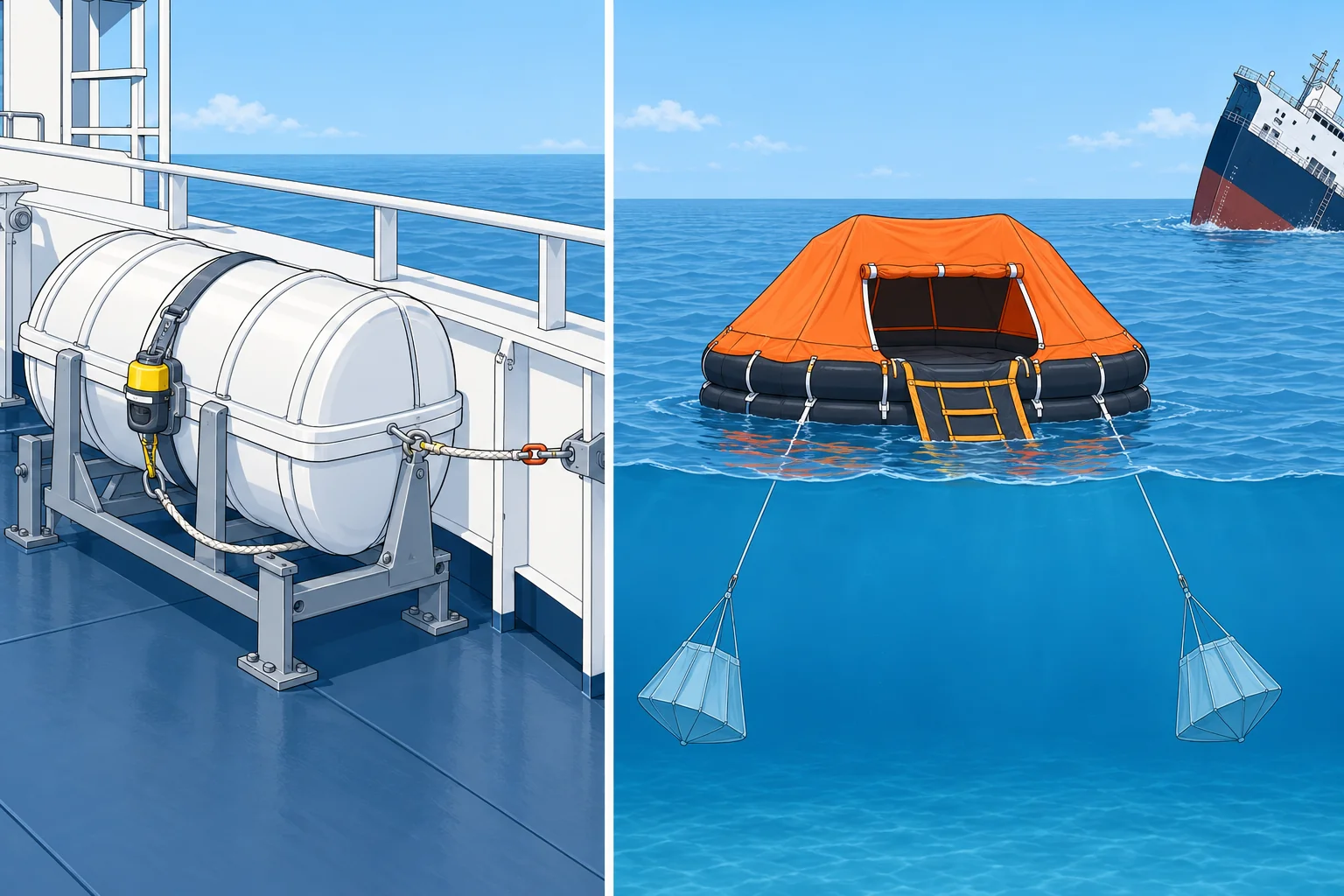
A liferaft is either inflatable, packed in a canister and filled by a gas cylinder, or rigid, with built-in buoyancy. Most ship rafts are inflatable. Each has a canopy, two sea anchors to reduce drift, lifelines inside and out, a boarding ramp or ladder, and means for collecting rain. Liferafts carry at least 6 persons.
Throw-over or davit
A throw-over liferaft has a canister designed for deployment over the side. A davit-launched liferaft uses a lifting arm and allows dry embarkation. The painter is the line that activates inflation.
Float-free
With a correctly installed float-free arrangement, an inflatable raft releases as the ship sinks. Its canister is held by a strap with a hydrostatic release unit (HRU), which frees it at a depth of not more than 4 m. The canister floats up, the painter pulls tight and activates inflation. A weak link, breaking at 2.2 ± 0.4 kN, then parts so the sinking ship cannot drag the raft under. Never bypass the weak link.
Markings and packs
The container shows identity, approval, capacity, pack, painter length, stowage limit, service date and launching instructions. A SOLAS A pack normally includes 1.5 litres of water and 10,000 kJ of food per person, flares, first aid and seasickness medicine. Approved desalination equipment may replace part of the water. A SOLAS B pack omits food and water and needs flag-state approval for suitable short international passenger voyages.
Servicing
Inflatable liferafts, inflatable lifejackets and marine evacuation systems are serviced at an approved station at intervals of not more than 12 months; the flag state may extend this to 17 months. Serviceable HRUs follow the same 12-month cycle; disposable HRUs are replaced by their expiry date. Check the dates on your rafts.
2Key data
- Minimum capacity
- 6 persons
- HRU
- Frees the raft at a depth of not more than 4 m
- Weak link
- Breaks at 2.2 ± 0.4 kN
- Servicing
- Normally ≤12 months; disposable HRUs: replace by expiry
3Key points
- 1
Liferafts carry at least 6 persons. Check the approved capacity on the container.
- 2
Read the container markings for capacity, pack type and service date.
- 3
Float-free: HRU releases at 4 m or less; the weak link stops the ship dragging the raft down.
- 4
A pack is standard; B pack needs flag approval for suitable short international passenger voyages.
- 5
Normally service inflatables and serviceable HRUs within 12 months; replace disposable HRUs by expiry.
4Frequent mistakes
Wrong: Tie the painter straight to the ship's rail so the raft can never be lost.
Right: Attach it as the maker shows, through the weak link. A raft tied to a sinking ship is dragged under.
Wrong: Crew checks replace an inflatable raft's approved-station service.
Right: Crew inspect rafts on board. Inflatable rafts also need servicing at an approved station, normally at intervals of not more than 12 months.
5Practice case & exam keys
Checking a liferaft on the boat deck, you see the HRU expiry date passed two months ago. The service label shows the raft was serviced 11 months ago.
Show the answer
Report it to the officer responsible at once: an expired HRU may not release the raft if the ship sinks. If it is a disposable HRU, it must be replaced; a serviceable one goes for servicing. Also note that the raft is due for its 12-month service within a month. Do not remove or tamper with the HRU or the weak link yourself.
Exam keys
- Liferafts carry at least 6 persons; containers show capacity, pack type and service date.
- SOLAS A: 1.5 L water and 10,000 kJ food per person; B packs omit food and water and need flag approval.
- HRU: releases at ≤ 4 m; weak link breaks at 2.2 ± 0.4 kN.
- Inflatable rafts and lifejackets: normally service within 12 months. Serviceable HRUs: normally 12 months; disposable HRUs: replace by expiry.
Finish this unit
When you've read it, answer three questions. Get all three right to finish the unit; opening the page alone doesn't count.
My notes for this unit
No notes