

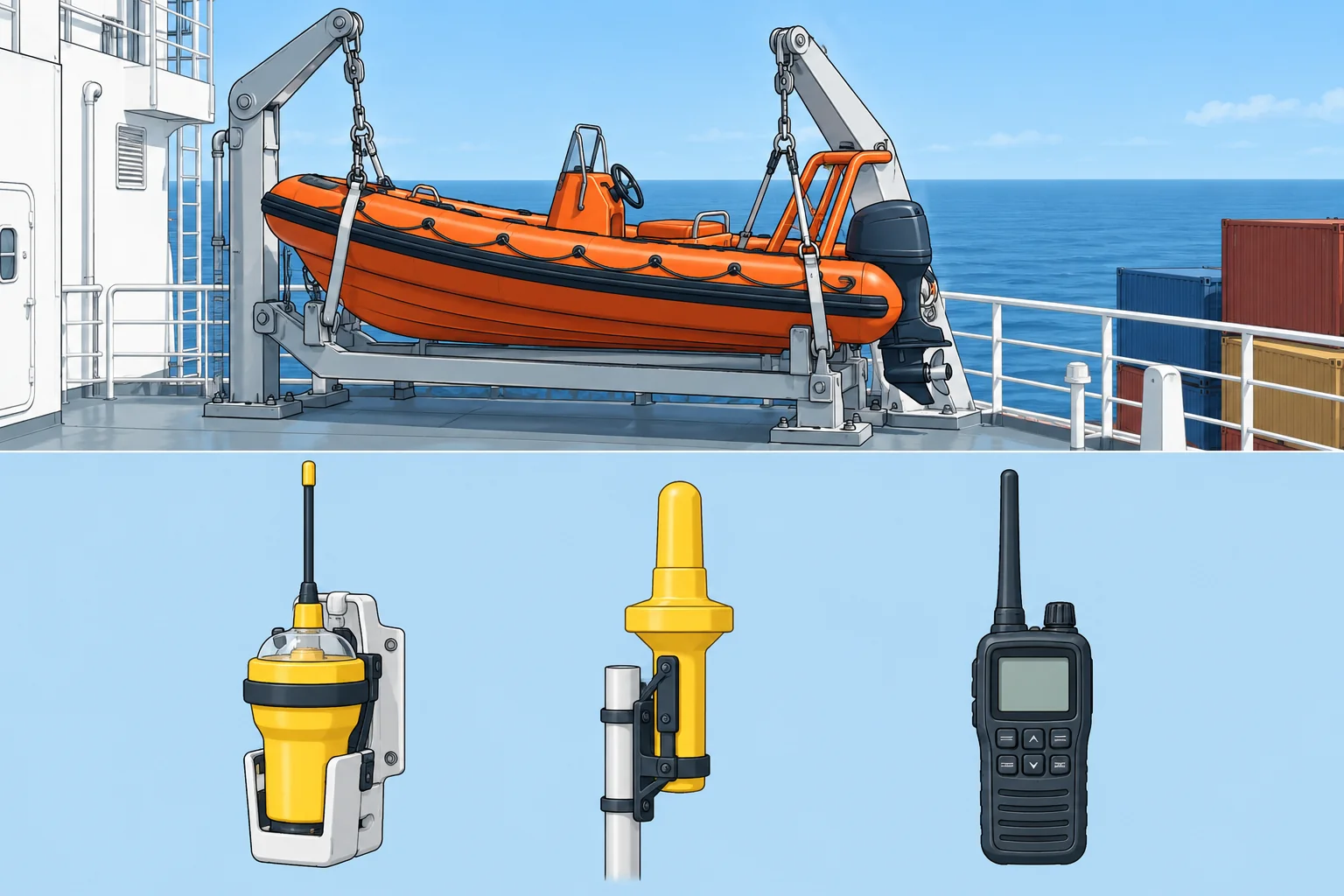
Rescue boats, EPIRB, SART and portable VHF
1The lesson in plain words
Rescue boats pick people out of the water. The EPIRB raises the alarm, SARTs guide rescuers to the craft, and portable VHFs let everyone talk.
Rescue boats
A rescue boat is designed to rescue people in the water and to marshal liferafts, gathering and towing them. SOLAS cargo ships carry at least one; a lifeboat may serve if it also meets the rescue-boat rules. It is rigid, inflated or both, 3.8 to 8.5 m long, carries at least five seated persons and one on a stretcher, runs at 6 knots or more for at least 4 hours, and can tow the ship's largest loaded liferaft at 2 knots.
Fast rescue boats
Ro-ro passenger ships, where vehicles roll on and off using ramps, carry at least one fast rescue boat, 6 to 8.5 m long, which can run for 4 hours at 20 knots with a crew of three, and at 8 knots fully loaded. Its crew need extra training; see Emergencies: fast rescue boats.
EPIRB
SOLAS passenger ships and cargo ships of 300 GT (gross tonnage, a measure of enclosed volume) or more on international voyages carry a float-free satellite EPIRB (emergency position-indicating radio beacon) in an accessible position. On sinking, it releases, floats up and activates. It sends a 406 MHz distress alert through Cospas-Sarsat satellites for at least 48 hours, plus a 121.5 MHz homing signal to guide rescuers. It can be released by hand and carried into a survival craft. Details: GMDSS (Global Maritime Distress and Safety System).
SART and AIS-SART
A radar SART (search and rescue transponder) or an AIS-SART helps rescuers locate a survival craft. AIS means automatic identification system: it shares identity and position by radio. SOLAS passenger ships and cargo ships of 500 GT and upwards carry at least one locating device on each side. SOLAS cargo ships of 300 to under 500 GT carry at least one. Detailed operation is covered in GMDSS.
Portable VHF
Survival craft talk to each other and rescuers by two-way VHF (very high frequency) radiotelephone, a waterproof handheld set. SOLAS passenger ships and cargo ships of 500 GT and upwards carry at least three; SOLAS cargo ships of 300 to under 500 GT carry at least two. Know their stowage locations and who takes them to the craft. Operation is covered in the GMDSS lessons.
2Key data
- Rescue boat
- 3.8–8.5 m; 5 seated + 1 stretcher; 6 knots for 4 h
- Fast rescue boat
- 6–8.5 m; 20 knots for 4 h with a crew of 3
- EPIRB
- Float-free, 406 MHz for at least 48 h, 121.5 MHz homing
- Locating devices, ≥500 GT
- At least one each side, two in all
- Two-way VHF, 500 GT and over
- At least three
- Cargo ship 300 to < 500 GT
- One locating device and two portable VHFs
3Key points
- 1
Rescue boats rescue people and marshal liferafts; SOLAS cargo ships carry at least one.
- 2
The EPIRB floats free and alerts by satellite on 406 MHz for at least 48 h.
- 3
A radar SART or AIS-SART helps nearby rescuers locate the survival craft.
- 4
At least two locating devices (radar SARTs or AIS-SARTs) and three portable VHFs on ships of 500 GT and upwards.
- 5
Take the locating devices and VHFs into the survival craft.
4Frequent mistakes
Wrong: The EPIRB is fixed to the ship, so it is lost if she sinks.
Right: It floats free and starts transmitting by itself, and can also be released by hand and taken into a craft.
Wrong: Any lifeboat can automatically serve as the ship's rescue boat.
Right: A lifeboat can serve only if it also meets the rescue-boat requirements. Check which craft is designated on your ship.
5Practice case & exam keys
While preparing to abandon your 25,000 GT container ship, you are assigned to collect the bridge radio life-saving equipment before boarding one of two lifeboats.
Show the answer
At least two locating devices (radar SARTs or AIS-SARTs) and three portable two-way VHF sets are required. Take one locating device and at least one VHF to each lifeboat, with spare batteries, as the muster list says. Take the EPIRB if it is accessible and safe; otherwise its float-free arrangement releases it if the ship sinks. Do not delay embarkation or return aboard for equipment.
Exam keys
- Rescue boat: 3.8–8.5 m, 5 seated + stretcher, 6 knots for 4 h, tows the largest raft at 2 knots.
- EPIRB: float-free, 406 MHz via Cospas-Sarsat for at least 48 h, 121.5 MHz homing.
- 500 GT and upwards: at least 2 locating devices (one each side) and 3 two-way VHFs.
- Cargo ships 300 to < 500 GT: at least 1 locating device and 2 two-way VHFs.
Finish this unit
When you've read it, answer three questions. Get all three right to finish the unit; opening the page alone doesn't count.
My notes for this unit
No notes