

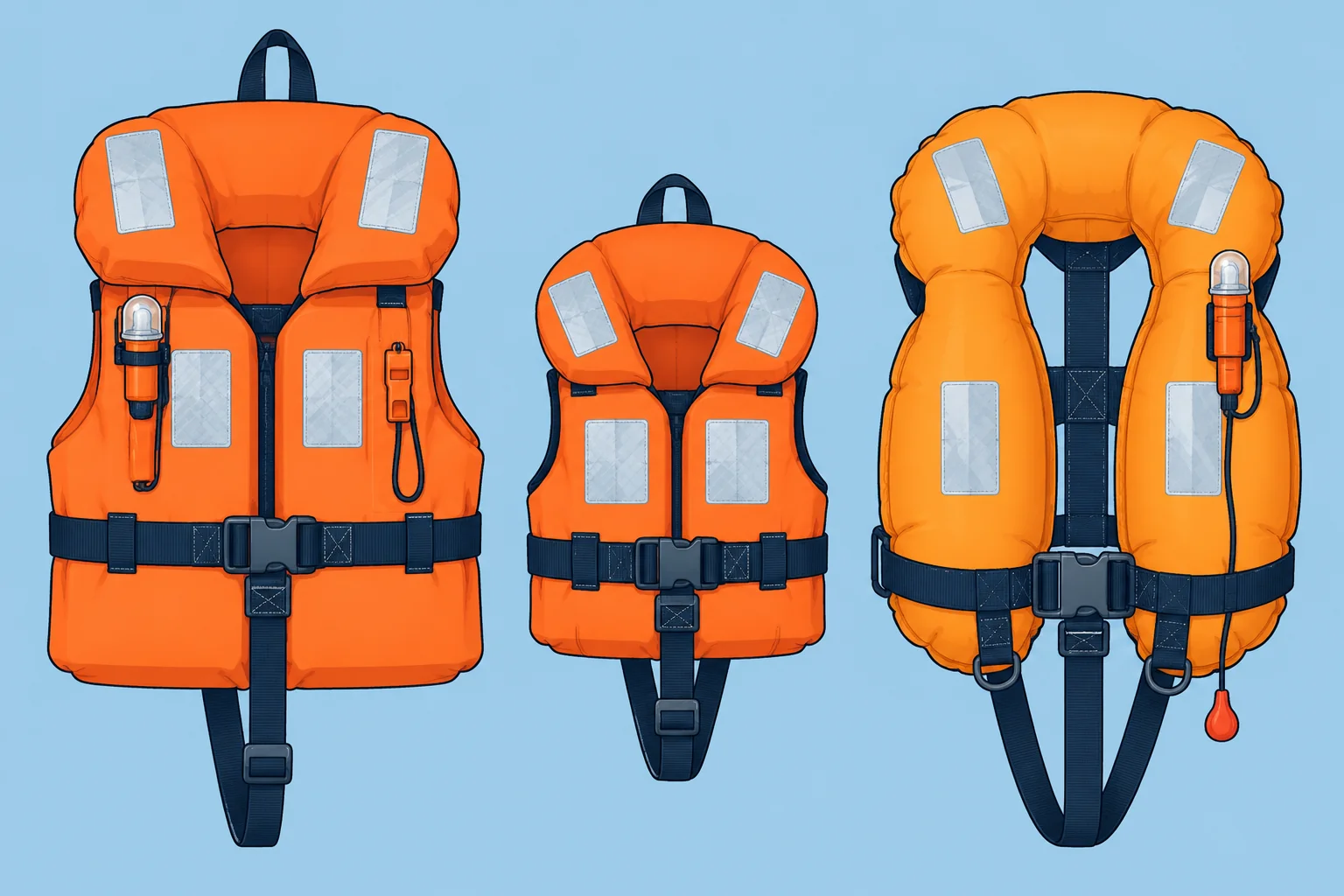
SOLAS lifejackets: sizes, performance and fittings
1The lesson in plain words
Every person on board has a SOLAS lifejacket that keeps an unconscious wearer's mouth clear of the water. Know its sizes, fittings and how to wear it.
One for everyone
SOLAS, the International Convention for the Safety of Life at Sea, requires a lifejacket for every person on board, plus extra lifejackets for people on watch and at survival craft stations far from the accommodation. There are three sizes by body weight: infant (under 15 kg), child (15 to under 43 kg) and adult (43 kg and over). An adult lifejacket must fit people up to 140 kg and 1,750 mm chest girth, or accessories are carried to secure it to them.
What it must do
The LSA Code (International Life-Saving Appliance Code) requires mouth support and face-up turning at least as good as a reference test device (RTD). At least 75 % of unfamiliar adults must put it on unaided within 1 minute; after demonstration, all must do so. Small children and infants may need help. Approval includes jumps from 4.5 m holding the jacket and 1 m with arms overhead. These tests do not make every jump safe. After 24 hours in water it retains at least 95 % buoyancy.
Fittings
Each lifejacket has a light (at least 0.75 candela for at least 8 hours, steady or flashing), a whistle on a lanyard, and retro-reflective tape, which shines brightly back in a searchlight beam. It also has a buddy line, a releasable buoyant line to fasten yourself to another person in the water, and a lifting loop or strap so rescuers can lift you out. Learn where each fitting is on your ship's model.
Inflatable lifejackets
Some ships carry inflatable lifejackets. They have at least two separate buoyancy compartments. If one fails, the other must retain the required flotation performance. They inflate automatically in the water, can be fired by a single manual pull, and each chamber can be inflated by mouth. They are serviced at intervals of not more than 12 months, like inflatable liferafts. Foam lifejackets need no inflation. For water entry, follow your ship's training and the manufacturer's instructions.
Wear it right
Lifejackets are stowed where you can reach them quickly, and their places are clearly marked. Fasten every buckle and tighten the straps so it cannot ride up over your face. Yacht lifejackets and the ISO 12402 buoyancy levels are in Emergencies: safety equipment.
2Key data
- Sizes
- Infant < 15 kg; child 15 to < 43 kg; adult 43 kg and over
- Donning test
- 75 % of untrained adults, unaided, within 1 min
- Approval jump tests
- 4.5 m holding the jacket; 1 m with arms overhead
- Light
- At least 0.75 cd for at least 8 h
- Inflatable
- 2 or more chambers; automatic, manual pull and by mouth
- Inflatable servicing
- At intervals of not more than 12 months
3Key points
- 1
One lifejacket per person, plus extras at watch stations and remote survival craft stations.
- 2
Three sizes: infant under 15 kg, child 15 to under 43 kg, adult 43 kg and over.
- 3
It turns an unconscious wearer face-up and keeps the mouth clear of the water.
- 4
Fittings: light, whistle, retro-reflective tape, buddy line, lifting loop.
- 5
Inflatables: at least two chambers, serviced at least every 12 months.
4Frequent mistakes
Wrong: Any lifejacket fits anyone if you pull the straps tight.
Right: Use the right size: infant, child or adult. A child in an adult jacket can slip out.
Wrong: Passing the jump test makes any jump safe.
Right: Approval tests do not make every water entry safe. Follow your ship's training and the manufacturer's instructions.
5Practice case & exam keys
Your ship takes the superintendent's 12-year-old daughter, who weighs 38 kg, on a short coastal passage. At the safety briefing she is handed an adult lifejacket from the cabin locker.
Show the answer
At 38 kg she needs a child lifejacket, for 15 to under 43 kg. An adult jacket may not turn her face-up and she could slip out. Tell the officer in charge so a child lifejacket is found and fitted, with all straps fastened. Show her the light and whistle. For water entry, follow your ship's training and the manufacturer's instructions.
Exam keys
- Lifejacket for every person, plus extras for watchkeepers and remote survival craft stations.
- Infant < 15 kg, child 15 to < 43 kg, adult 43 kg and over.
- Approval tests: 75 % of untrained adults don unaided within 1 min; jumps 4.5 m holding it and 1 m arms overhead. Light: 0.75 cd for 8 h.
- Inflatable: at least two compartments; serviced at intervals of not more than 12 months.
Finish this unit
When you've read it, answer three questions. Get all three right to finish the unit; opening the page alone doesn't count.
My notes for this unit
No notes