

Adult CPR and the AED
1The lesson in plain words
If an adult is unresponsive, call for help at once. If they are not breathing normally, start CPR and use an AED as soon as it arrives.
Recognise cardiac arrest
In cardiac arrest the heart stops pumping blood. The person is unresponsive and not breathing normally: no breathing at all, or slow gasps. A short burst of jerking, like a fit, can happen at the start. If you are in any doubt, assume cardiac arrest and start CPR (cardiopulmonary resuscitation). CPR on someone who turns out not to need it rarely causes serious harm.
Chest compressions
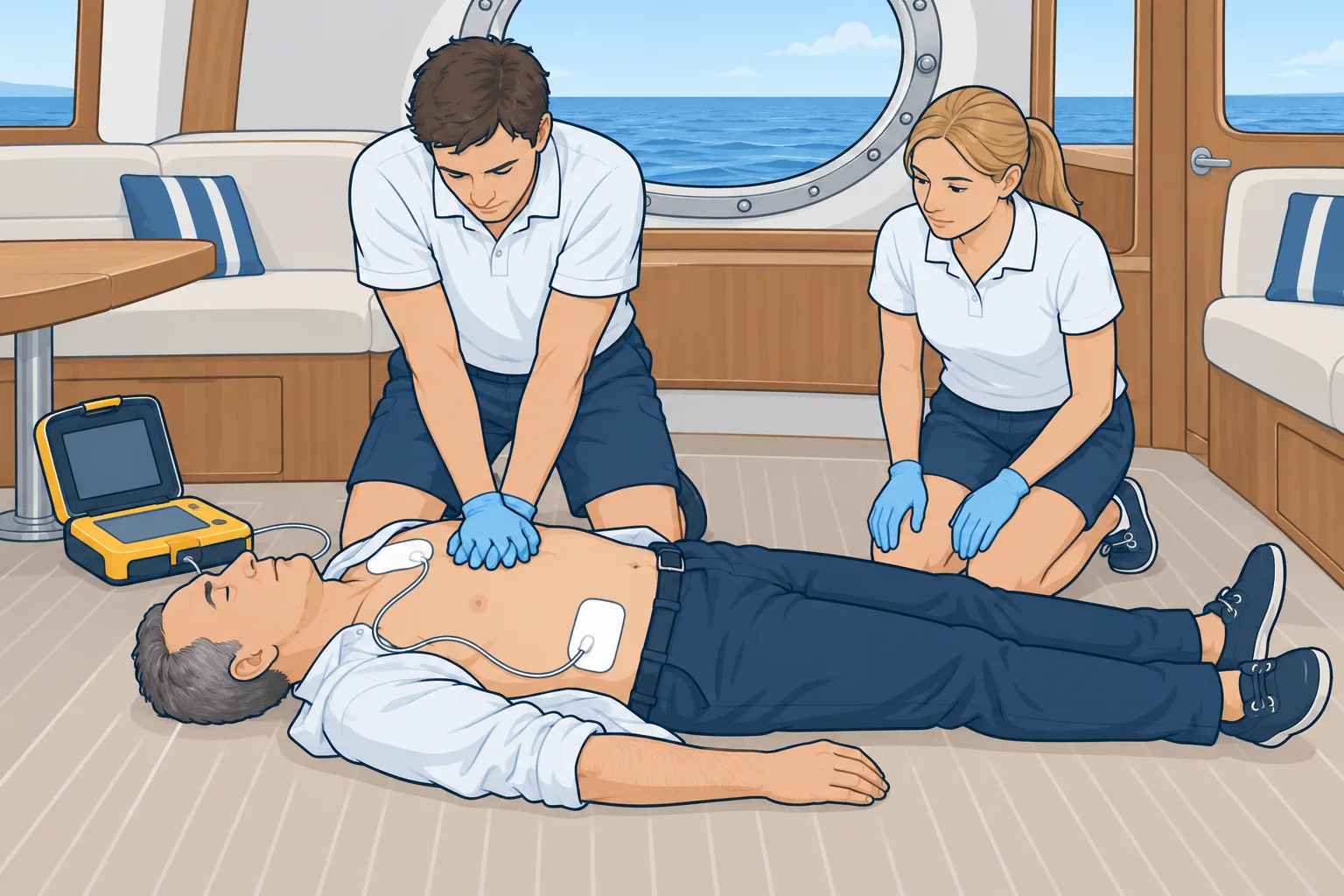
Start where the casualty lies; do not lose time moving them. Kneel beside them, put the heel of one hand on the lower half of the breastbone, in the centre of the chest, and the other hand on top. Keep your arms straight, shoulders above your hands, and push down 5 to 6 cm at 100 to 120 a minute. Let the chest come fully back up after each push. On a soft bunk, push further to allow for mattress movement; aim for 5–6 cm of chest compression.
Rescue breaths and 30:2
If trained and willing, give 30 compressions, then 2 rescue breaths. Tilt the head and lift the chin. For mouth-to-mouth, pinch the nose, seal your mouth over theirs and blow for about 1 second, just until the chest rises. Let the chest fall before the next breath. Keep the total pause under 10 seconds. If you cannot give breaths, give continuous compressions.
The AED
An AED (automated external defibrillator) is a box that reads the heart rhythm and gives an electric shock if one is needed. Anyone can use one: switch it on and follow the voice. Bare and dry the chest, stick the pads where the picture shows, and make sure nobody touches the casualty while it analyses or shocks. Restart compressions immediately after a shock or a no-shock message.
Keep going
Swap the person doing compressions every 2 minutes if possible. If clear signs of life appear, check breathing for no more than 10 seconds. Resume CPR if breathing is absent or abnormal. If breathing is normal, stop compressions, keep the airway open and monitor. Otherwise continue until professional help takes over, the scene becomes unsafe or you are too exhausted to continue.
2Step by step
Adult CPR, step by step
- 1
Check for danger, then shout and tap the shoulders.
You must be safe, and a person who answers is not in cardiac arrest.
- 2
If there is no response, send a crew member to call for help and fetch the AED and kit.
Help and the AED take time to arrive; ask now, not later.
- 3
Open the airway and check breathing for no more than 10 seconds.
Absent or gasping breathing means cardiac arrest.
- 4
Give 30 compressions in the centre of the chest, 5–6 cm deep, 100–120 a minute.
Compressions push some blood to the brain and heart.
- 5
Give 2 rescue breaths, then repeat 30:2; or give compressions without stopping.
Breaths add oxygen; unbroken compressions keep blood moving.
- 6
Switch on the AED as soon as it arrives and follow its prompts.
A shock can restart a heart that is quivering instead of pumping.
3Key data
- Compression depth
- 5–6 cm in an adult
- Compression rate
- 100–120 a minute
- Ratio
- 30 compressions : 2 breaths (trained rescuers)
- Breath size
- Just enough to make the chest start to rise
- Swap rescuers
- Every 2 minutes if you can
4Key points
- 1
Unresponsive: call for help at once. If not breathing normally, start CPR.
- 2
Push 5–6 cm deep at 100–120 a minute and let the chest recoil fully.
- 3
Trained rescuers give 30:2; otherwise give continuous compressions.
- 4
Use the AED as soon as it arrives; nobody touches the casualty during analysis or shock.
- 5
Keep pauses short and swap rescuers every 2 minutes.
5Frequent mistakes
Wrong: Check the pulse carefully before starting CPR.
Right: Lay rescuers do not check a pulse. Unresponsive and not breathing normally is enough to start.
Wrong: Compress gently so you do not break a rib.
Right: Push 5–6 cm deep. Broken ribs heal; too-shallow compressions do not move enough blood.
Wrong: Wait for the AED before doing anything.
Right: Start compressions at once and attach the AED while someone else keeps pushing.
6Practice case & exam keys
Your friend collapses on the pontoon beside your boat. He does not respond, and his breathing is slow and gasping. Another skipper says there is an AED at the marina office. You are trained in CPR.
Show the answer
Send the other skipper to call the emergency number and bring the AED. Start compressions at once in the centre of the chest, 5–6 cm deep at 100–120 a minute, giving 2 breaths after every 30. When the AED arrives, keep compressing while the pads go on, stand clear during analysis and shock, then restart compressions immediately.
Exam keys
- Cardiac arrest: unresponsive and not breathing normally (including agonal gasps).
- Compressions 5–6 cm deep, 100–120 a minute, full recoil; 30:2 for trained rescuers.
- AED: switch on, follow prompts, nobody touches during analysis and shock.
- Restart compressions straight after a shock; swap rescuers every 2 minutes.
Finish this unit
When you've read it, answer three questions. Get all three right to finish the unit; opening the page alone doesn't count.
My notes for this unit
No notes