

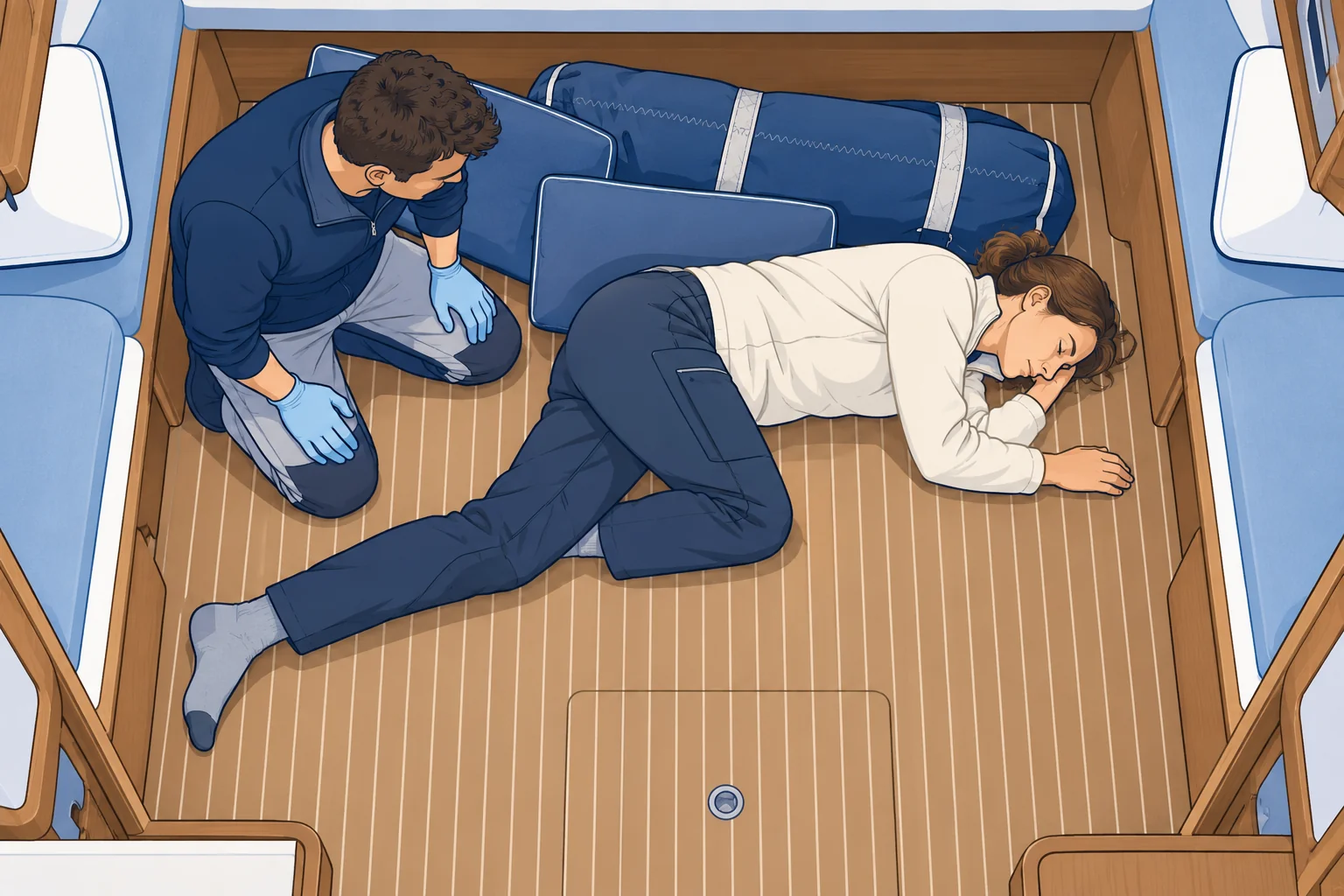
The recovery position
1The lesson in plain words
If an unresponsive person breathes normally and has no suspected injury, turn them onto their side to help keep the airway clear. Keep watching breathing.
When to use it
Use the recovery position for someone who does not respond but is breathing normally, unless you suspect an injury. Lying on their back, an unconscious person’s tongue can fall back and block the airway, and vomit can be breathed in. Turning them onto their side helps keep the airway open and lets fluid drain. Someone who is not breathing normally needs CPR instead.
How to turn them
Kneel beside them. Place the near arm at a right angle to the body, palm up. Hold the back of their far hand against their near cheek. Bend the far knee, keeping the foot on the floor, and roll them towards you. Bend the top hip and knee to right angles. Tilt the head back and adjust the hand under the cheek to hold the airway open, with the mouth pointing down so fluid can drain.
On a moving boat
Choose a place where they cannot roll or fall: the cabin sole (the cabin floor), a wide bunk with a lee cloth (a canvas side that stops you falling out), or the cockpit floor wedged with cushions or sail bags. Keep them out of spray and wind and put something insulating underneath. Stay with them. If they stay in the position for more than 30 minutes, turn them to the other side.
Keep checking
A casualty in the recovery position can stop breathing. Watch their breathing all the time and be ready to roll them onto their back and start CPR. Note the times and any changes; the radio doctor will ask.
After an injury
After a fall or head or neck injury, keep them on their back and minimise neck movement, but never at the expense of an open airway. If you cannot keep the airway open, or blood or vomit threatens it, turn them onto their side with help if available, keeping head and body aligned.
2Key data
- Use for
- Unresponsive, breathing normally, no suspected injury
- Not for
- Abnormal or no breathing (start CPR)
- Breathing
- Check continuously
- Change sides
- After about 30 minutes
3Key points
- 1
Recovery position: unresponsive, breathing normally, no suspected injury.
- 2
Lying on their side helps keep the airway open and lets fluid drain.
- 3
Wedge the casualty so the boat’s motion cannot roll them.
- 4
Keep checking breathing; if it stops or becomes abnormal, start CPR.
- 5
After an injury, keep them on their back unless the airway is at risk.
4Frequent mistakes
Wrong: Put a gasping casualty in the recovery position to help them breathe.
Right: Gasping is not normal breathing. Start CPR.
Wrong: Leave the casualty in a bunk and check them every half hour.
Right: Stay with them and watch breathing all the time; it can stop without warning.
5Practice case & exam keys
Motoring across a bay with a short chop, a guest faints in the cockpit after a long day in the sun. She does not answer but is breathing normally, and there is no sign of a fall or injury.
Show the answer
Put her in the recovery position on the cockpit floor, wedged with cushions so she cannot roll, in the shade and away from spray. Ask the person steering to slow down to ease the motion. Stay beside her and watch her breathing all the time. Call for radio medical advice. If her breathing stops or becomes abnormal, roll her onto her back and start CPR.
Exam keys
- Recovery position: unresponsive, breathing normally, no suspected injury.
- It helps keep the airway open and lets fluid drain.
- Check breathing continuously; abnormal breathing means CPR.
- Turn to the other side after about 30 minutes.
Finish this unit
When you've read it, answer three questions. Get all three right to finish the unit; opening the page alone doesn't count.
My notes for this unit
No notes