

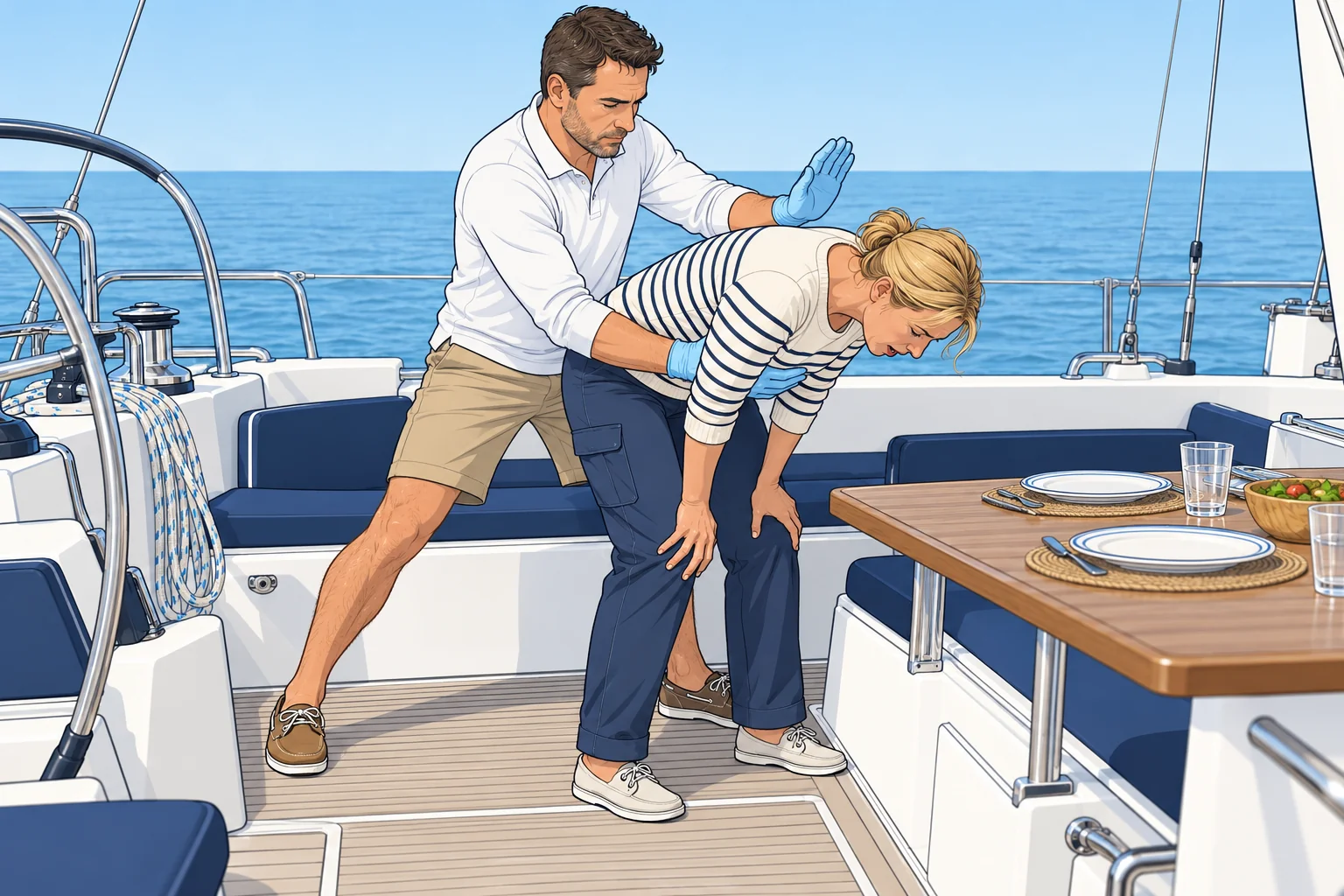
Choking in an adult
1The lesson in plain words
If a choking adult coughs strongly, encourage it. If the cough is weak or absent, give up to 5 back blows, then up to 5 abdominal thrusts; repeat if needed.
Mild or severe
Choking means food or an object blocking the airway. In mild obstruction the person can speak, breathe and cough strongly and effectively: encourage them to keep coughing and stay with them. In severe obstruction they cannot speak or cough effectively; breathing may be very difficult or absent. They may clutch their throat. Severe choking needs action now.
Back blows
Stand to the side and slightly behind. Support the chest with one hand and lean them well forward, so the object comes out of the mouth rather than going further down. Give up to 5 sharp back blows between the shoulder blades with the heel of your other hand. Check after each blow whether the obstruction has cleared. Brace your feet wide on a moving deck.
Abdominal thrusts
If back blows fail, give up to 5 abdominal thrusts. Stand behind them, put both arms round the upper abdomen and lean them forward. Make a fist between the navel and the bottom of the breastbone, grasp it with your other hand and pull sharply inwards and upwards. Check after each thrust. Stop as soon as the blockage clears. If it remains, alternate up to 5 back blows and up to 5 thrusts, and call for help.
If they become unresponsive
Lower them carefully to the cabin sole or deck, make sure help is being called and start CPR. Chest compressions can push the object out. Look in the mouth before giving breaths and remove anything you can see and reach easily, but never sweep blindly with your fingers.
Afterwards
Anyone who had abdominal thrusts or chest compressions needs a medical check: thrusts can injure organs inside the abdomen. A cough that will not stop, difficulty swallowing or the feeling that something is still stuck also needs advice. At sea, ask the radio doctor.
2Key data
- Mild choking
- Strong, effective cough: encourage coughing
- Severe choking
- Up to 5 back blows, then up to 5 abdominal thrusts
- Becomes unresponsive
- Call for help and start CPR
- Finger sweeps
- Never blind; remove only what you can see
3Key points
- 1
Encourage a strong, effective cough; a weak or silent cough needs treatment.
- 2
Severe choking: up to 5 back blows, then up to 5 abdominal thrusts. Stop as soon as the blockage clears.
- 3
If they become unresponsive, start CPR: compressions can clear the airway.
- 4
No blind finger sweeps.
- 5
Anyone given abdominal thrusts needs a medical check.
4Frequent mistakes
Wrong: Slap the back of someone who is coughing hard.
Right: A strong cough is the best way to clear the airway. Encourage it and act only if the cough fails.
Wrong: Sweep a finger round the mouth to find the object.
Right: Blind sweeps can push it deeper. Remove only what you can see.
Wrong: Once the food is out, there is nothing more to do.
Right: After abdominal thrusts, get medical advice: they can cause internal injury.
5Practice case & exam keys
At anchor, a guest initially coughs strongly and can speak after swallowing food. His cough then becomes silent and he cannot speak. Another crew member is beside you; the cockpit is rolling.
Show the answer
Encourage the strong cough at first. Once it becomes ineffective, brace yourself and have the other crew member call for help. Lean him forward and give up to 5 back blows, then up to 5 abdominal thrusts if needed. Check after each and stop when clear. Keep alternating if needed. If he becomes unresponsive, lower him to the floor and start CPR. Arrange medical assessment afterwards.
Exam keys
- Effective cough: encourage coughing. Ineffective cough: treat as severe obstruction.
- Severe obstruction: up to 5 back blows, then up to 5 abdominal thrusts, alternating.
- Unresponsive: call for help and start CPR.
- Medical check after abdominal thrusts.
Finish this unit
When you've read it, answer three questions. Get all three right to finish the unit; opening the page alone doesn't count.
My notes for this unit
No notes