

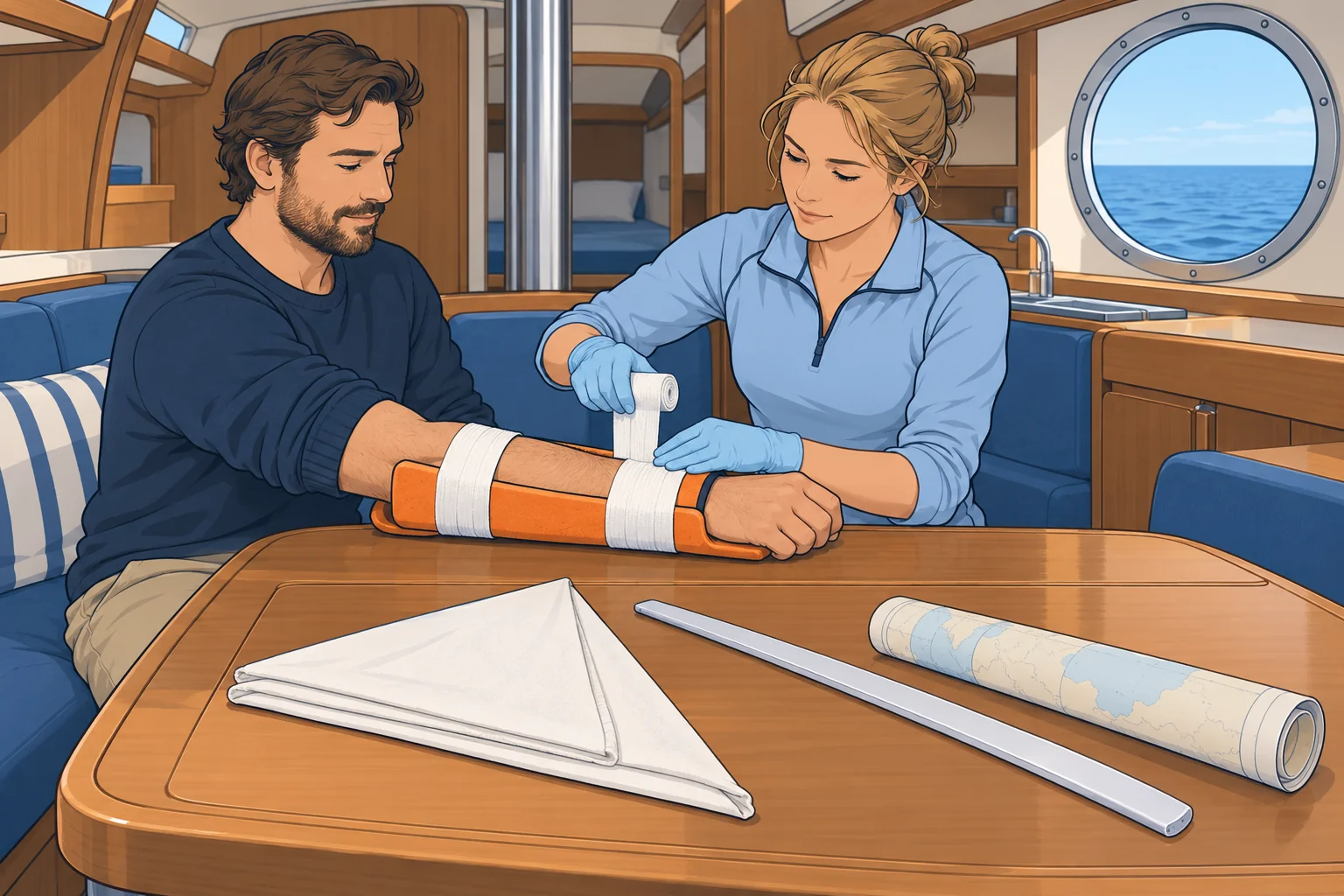
Fractures, sprains and improvised splints
1The lesson in plain words
Support a suspected fracture in the position you find it, splint it with what is on board, and check the blood supply beyond the injury.
Fracture or sprain?
A fracture is a broken bone; a sprain is damage to a ligament, the strong tissue joining bones at a joint. Both cause pain, swelling and bruising. Suspect a fracture if the limb is bent or misshapen, the casualty heard a crack, cannot bear weight or move it, or the pain is sharp over the bone. If in doubt, treat it as a fracture.
Support it as you find it
Do not try to straighten a broken limb. Help the casualty support it in the most comfortable position, usually the one they are holding. Pad it with clothing or towels. Stopping movement eases pain and prevents further damage to blood vessels and nerves.
Improvised splints
A splint is anything rigid that keeps a broken bone still. Use a sail batten (a stiff strip supporting a sail), a rolled chart or magazine, or a mouldable SAM splint from the kit. Make it long enough to immobilise the joints above and below the break. Pad it, and tie it above and below the injury, not over it. Support an arm in a sling; a leg can be tied to the good leg with padding between them.
Check the blood supply
Check fingers or toes before and after splinting, then every 15 minutes. Compare their colour, warmth and feeling with the uninjured side. If they become unusually pale, blue, cold or numb, loosen the ties and recheck immediately. If this persists, get urgent radio medical advice; do not straighten the limb yourself.
Open fractures
Treat a wound over a suspected break as an open fracture, even if no bone is visible. Cover it with a clean dressing, press around any protruding bone to control bleeding and never push bone back. Fractures need radio medical advice.
Sprains
For a sprain, rest it, apply a cloth-wrapped cold pack for up to 20 minutes, use gentle compression with an elastic bandage and raise it. Loosen the bandage if toes or fingers become cold, numb or change colour.
2Key data
- Position
- As found; do not straighten
- Splint support and ties
- Support joints above/below; tie above/below injury, never over it
- Circulation check
- Compare colour, warmth and feeling before/after; every 15 min
- Cold pack
- Wrapped in cloth, up to 20 minutes at a time
3Key points
- 1
If in doubt, treat as a fracture.
- 2
Support the limb in the position found; do not straighten it.
- 3
Use a padded rigid splint long enough to support both neighbouring joints; tie above and below the break, never over it.
- 4
Check the fingers or toes after splinting and every 15 minutes.
- 5
Open fracture: cover, press around the bone, never push it back.
4Frequent mistakes
Wrong: Pull a bent broken arm straight so it fits the splint.
Right: Splint it as you find it. Straightening can damage vessels and nerves.
Wrong: Splint it tightly and leave it until port.
Right: Swelling makes ties tight. Check circulation every 15 minutes and loosen as needed.
5Practice case & exam keys
In a rough sea a crew member falls against the chart table. Her forearm is painful, swollen and slightly bent above the wrist, and she is holding it against her chest. You are five hours from harbour.
Show the answer
Treat it as a fracture. Support her arm as found and pad it with a towel. Use a padded rolled chart or SAM splint long enough to support the joints above and below the break; tie above and below it, never over it. Support the arm in a sling. Compare her fingers’ colour, warmth and feeling before and after splinting, then every 15 minutes, and get radio medical advice.
Exam keys
- Suspected fracture: support in the position found, do not straighten.
- Splint: rigid, padded, long enough to immobilise joints above and below; ties above and below the injury, never over it.
- Check circulation beyond the injury regularly.
- Open fracture: cover, press around the bone, do not push it back.
Finish this unit
When you've read it, answer three questions. Get all three right to finish the unit; opening the page alone doesn't count.
My notes for this unit
No notes