

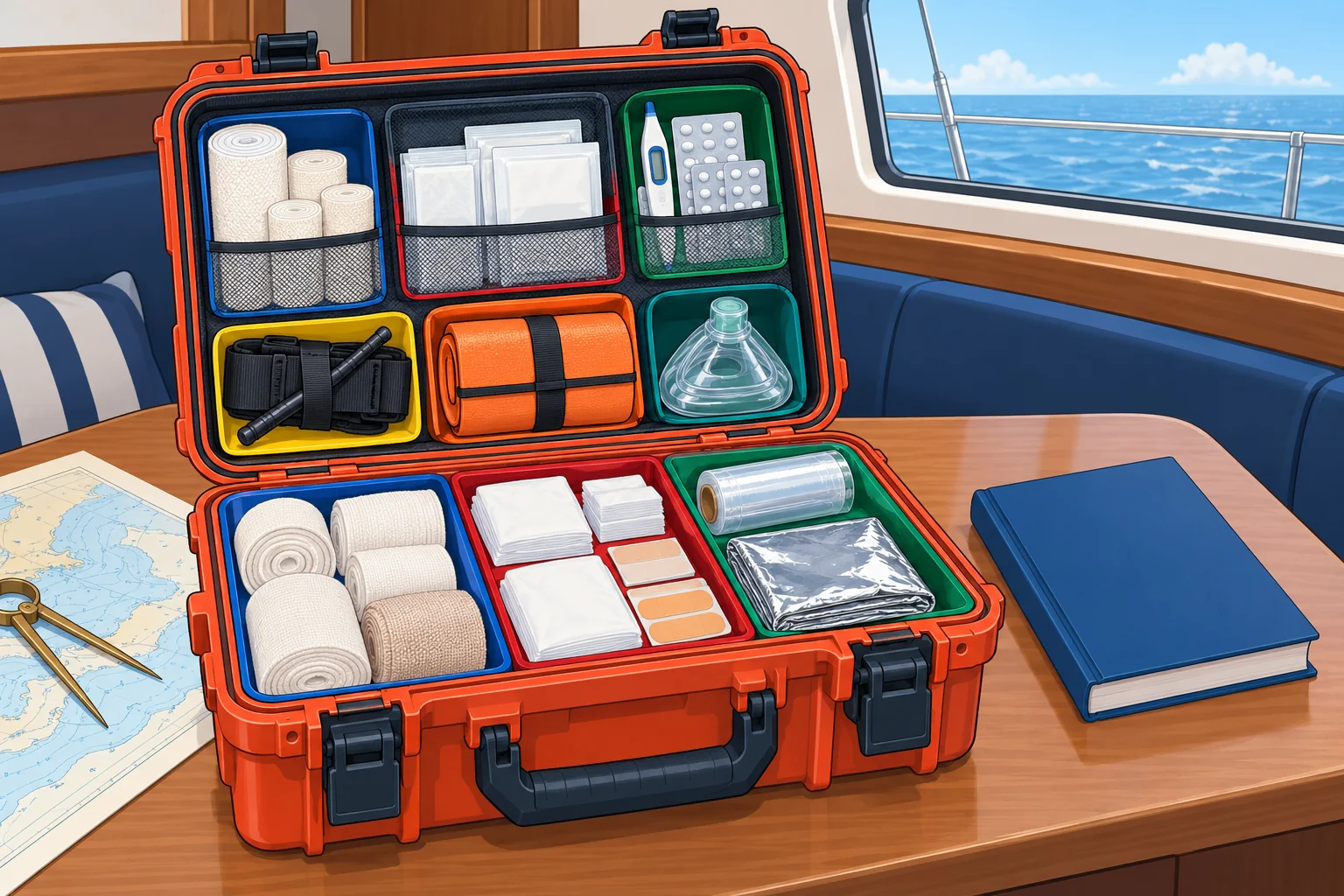
A medical kit for the passage you plan
1The lesson in plain words
Size the kit to how far you will be from help, follow your flag’s carriage rules, and carry a medical guide that tells you how to use it.
Distance decides
Match your kit to how long medical help may take to reach you. On a day sail near a harbour, carry first-aid supplies for immediate care, but allow for delays in reaching help. Coastal passages may leave you hours from port. Offshore, help may take days, so plan supplies and training with a doctor.
What every kit holds
Every boat, however small, should carry gloves, a pocket mask for rescue breaths, dressings, a haemostatic dressing (to help blood clot), a manufactured tourniquet (a strap to stop severe limb bleeding), wound-closure strips, bandages, a mouldable splint (to support an injured limb), tape, scissors, tweezers, cling film for burns, a survival bag, a thermometer, eye wash, painkillers and seasickness tablets. Keep a list inside the lid.
Carriage rules
Rules depend on flag and use. In Spain, RD 339/2021 requires recreational boats without professional crew in zones 1–4 to carry the RD 258/1999 annex II liferaft-type kit and Guía sanitaria a bordo. EU Directive 92/29/EEC categories for working vessels: A, unrestricted voyages; B, under 150 nautical miles from the nearest medically equipped port (under 175 if continuously within helicopter-rescue range); C, harbour craft, craft staying very close to shore, or craft with no accommodation beyond a wheelhouse.
A guide on board
A kit is only useful if someone knows how to use it. Carry a medical guide: the Spanish Guía sanitaria a bordo, the UK Ship Captain’s Medical Guide, or the WHO International Medical Guide for Ships on commercial vessels. The radio doctor will often refer to the medicines by their number or name in your official list, so keep that list up to date.
Optional extras
Offshore crews may add an automated external defibrillator (AED), a device that can give an electric shock in certain cardiac arrests, medical oxygen if someone is trained to use it, and prescription medicines such as antibiotics and stronger painkillers after a talk with a doctor. A first-aid course for at least two crew members is worth more than any extra item.
2Key data
- Spain, recreational
- RD 339/2021: zones 1–4 carry the liferaft kit of RD 258/1999
- Spain, guide
- Guía sanitaria a bordo with any kit
- EU working vessels
- Directive 92/29/EEC: categories A, B, C
- Category B
- Under 150 nautical miles; under 175 with helicopter-rescue cover.
- Professional guide
- WHO International Medical Guide for Ships
3Key points
- 1
Size the kit to the distance from help: day sail, coastal, offshore.
- 2
Every kit: gloves, mask, dressings, tourniquet, splint, cling film, thermometer, survival bag.
- 3
Spain: RD 339/2021, zones 1–4 carry the liferaft-type kit and the Guía sanitaria.
- 4
EU working vessels: Directive 92/29/EEC, categories A, B and C.
- 5
Carry a medical guide and train at least two crew in first aid.
4Frequent mistakes
Wrong: A car first-aid kit is enough for any passage.
Right: Offshore you may be days from help. Size the kit and training to the passage.
Wrong: Buy a large kit and the job is done.
Right: A kit without a guide and trained crew helps little. Learn what is in it and how to use it.
5Practice case & exam keys
You are preparing a Spanish-flagged 11 m yacht, with no professional crew, for a coastal passage that stays within navigation zone 3. What medical kit do you need?
Show the answer
For zone 3, Real Decreto 339/2021 requires a kit identical to the liferaft kit in annex II of Real Decreto 258/1999, plus the Guía sanitaria a bordo. Check the required contents, then assess extra supplies for the passage and crew. Check expiry dates and make sure two crew know first aid.
Exam keys
- Kit size depends on time and distance to medical help.
- Spain: RD 339/2021, zones 1–4: liferaft kit of RD 258/1999 annex II plus the Guía sanitaria a bordo.
- EU Directive 92/29/EEC: A unrestricted; B under 150 nautical miles from a medically equipped port, under 175 if continuously within helicopter-rescue range; C harbour craft, very near shore, or no accommodation beyond a wheelhouse.
- Carry a medical guide; the WHO guide is the professional reference.
Finish this unit
When you've read it, answer three questions. Get all three right to finish the unit; opening the page alone doesn't count.
My notes for this unit
No notes