

Life-threatening bleeding
1The lesson in plain words
Press hard on severe bleeding. Pack only deep limb, groin or armpit wounds. Use a tourniquet if pressure cannot stop limb bleeding.
Recognise it
Life-threatening bleeding is blood that spurts, pours or soaks through clothing and dressings fast, or pools quickly on the deck. It can come from a deep cut on a sharp fitting, a knife slip in the galley or a propeller injury. Do not wait to see if it stops: act at once and send someone to call for help.
Direct pressure
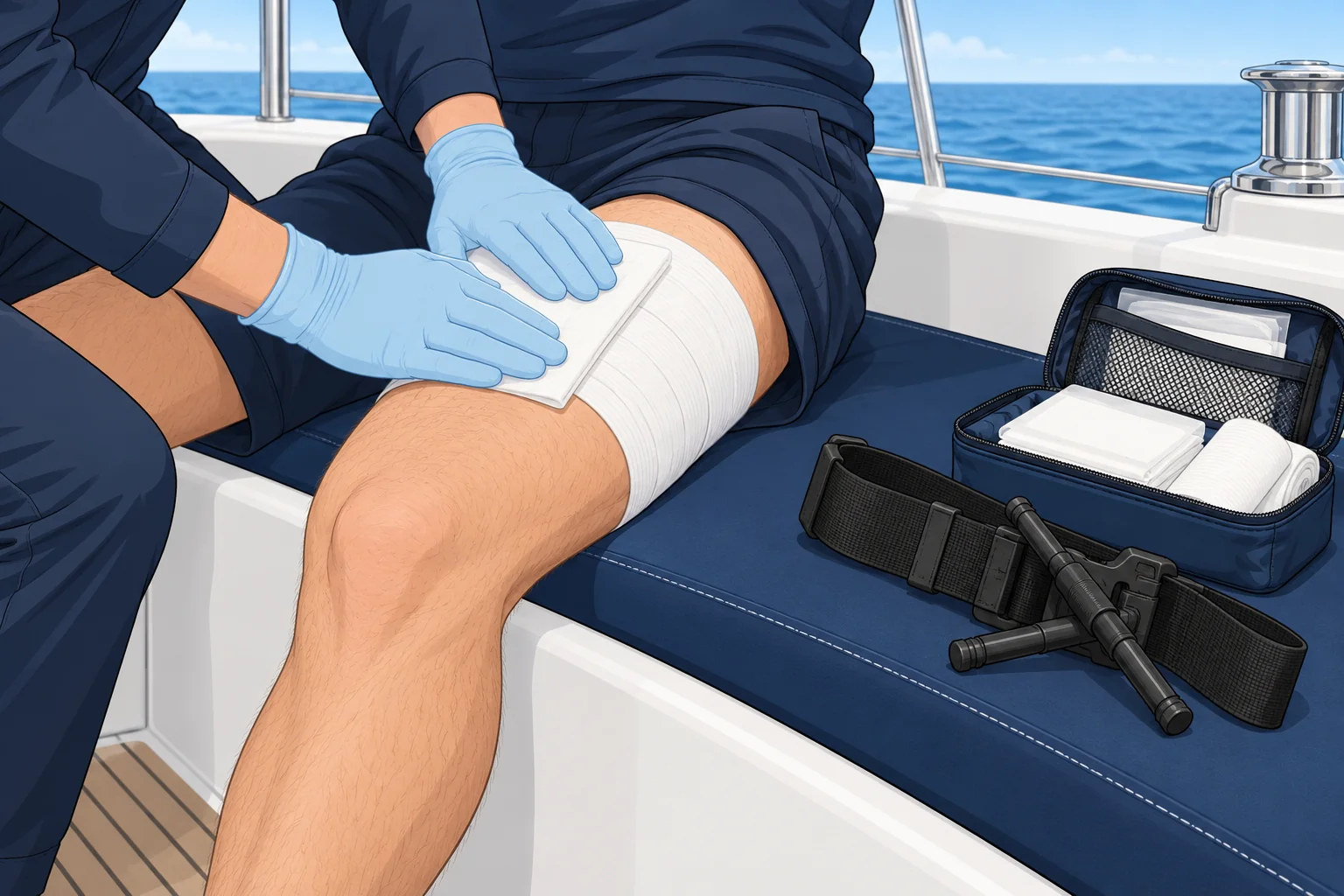
Put on gloves if within reach, but do not delay. Press firmly and directly on the bleeding point with a dressing, clean cloth or your hand. For a deep limb, groin or armpit wound, push the dressing into it (packing) and keep pressing. Never pack the chest or abdomen. If blood soaks through, do not lift the dressing to look: add more on top and press harder.
Haemostatic dressing
A haemostatic dressing is gauze treated with a substance that helps blood clot. For a deep limb, groin or armpit wound, pack it in and press continuously for the time stated on the packet. Never pack the chest or abdomen. Once bleeding is controlled, wrap a pressure bandage firmly over the dressing to hold it.
Tourniquet
A tourniquet is a strap that squeezes a limb so hard that blood flow stops. Use one on an arm or leg when firm pressure does not stop the bleeding. Put it 5–7 cm above the wound, not over a joint, and tighten until the bleeding stops. It hurts; that is expected. Write the time on it or on the casualty, and never loosen it yourself.
Manufactured beats improvised
A purpose-made tourniquet works far better than a belt or a scarf, which often fail to stop the flow. If one tourniquet does not stop the bleeding, put a second one just above the first. Keep the casualty lying down and warm, watch for shock, and get radio medical advice early: a tourniquet means hospital.
2Step by step
Controlling life-threatening bleeding
- 1
Make it safe, then send a crew member to call for help.
Severe bleeding needs hospital care, and help at sea takes time.
- 2
Press firmly and directly on the wound with a dressing or your hand.
Pressure squeezes the damaged vessels and lets a clot form.
- 3
Pack only deep limb, groin or armpit wounds and keep pressing. Never pack the chest or abdomen. Once bleeding stops, secure the dressing with a firm pressure bandage.
Pressure must reach the bleeding point, not just the skin.
- 4
If limb bleeding continues, apply a tourniquet 5–7 cm above the wound, not over a joint.
A tight tourniquet stops blood reaching the wound.
- 5
Tighten until the bleeding stops; note the time and never release it.
Doctors need the time; loosening it can restart fatal bleeding.
- 6
Lay the casualty down, keep them warm and watch for shock.
Blood loss leads to shock, and cold makes bleeding worse.
3Key data
- First action
- Firm direct pressure
- Haemostatic dressing
- Pack limb/groin/armpit only; press as the packet directs
- Tourniquet position
- 5–7 cm above the wound, not over a joint
- Tourniquet time
- Write it down; never release it yourself
4Key points
- 1
Act at once: press firmly and directly on the wound.
- 2
Pack only deep limb, groin or armpit wounds, never chest or abdomen; keep pressing and add dressings on top.
- 3
Limb bleeding that pressure cannot stop: tourniquet, 5–7 cm above, not over a joint.
- 4
Note the tourniquet time and never loosen it.
- 5
Keep the casualty flat and warm, and call for help early.
5Frequent mistakes
Wrong: Lift the dressing every minute to see whether the bleeding has stopped.
Right: Keep pressing. Add dressings on top; lifting tears away the clot.
Wrong: Loosen the tourniquet now and then to let blood reach the limb.
Right: Never release it. Only a doctor should remove a tourniquet.
Wrong: A belt makes a good tourniquet.
Right: Improvised tourniquets often fail. Carry a manufactured one if you sail offshore.
6Practice case & exam keys
Cleaning fish in the cockpit, a crew member slips and the knife cuts deep into his thigh. Bright red blood is soaking his shorts fast. You are two hours from port.
Show the answer
Shout for help and have a crew member call the coastguard. Press hard on the wound with a dressing or your hand at once, then pack it with the haemostatic dressing and keep pressing. If the bleeding does not stop, apply the tourniquet 5–7 cm above the wound, tighten until it stops and note the time. Lay him down, keep him warm and get radio medical advice.
Exam keys
- Direct pressure first; pack only deep limb, groin or armpit wounds, never chest or abdomen. Follow the haemostatic gauze packet’s pressure time.
- Tourniquet for limb bleeding not stopped by pressure: 5–7 cm above, not over a joint; note the time, never release.
- Lay down, keep warm, call for help early.
Finish this unit
When you've read it, answer three questions. Get all three right to finish the unit; opening the page alone doesn't count.
My notes for this unit
No notes