

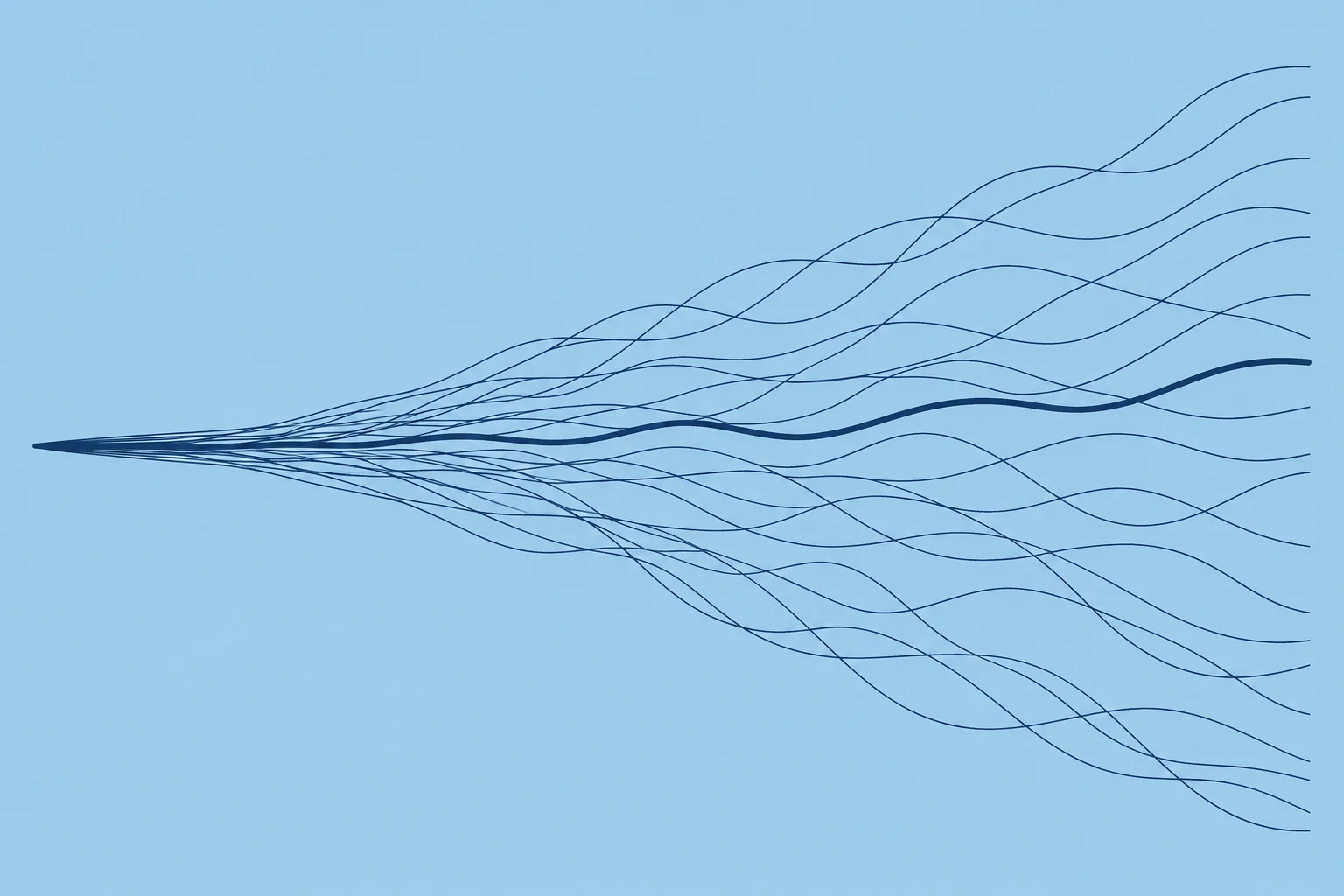
Ensembles: how sure is the forecast?
1The lesson in plain words
An ensemble runs a model from slightly different starting states. Its spread helps you judge uncertainty; close agreement does not guarantee accuracy.
Why ensembles
Small errors in today's observations grow as a forecast runs. An ensemble runs the model many times, each member starting from a slightly different state. Close agreement suggests greater confidence, but members can share errors and miss local effects; wide spread signals uncertainty.
Main ensembles
ECMWF's ENS has 51 members at about 9 km: one uses the unchanged starting state, and 50 use slightly altered starting states. NOAA's GEFS has 31 members at about 0.25°. Both run four times a day and look out to about two weeks; ECMWF's AIFS also has a machine-learning ensemble.
Spread and probability
The spread is how far the members differ. A narrow spread suggests greater confidence, not certainty. Many apps show the ensemble mean, the average of the members, and exceedance probabilities: estimated chances of wind above a threshold at a selected place and valid time, such as more than 25 knots.
The mean hides extremes
The ensemble mean smooths the members out. If half the members predict 36 knots and half predict calm, their mean wind speed is 18 knots—a fresh breeze that no member predicted. Look at the spread and at the strongest members, not just the mean.
Using it
Check exceedance probabilities against your stated wind limit at the places and times you expect to pass. A probability at one point and time does not give the chance of exceeding your limit anywhere during the passage. Where member data are available, count members that exceed your limit somewhere along your route at your passage times. Check official forecasts and warnings too.
2Key data
- ECMWF ENS
- 51 members: one unchanged start and 50 varied starts, about 9 km
- NOAA GEFS
- 31 members, about 0.25°
- Spread
- Narrower spread suggests confidence, not certainty.
- Ensemble mean
- Smooths out extremes; check the members too
3Key points
- 1
An ensemble runs a model many times from slightly different starts.
- 2
ECMWF ENS has 51 members; NOAA GEFS has 31.
- 3
Spread shows disagreement; exceedance probabilities estimate the chance of crossing a limit, without guarantees.
- 4
The mean hides extremes; check the strongest members against your limits.
4Frequent mistakes
Wrong: The ensemble mean is the most likely wind.
Right: It can show a value no member forecast. Look at the spread and the members.
Wrong: A detailed single run needs no ensemble.
Right: A single run shows one possibility. An ensemble samples other plausible outcomes.
5Practice case & exam keys
For a crossing in three days, the ensemble mean shows 15 knots at the worst point. The probability of more than 25 knots is 35 %. Your limit for this crew is 22 knots. Do you go?
Show the answer
At the stated place and time, the estimated chance of exceeding your 22-knot limit is at least 35%: every outcome above 25 knots also exceeds 22. Outcomes between 22 and 25 knots could increase it. The 15-knot mean does not make this acceptable. Check the probability above 22 knots and its evolution across relevant places, times and runs, alongside official forecasts and warnings.
Exam keys
- Ensemble: many members from slightly different initial states.
- ECMWF ENS 51 members; GEFS 31 members.
- Spread = uncertainty; probabilities of exceeding thresholds.
- The mean smooths extremes.
Finish this unit
When you've read it, match the terms, then answer three questions. Get them all right to finish the unit; opening the page alone doesn't count.
My notes for this unit
No notes