

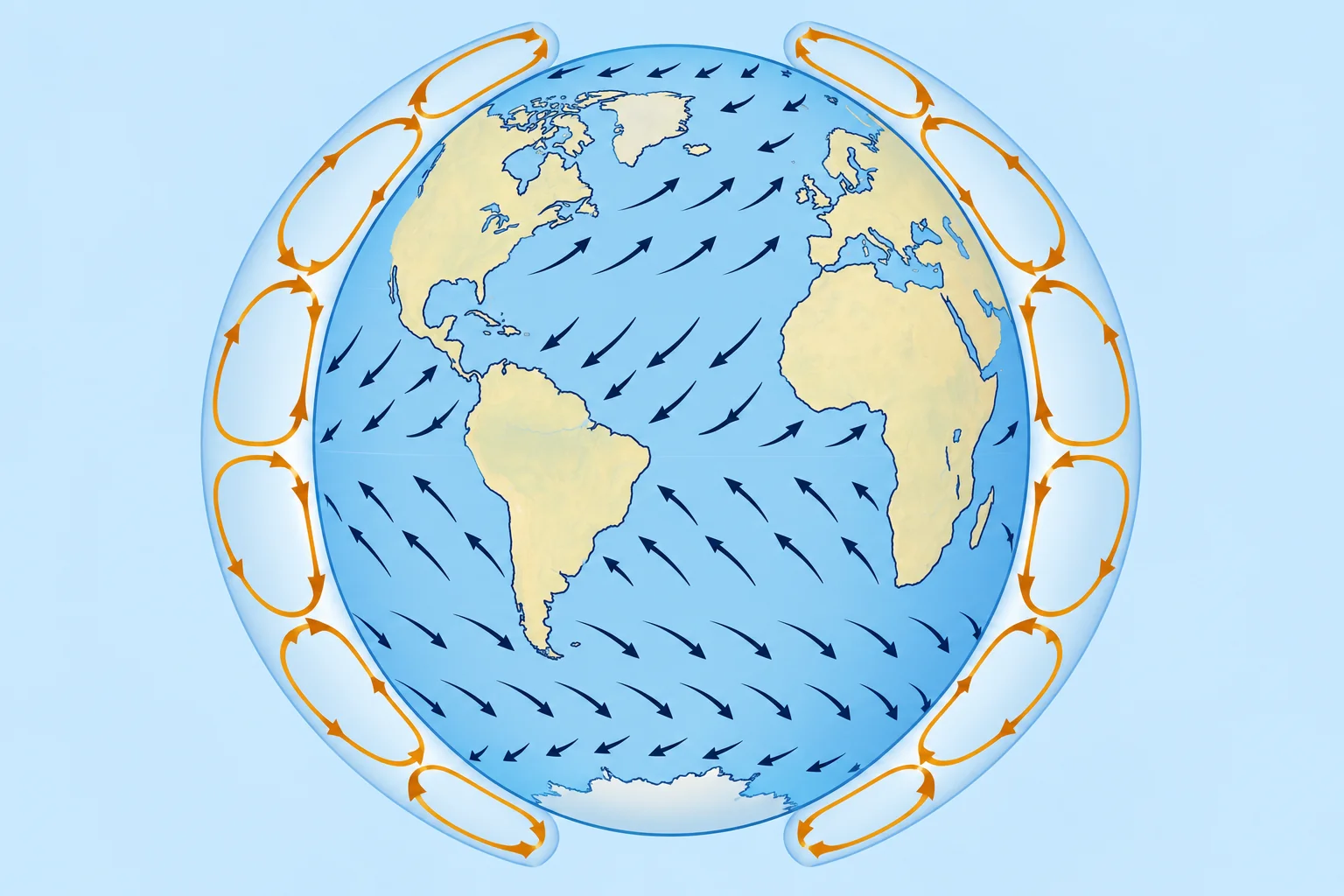
The global circulation: three cells and the pressure belts
1The lesson in plain words
The sun heats the tropics most, and Earth's rotation turns the moving air. The result is a pattern of pressure belts and wind belts you can plan an ocean passage on.
Why the air moves
The sun heats the tropics far more than the poles. Warm air rises near the equator and flows poleward high up; cold air sinks near the poles. The Coriolis effect, the apparent turning caused by Earth's rotation, deflects moving air to the right in the northern hemisphere and to the left in the southern. So the flow breaks into three loops, or cells, in each hemisphere.
The three cells
In the Hadley cell (0°–30°), air rises near the equator, flows poleward aloft and sinks near 30°, returning equatorward at the surface. The Ferrel cell (30°–60°) has poleward surface flow, rising air near 60° and an equatorward return aloft. In the polar cell (60°–90°), air sinks over the pole, flows towards 60° at the surface, rises there and returns poleward aloft. These are simplified averages.
The pressure belts
Rising air leaves low pressure: the equatorial trough near the equator and the subpolar lows near 50°–60°. Sinking air builds high pressure: the subtropical highs near 30° and the polar highs. Over the oceans the subtropical belt breaks into large cells, such as the Azores High in the North Atlantic and the St Helena High in the South Atlantic.
The wind belts
Air flowing from the subtropical highs towards the equator, turned by Coriolis, makes the trade winds: north-east in the northern hemisphere, south-east in the southern. Air flowing poleward from the highs makes the westerlies of the middle latitudes. Near the poles blow the polar easterlies. Winds are named for where they come from.
The belts move with the seasons
The whole pattern shifts towards the summer hemisphere, lagging the sun by a month or two. In the northern summer the Azores High moves north and grows, the trades reach further north and the westerlies retreat. Land heats and cools faster than sea, which bends the belts further and drives the monsoons.
2Key data
- Hadley cell
- Equator to about 30°; rises at the equator, sinks near 30°
- Ferrel cell
- About 30° to 60°; westerlies at the surface
- Subtropical highs
- Near 30°, e.g. Azores High, St Helena High
- Subpolar lows
- Near 50°–60°, along the polar front
- Coriolis deflection
- Right in the northern hemisphere, left in the southern
- Seasonal shift
- Towards the summer hemisphere, lagging the sun
3Key points
- 1
Three cells in each hemisphere: Hadley, Ferrel and polar.
- 2
Low pressure near the equator and near 50°–60°; high pressure near 30° and at the poles.
- 3
Trades blow towards the equator: north-east in the north, south-east in the south.
- 4
Westerlies blow on the poleward side of the subtropical highs.
- 5
All the belts shift towards the summer hemisphere.
4Frequent mistakes
Wrong: The trade winds blow from the west, as their westward-moving storms suggest.
Right: Trades blow from the north-east (north) or south-east (south). Storms move west because the trades carry them.
Wrong: The pressure belts stay at the same latitude all year.
Right: They shift towards the summer hemisphere, so the trades, calms and westerlies move with the season.
5Practice case & exam keys
A crew member treats 30° N as the fixed northern boundary of the trades and uses it to predict July winds. What assumption do you challenge?
Show the answer
The belts shift towards the summer hemisphere. In July they are generally farther north. Treat the textbook latitudes as averages and check the current position of the high.
Exam keys
- Three cells per hemisphere: Hadley (0–30°), Ferrel (30–60°), polar (60–90°).
- Pressure: low near the equator and near 50°–60°; high near 30° and at the poles.
- Trades north-east (north) and south-east (south); westerlies in mid-latitudes; polar easterlies.
- The belts shift towards the summer hemisphere.
Finish this unit
When you've read it, match the terms, then answer three questions. Get them all right to finish the unit; opening the page alone doesn't count.
My notes for this unit
No notes