

Monsoons: seasonal winds that reverse
1The lesson in plain words
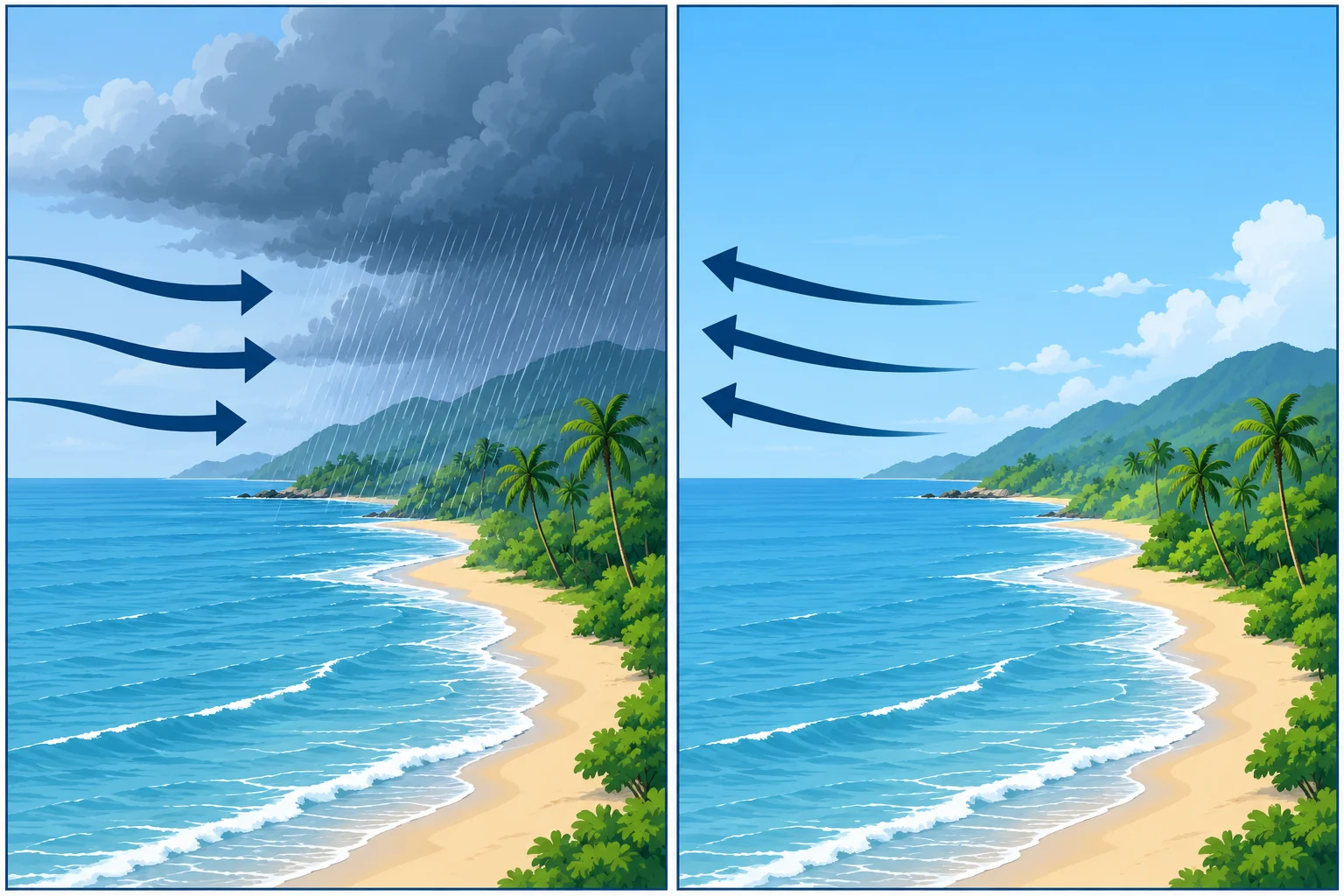
A monsoon is a seasonal wind that reverses direction between summer and winter. In the Indian Ocean it decides when you can sail and where.
What a monsoon is
A monsoon is a large-scale seasonal wind that reverses direction between summer and winter. In summer the land heats faster than the sea: pressure falls over the continent and moist air flows in from the sea. In winter the land cools faster: pressure rises over it and dry air flows out to sea. The shift of the ITCZ with the seasons strengthens the effect.
The Indian Ocean
The clearest example is the north Indian Ocean. The south-west monsoon, roughly June to September, is strong and wet: force 6 to 7 is frequent in the Arabian Sea, with heavy seas, especially in July and August. The north-east monsoon, roughly November or December to March, is generally lighter and drier offshore, though some east-facing coasts have a wet winter monsoon. This reversal sets the sailing seasons in the region.
The transitions
Between the monsoons come the transition months, roughly April–May and October–November. Winds are often lighter and variable. Cyclone risk peaks around these transitions, when the sea is warm and vertical wind shear, the change in wind with height, is often weaker. Cyclones can also occur outside these months.
Other monsoons
Monsoon-like reversals also occur in South-East Asia and the South China Sea, off West Africa, and in northern Australia, where a north-westerly monsoon blows from about December to March. Each region's sailing directions describe the local timing and strength.
Planning
Most yachts cross the north Indian Ocean westbound in the north-east monsoon, roughly January to March. Routeing guides give the best months for each leg; the Ocean passage planning unit shows how to combine them with the main cyclone-risk periods.
2Key data
- Monsoon
- Seasonal wind that reverses between summer and winter
- South-west monsoon (N Indian Ocean)
- About June – September; strong, wet, force 6–7 frequent
- North-east monsoon
- About Nov/Dec–March; generally lighter and drier offshore
- Transition months
- About April–May and October–November; main cyclone-risk periods
- Spanish terms
- Monzón del suroeste, monzón del noreste
3Key points
- 1
A monsoon is a seasonal reversal of wind, driven by land heating and cooling.
- 2
North Indian Ocean: strong south-west monsoon in summer, lighter north-east monsoon in winter.
- 3
The transitions between monsoons are the north Indian Ocean's main cyclone-risk periods.
- 4
Westbound yachts usually cross in the north-east monsoon, about January to March.
4Frequent mistakes
Wrong: Monsoon just means heavy rain.
Right: It means a seasonal reversal of the wind. The summer monsoon is wet; the winter monsoon is often drier, depending on the region.
Wrong: The calm transition months are the safest time to cross.
Right: Light winds do not mean low cyclone risk: activity peaks around the transitions. Check current warnings.
5Practice case & exam keys
In Phuket in July, a skipper wants to sail west across the Bay of Bengal and the Arabian Sea to Oman as soon as possible. What do you advise about timing?
Show the answer
July is the height of the south-west monsoon: strong headwinds and heavy seas on that route. October–November brings lighter winds but is a main cyclone-risk period, especially in the Bay of Bengal. The usual choice is to wait for the established north-east monsoon, about January to March, which gives fair winds westbound.
Exam keys
- Monsoon: a seasonal wind that reverses, driven by land–sea heating contrasts and the shift of the ITCZ.
- North Indian Ocean: south-west monsoon June–September; north-east monsoon November/December–March.
- Transitions (April–May, October–November) are the main cyclone-risk periods there.
Finish this unit
When you've read it, match the terms, then answer three questions. Get them all right to finish the unit; opening the page alone doesn't count.
My notes for this unit
No notes