

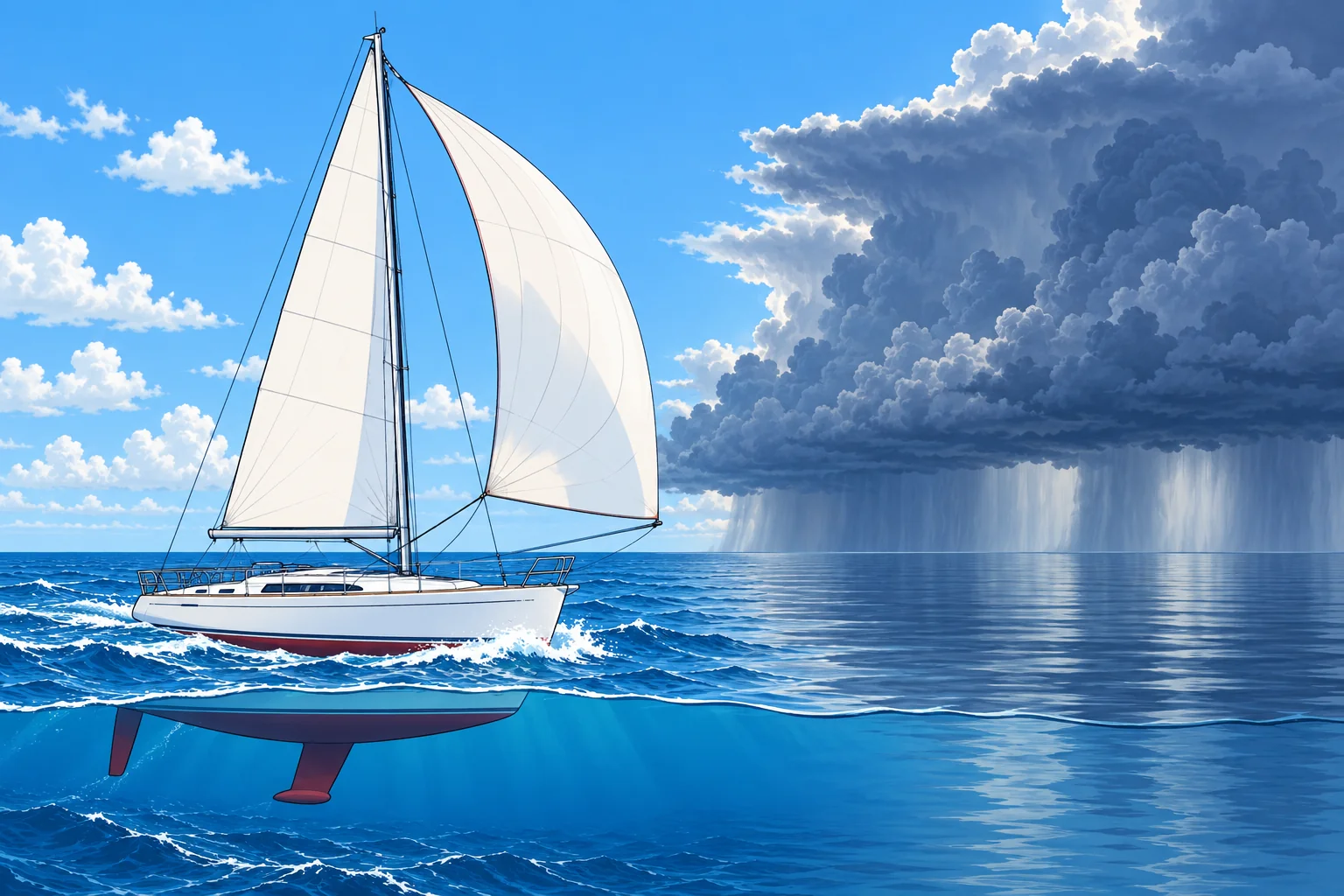
Trade winds, the ITCZ, the doldrums and the horse latitudes
1The lesson in plain words
The trades are the ocean sailor's engine, the doldrums the place where it stops. Know where each belt lies in your month and how to cross the calms.
The trade winds
The trade winds blow steadily from the subtropical highs towards the equator, mostly force 3 to 5, with long fair-weather spells and small trade-wind cumulus. When the high is strong they become reinforced trades of force 6 or more for days, with big seas, as in the Caribbean in winter. Trade-wind squalls are common, especially at night; the Squalls unit covers them.
The ITCZ
Where the trades of the two hemispheres meet, the air rises along the Intertropical Convergence Zone (ITCZ), in the equatorial trough. In the Atlantic and eastern Pacific it stays mostly north of the equator, furthest north, around 10° N, in the northern late summer and closest to the equator in the northern late winter and spring. Over the Indian Ocean it swings much further with the monsoons.
The doldrums
The doldrums are the calm belt of the ITCZ: light, variable winds broken by squalls, heavy showers and thunderstorms. Their width changes from day to day and with longitude: a few miles in places, hundreds in others. Satellite images show the cloud band. The light-wind belt may be wider than its visible cloud band.
The horse latitudes
Near the centres of the subtropical highs, around 30°, sinking air gives light, variable winds and fair weather: the horse latitudes. The wind is weakest close to the centre of the high. When the high moves or stretches, a yacht can find days of calm there, so sail round the edge, where the isobars are closer and the wind steadier.
2Key data
- Trade winds
- Mostly force 3–5; reinforced trades force 6+ for days
- ITCZ (Atlantic, E Pacific)
- Mostly north of the equator; furthest north (~10° N) in late summer
- Doldrums
- Light, variable winds with squalls and thunderstorms
- Horse latitudes
- Calms near the centres of the subtropical highs, ~30°
- Spanish terms
- Alisios, ZCIT, calmas ecuatoriales, calmas tropicales
3Key points
- 1
The trades are steady, mostly force 3–5, with frequent squalls.
- 2
The ITCZ is where the two trade systems meet; in the Atlantic it stays mostly north of the equator.
- 3
The doldrums bring calms, squalls and thunderstorms; their width changes daily.
- 4
The horse latitudes are the calms near the centre of a subtropical high.
4Frequent mistakes
Wrong: The doldrums lie exactly on the equator all year.
Right: In the Atlantic and eastern Pacific they lie mostly north of the equator and move north and south with the season.
Wrong: The shortest route across a subtropical high is the fastest.
Right: Its centre is calm. Sail round the edge, where the wind is steadier, even if the distance is longer.
Wrong: Trade winds are always gentle.
Right: Reinforced trades can blow force 6 or more for days, with a big sea.
5Practice case & exam keys
You are sailing south from the Cape Verde Islands towards Brazil in October. The north-east trades are fading at 9° N, the sky to the south is a solid band of towering cloud and your fuel gives 300 miles of motoring. What conditions are likely, and does the fuel range alone establish whether you can motor across?
Show the answer
The fading trades and cloud band suggest the ITCZ. Expect variable winds, calms, squalls and heavy rain, then south-east trades beyond it. Check current forecasts and satellite images: the calm belt changes width, and the visible cloud band alone cannot show whether 300 miles of motoring range is enough.
Exam keys
- Trades: steady, mostly force 3–5; north-east in the north, south-east in the south.
- ITCZ: convergence of the trades; Atlantic position mostly north of the equator, moving with the season.
- Doldrums: calms, squalls, thunderstorms. Horse latitudes: calms of the subtropical high centres.
- Reinforced trades can reach force 6 or more for days, with heavy seas.
Finish this unit
When you've read it, match the terms, then answer three questions. Get them all right to finish the unit; opening the page alone doesn't count.
My notes for this unit
No notes