

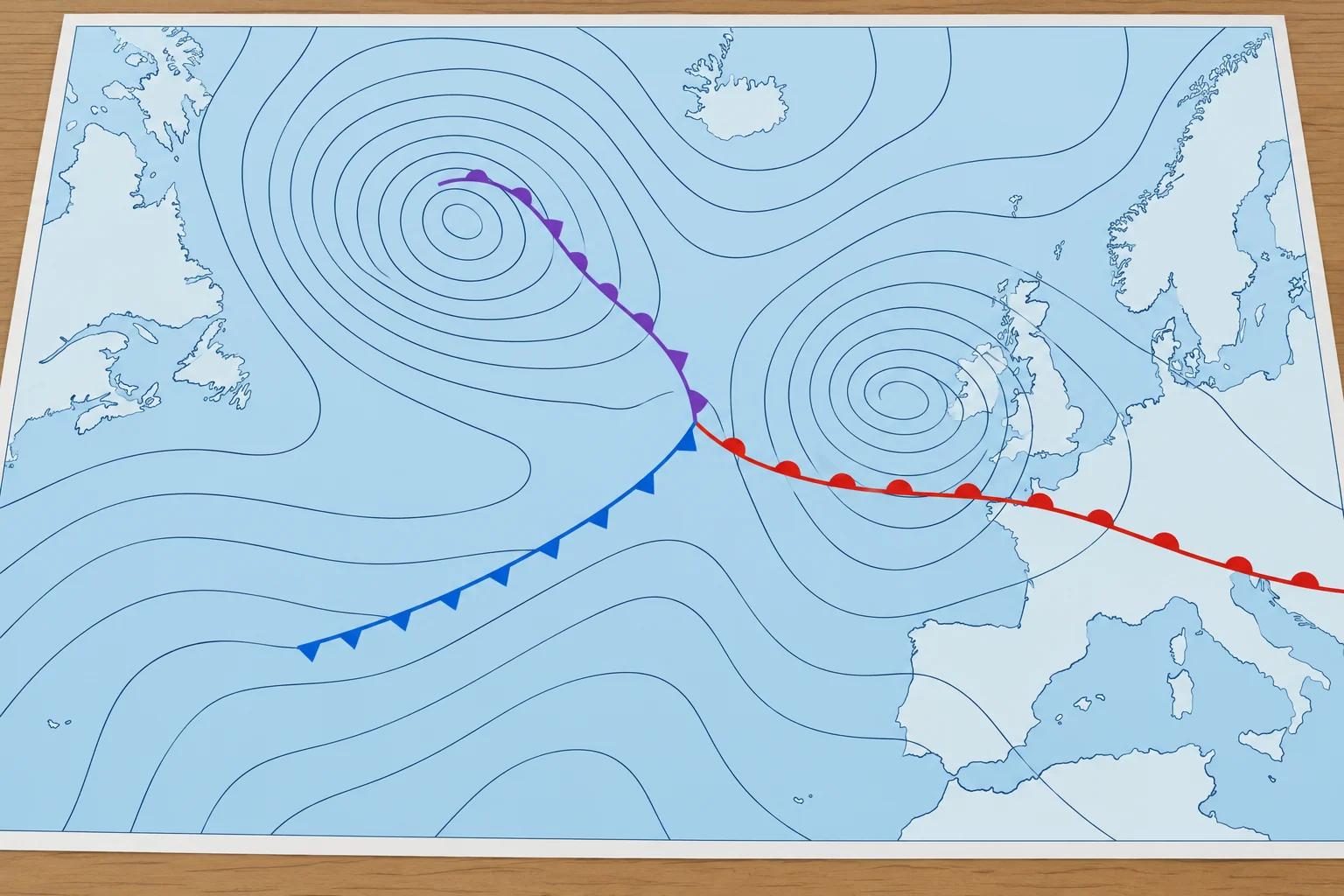
What a surface pressure chart shows
1The lesson in plain words
A synoptic chart maps pressure and fronts at one moment. Read its valid time, the isobars, the centres and the front symbols.
Analysis and forecast
A synoptic chart shows weather over a large area at one moment. An analysis shows the observed situation. A forecast chart (or prognostic chart) shows the expected situation later. T+24 means 24 hours after the chart's base time; the valid time tells you when the forecast applies. UTC is the common time reference, unaffected by local daylight saving. Check the valid time before reading the chart.
Isobars
Isobars are lines joining places of equal sea-level pressure. They are drawn at fixed steps, often every 4 or 5 hectopascals (hPa), and labelled in hPa. The pressure gradient is pressure change over distance. Close isobars generally mean stronger wind; wider spacing generally means lighter wind.
Centres
L (or T, D, B in some languages) marks a low and H (or A) a high, each with its central pressure. Closed isobars surround a low (a depression) or a high (an anticyclone).
Front symbols
A warm front has red semicircles; a cold front, blue triangles. An occluded front has both in purple on the same side. On moving fronts, symbols point towards the advance. A stationary front has alternating red semicircles and blue triangles on opposite sides, showing little or no movement. On monochrome charts, use the symbol shapes. Check the chart legend for trough lines.
Shapes to recognise
Isobars bulging out from a high form a ridge. Isobars bulging out from a low form a trough. A col is a saddle-shaped area between two opposing highs and two opposing lows. Practise on the Weather lab: synoptic charts, which lets you move the systems yourself.
2Key data
- Isobar interval
- Often 4 hPa; some services use 5 hPa
- Analysis chart
- The observed situation at its valid time
- Forecast chart
- Expected situation at T+24, T+48… from its base time
- Warm / cold front
- Red semicircles / blue triangles, pointing the way it moves
- Occluded front
- Purple semicircles and triangles on the same side
3Key points
- 1
Check the valid time and whether it is an analysis or a forecast.
- 2
Isobars join equal pressure, often every 4 hPa.
- 3
Close isobars mean strong wind; wide spacing means light wind.
- 4
Moving-front symbols indicate direction; stationary-front symbols lie on opposite sides.
- 5
Recognise ridges, troughs and cols from the isobar shapes.
4Frequent mistakes
Wrong: A chart shows the weather for the whole day.
Right: Each chart shows one moment, its valid time. Compare charts for successive times to see the change.
Wrong: Isobars show where it is raining.
Right: Isobars show pressure only. Rain is linked to fronts, troughs and showers, not to the isobars themselves.
5Practice case & exam keys
You download a chart labelled "T+48, valid 12 UTC Saturday" on Thursday morning. It shows a cold front with blue triangles pointing east, 200 nautical miles west of your harbour. How do you use it?
Show the answer
It is a forecast chart for midday UTC on Saturday, not the present situation. It suggests a cold front approaching from the west at that time. Use it to plan, then check the newer charts and the official forecast on Friday and Saturday: front timing often changes by several hours.
Exam keys
- Synoptic chart = map of pressure and fronts at one valid time (analysis or forecast).
- Isobars join equal pressure; spacing shows the pressure gradient and wind strength.
- Fronts: warm red semicircles; cold blue triangles; occluded purple both, same side; stationary opposite sides.
Finish this unit
When you've read it, match the terms, then answer three questions. Get them all right to finish the unit; opening the page alone doesn't count.
My notes for this unit
No notes