

Surface wind: friction, veer and back
1The lesson in plain words
Friction slows surface wind and turns it towards low pressure: backed in the Northern Hemisphere, veered in the Southern Hemisphere.
Friction slows and turns
Near the surface, friction slows the wind. The Coriolis effect weakens with it, so the wind crosses the isobars towards low pressure. Backing means the direction the wind comes from changes anticlockwise; veering means clockwise. Compared with the geostrophic wind, surface wind is backed in the Northern Hemisphere (NH) and veered in the Southern Hemisphere (SH).
Over the sea
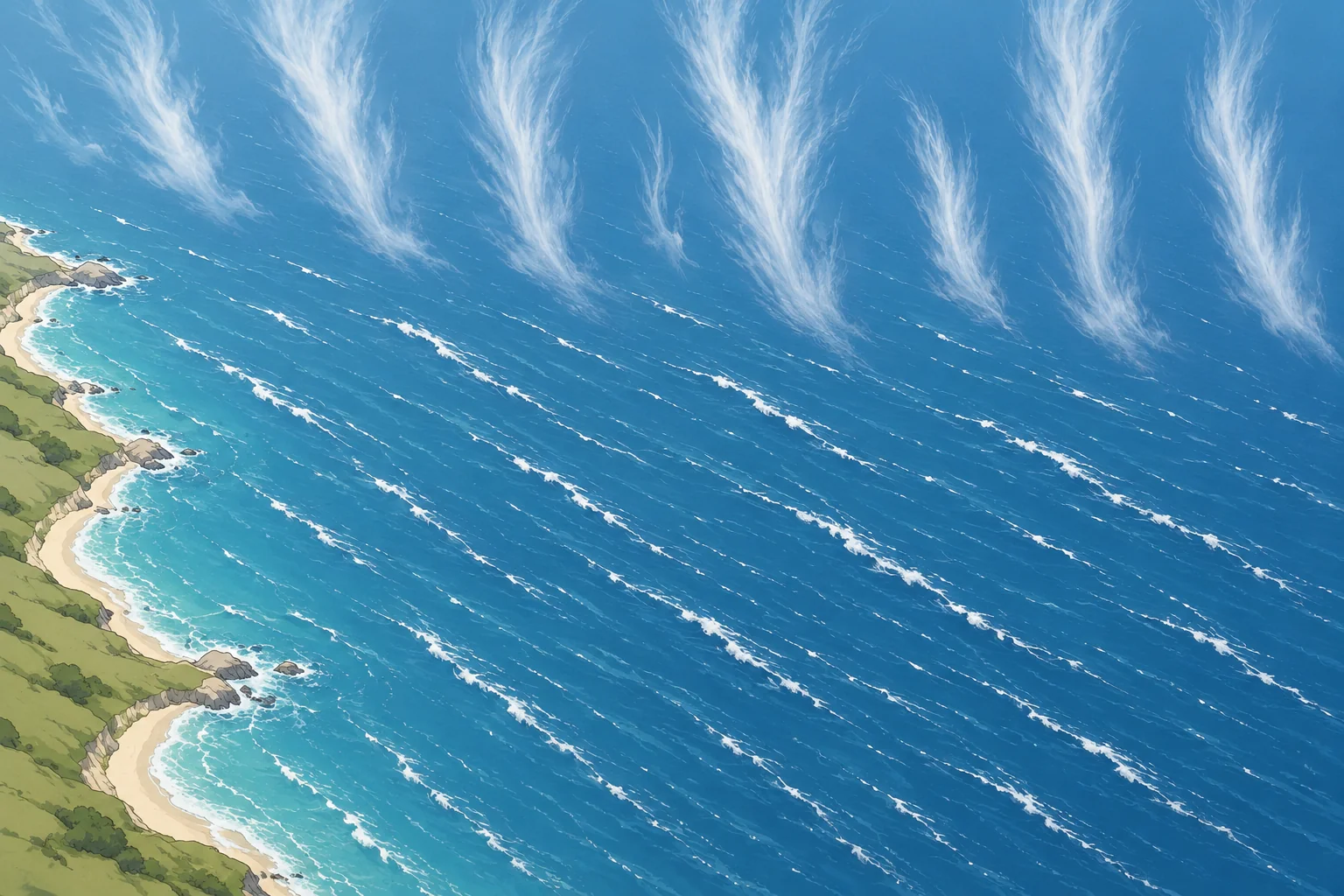
The sea is smooth, so friction is relatively small. In the Northern Hemisphere, surface wind over the open sea is backed about 10–20° and has about two-thirds to three-quarters of the geostrophic speed. Over land, friction is greater: backed about 30° or more and often only half the speed.
Stability changes it
In unstable air, such as cold air over a warmer sea, mixing brings down fast air from above: the surface wind is stronger and gusty, with a smaller turning angle towards low pressure. In stable air, such as warm air over a colder sea, the surface wind is lighter, with a larger turning angle, but it can stay strong just above the mast.
Worked example (Northern Hemisphere)
The chart gives a geostrophic wind of 30 knots from 270°. Over the open sea, expect about 20–23 knots, force 5 to 6, from about 250–260°. Stable air can reduce the surface wind further. Coastal effects can strengthen or weaken it; shower gusts may approach 30 knots.
Crossing the coast (Northern Hemisphere)
Wind leaving land meets less friction: it veers and strengthens over the sea. Wind blowing onto land backs and weakens. With your back to a wind blowing along a coast, land on your right squeezes the flow together: stronger wind near shore. Land on your left spreads it apart: lighter wind. Squeezing together is convergence; spreading apart is divergence.
2Key data
- Over sea (NH)
- Backed ~10–20°; about 2/3 to 3/4 of geostrophic speed
- Over land (NH)
- Backed ~30° or more; often about half the speed
- Southern Hemisphere
- Surface wind veered from geostrophic, not backed
- Example (NH)
- Geostrophic 270°/30 kn → sea surface ~255°, 20–23 kn
- Offshore wind leaving land (NH)
- Veers and strengthens over the sea
- Along a coast (NH)
- Back to wind, land on right: stronger; land on left: lighter
3Key points
- 1
Friction turns the surface wind towards the low.
- 2
Northern Hemisphere: surface wind is backed; Southern: veered.
- 3
Over the sea (NH): backed about 10–20°, about two-thirds to three-quarters of geostrophic speed.
- 4
Unstable air: stronger and gusty; stable air: lighter at the surface.
- 5
Wind leaving the land veers and strengthens over the sea (NH).
4Frequent mistakes
Wrong: The surface wind over the sea equals the geostrophic wind from the chart.
Right: Reduce it to about two-thirds to three-quarters and back it 10–20° (NH). Then allow for gusts.
Wrong: Friction backs the wind in both hemispheres.
Right: Friction turns the wind towards the low. That is backing in the north and veering in the south.
Wrong: A calm harbour means calm at sea.
Right: Shelter can change both wind speed and direction in a harbour. Estimate open-sea wind from the chart and official forecast.
5Practice case & exam keys
The chart over the Gulf of Lion shows a geostrophic wind of 45 knots from 320°. The air is cold and flowing over a warmer sea. What surface wind do you expect at sea?
Show the answer
The standard correction gives about 30–34 knots, force 7–8, from 300–310°. Cold air over a warmer sea promotes mixing, so the mean may be stronger and less backed: closer to 320°. Gusts can reach or exceed 45 knots; the chart alone cannot predict them. Check the official wind and gust forecast.
Exam keys
- Surface friction slows the wind and turns it towards low pressure (backed in NH, veered in SH).
- Over the sea (NH): roughly 10–20° backed and 2/3–3/4 of geostrophic speed; over land, more backed and slower.
- Wind leaving land veers and strengthens over the sea (NH); onshore wind backs and weakens.
Finish this unit
When you've read it, match the terms, then answer three questions. Get them all right to finish the unit; opening the page alone doesn't count.
My notes for this unit
No notes