

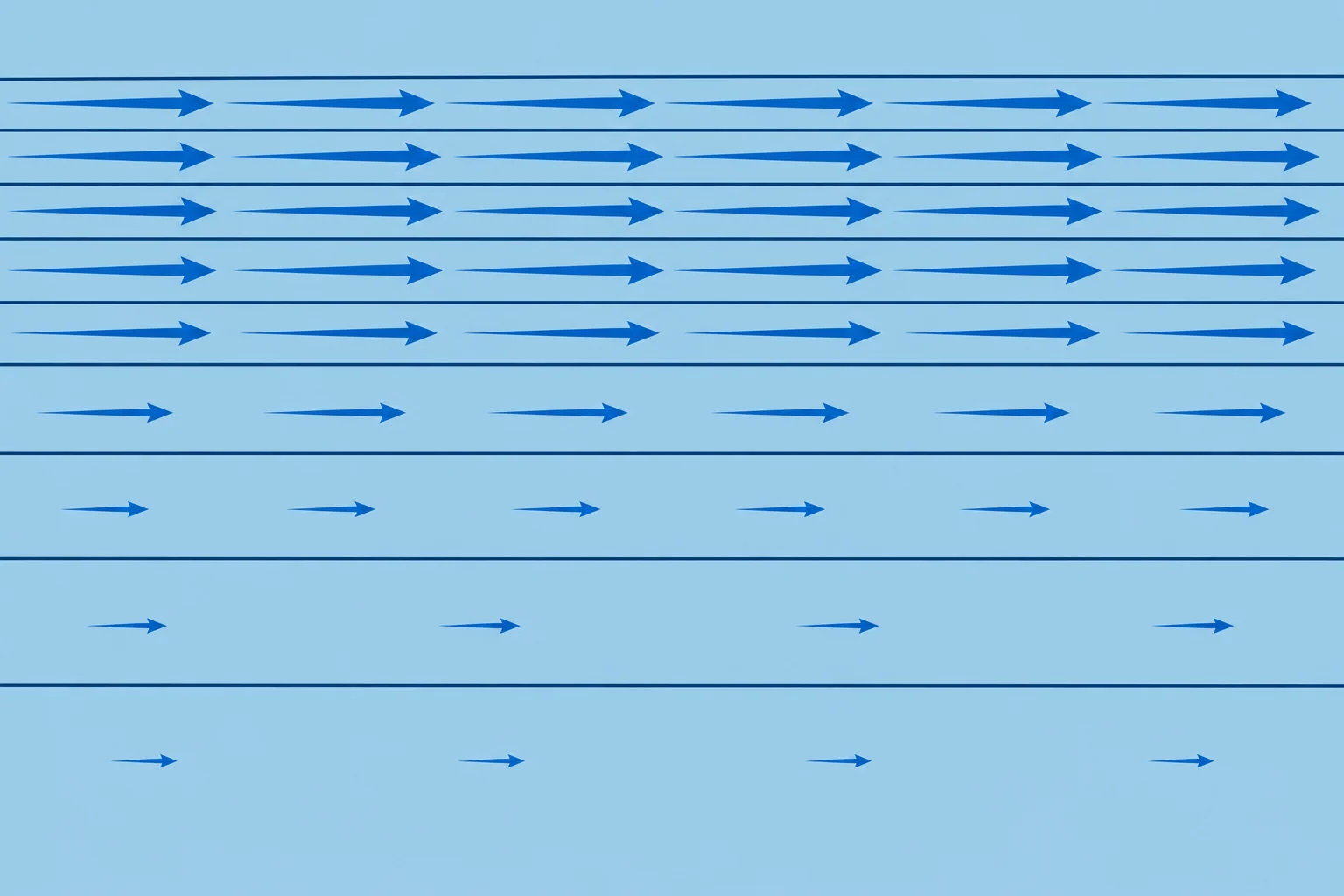
Geostrophic wind: speed from isobar spacing
1The lesson in plain words
Above surface friction, wind follows nearly straight isobars. Its speed grows with a tighter pressure gradient and, for the same gradient, at lower latitude.
Two forces in balance
The pressure gradient force pushes air from high to low pressure. The Coriolis effect of the Earth's rotation turns moving air to the right in the Northern Hemisphere. Above the friction layer, these forces approximately balance in steady flow along straight or gently curved isobars. This gives the geostrophic wind.
Spacing gives speed
Closer isobars mean stronger geostrophic wind. Halve the spacing and the wind doubles. Measure perpendicular to adjacent isobars: the shortest gap. Use the chart's geostrophic scale for your latitude and its stated pressure interval; do not use a 4 hPa scale directly for 5 hPa spacing.
Latitude matters
The Coriolis effect weakens towards the equator. For the same pressure gradient, wind is stronger at lower latitudes. Near the equator, below about 15°, the geostrophic rule becomes unreliable.
A worked example
At 50°N, isobars 4 hPa apart and 100 nautical miles (NM) apart give a geostrophic wind of about 30 knots. At 40°N, the same spacing gives about 37 knots. If the isobars close to 50 NM apart at 50°N, the wind doubles to about 60 knots.
Curved isobars
Gradient wind follows curved isobars above surface friction. For the same pressure gradient, it is slower than geostrophic around a low and faster around a high. Cyclostrophic wind balances the pressure force with the outward effect of a tight turn. Euler wind accelerates under the pressure force alone. Antitriptic wind balances the pressure force with friction. These last three names appear in Spanish syllabuses.
2Key data
- Geostrophic wind
- Along nearly straight isobars, above the surface friction layer
- Scale check
- Match latitude and isobar interval; measure perpendicular spacing
- Example at 50°N
- 4 hPa per 100 NM ≈ 30 knots
- Example at 40°N
- 4 hPa per 100 NM ≈ 37 knots
- Half the spacing
- Twice the geostrophic wind
- Curvature
- Gradient wind, same gradient: slower round a low; faster round a high
3Key points
- 1
Geostrophic wind blows along nearly straight isobars above the friction layer.
- 2
Closer isobars mean stronger wind: half the spacing, double the wind.
- 3
The same spacing gives stronger wind at lower latitude.
- 4
Match the geostrophic scale to latitude and pressure interval; measure perpendicular to adjacent isobars.
- 5
For the same pressure gradient, gradient wind is slower round a low and faster round a high than geostrophic wind.
4Frequent mistakes
Wrong: The same isobar spacing always means the same wind.
Right: The wind depends on latitude too. The same spacing gives more wind in the Mediterranean than off Scotland.
Wrong: The geostrophic wind is the wind you will feel on deck.
Right: It is the wind above the friction layer. At sea level it is lighter and turned towards the low.
5Practice case & exam keys
Two areas have 4 hPa isobars. The chart scale gives 33 knots for 100 NM at 45°N and 35 knots for 100 NM at 43°N. Actual spacing is 100 NM in Biscay (45°N), but 50 NM off Galicia (43°N). Compare the geostrophic winds. Can you use these as deck winds?
Show the answer
About 33 knots in Biscay and 70 knots off Galicia: halving the gap doubles Galicia's 35-knot reading. These are winds above surface friction. You still need a surface correction before estimating deck wind.
Exam keys
- Geostrophic wind: balance of pressure gradient and Coriolis, blowing along nearly straight isobars.
- Speed increases with closer isobars and, for the same spacing, at lower latitude.
- For the same pressure gradient, gradient wind is slower round a low and faster round a high than geostrophic wind.
Finish this unit
When you've read it, match the terms, then answer three questions. Get them all right to finish the unit; opening the page alone doesn't count.
My notes for this unit
No notes