

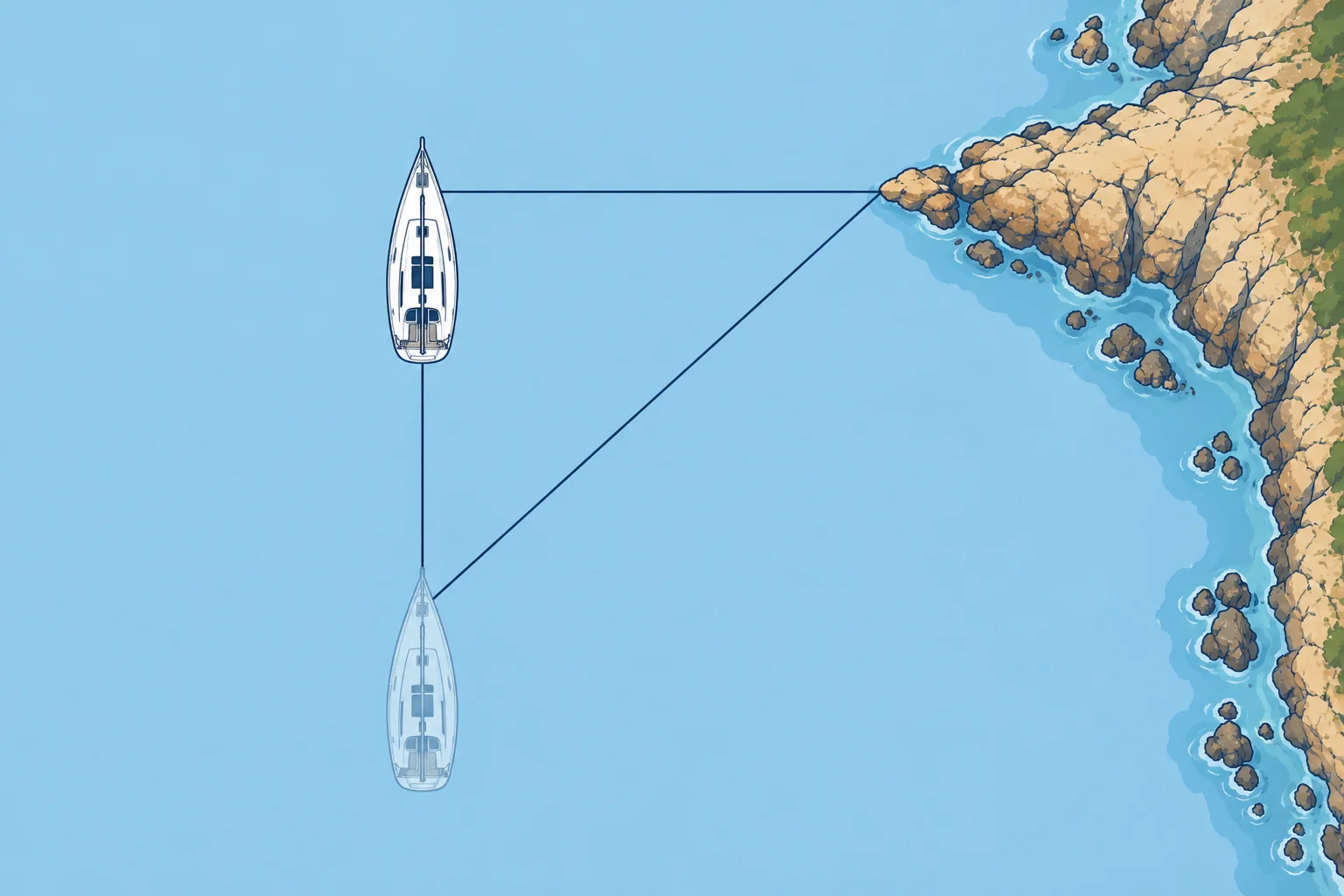
Bow angles: doubling the angle and the four-point bearing
1The lesson in plain words
On a straight ground track aligned with your heading, doubling a mark’s bow angle makes its range at the second bearing equal your run.
Relative bearings
A relative bearing is measured from the bow: 30° on the starboard bow is 30° to the right of the heading. Spanish courses call it a marcación. Read it from a sighting ring marked in degrees from the bow, or take a compass bearing and subtract the heading. Use a straight, steady ground track aligned with your heading, with no cross-set or leeway; measure distance over the ground.
Doubling the angle
Note the time and log when an object bears, say, 30° on the bow. Hold your course until the angle has doubled to 60°. The triangle formed has two equal sides, so your distance from the object at the second bearing equals the distance run between the two. Example: 30 minutes at 5.0 kn over the ground is 2.5 M, so you are 2.5 M off at the second bearing. Spanish: ángulo doble.
The four-point bearing
The best-known pair is 45° on the bow, four old compass points, and then 90°, abeam. The distance abeam equals the distance run between them. Example: 45° at 1100, abeam at 1124, at 6.0 kn over the ground: 0.4 h × 6.0 = 2.4 M, so you passed 2.4 M off. It is simple and accurate, but it tells you only afterwards how close you passed.
Predicting the passing distance
Two other pairs warn you in advance. From 26.5° to 45° on the bow, the distance run approximately equals the distance at which you will pass abeam if you hold your course. From 22.5° to 45°, the passing distance will be about 0.7 × the distance run. If that predicted distance is too small for the danger off the point, alter course early.
Where it fails
The geometry assumes the boat moves straight along its heading over the ground. A cross-stream or leeway moves you off that line, and the answer can be wrong on the dangerous side. Use these methods where there is little cross-set, use the speed over the ground when a stream runs along your track, and plot a full running fix when there is a cross-stream.
2Key data
- Doubling the angle
- Distance off at the second bearing = distance run
- Four-point (45° → 90°)
- Distance abeam = distance run
- 26.5° → 45°
- Distance run ≈ distance you will pass abeam
- 22.5° → 45°
- Passing distance ≈ 0.7 × distance run
- Relative bearing
- Compass bearing − compass heading
- Spanish terms
- Marcación (relative bearing), ángulo doble
3Key points
- 1
Doubling the bow angle: distance off at the second bearing = distance run.
- 2
Four-point bearing, 45° then abeam: distance abeam = distance run.
- 3
26.5° → 45° and 22.5° → 45° predict how close you will pass, before you get there.
- 4
All bow-angle methods fail in a cross-stream or with leeway: use a running fix.
4Frequent mistakes
Wrong: Use the log distance when a strong stream runs along your track.
Right: Use the distance over the ground. A fair or foul stream changes how far you really ran.
Wrong: Use doubling the angle in a strong cross-stream.
Right: A cross-set moves you off your heading line. Plot a running fix with the stream instead.
Wrong: Rely on the four-point bearing to keep clear of a danger off a headland.
Right: It gives the distance only once you are abeam. Use the 26.5°–45° pair to estimate your passing distance in advance.
5Practice case & exam keys
A headland bears 22.5° on your port bow at 0940 and 45° at 1000. You make 6.0 kn over the ground with no cross-stream or leeway. Rocks extend 1.5 M off the headland. Will you pass safely if you hold your course?
Show the answer
In 20 minutes you ran 2.0 M. From 22.5° to 45°, the passing distance is about 0.7 × 2.0 = 1.4 M. That is inside the 1.5 M of rocks. Alter course to starboard, away from the headland, now, and check again with a fresh bearing or a fix.
Exam keys
- Relative bearing (marcación) is measured from the bow.
- Doubling the angle: distance off = distance run; four-point: distance abeam = run.
- 26.5°–45°: run ≈ passing distance; 22.5°–45°: passing distance ≈ 0.7 × run.
- Valid only with no cross-set: the track over the ground must follow the heading.
Finish this unit
When you've read it, match the terms, then answer three questions. Get them all right to finish the unit; opening the page alone doesn't count.
My notes for this unit
No notes