

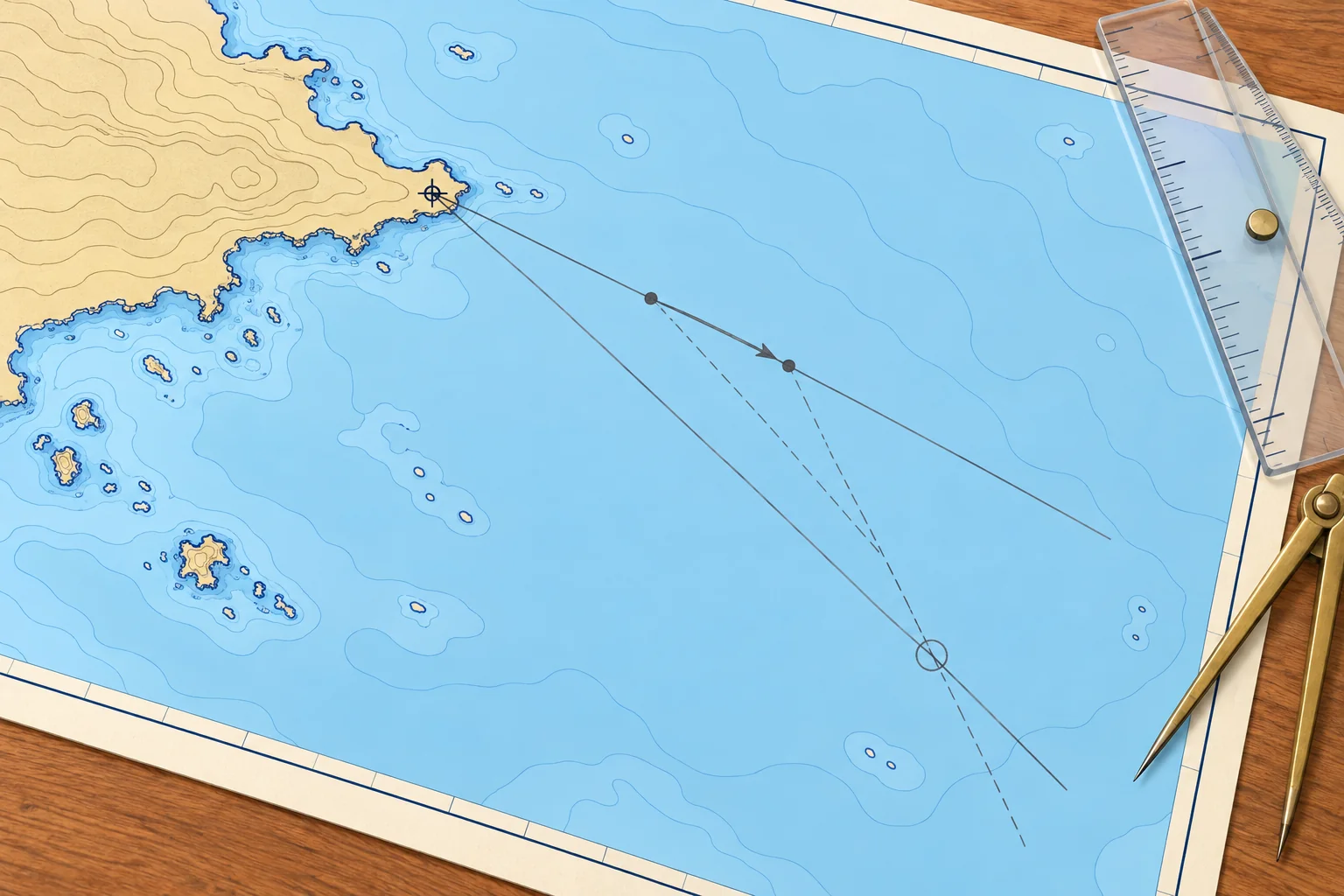
The running fix: one object, two times
1The lesson in plain words
With only one object in sight, take a bearing, run on, take another, and move the first position line along your ground track for the time between.
When you need it
A fix needs two position lines at the same moment (Position fixing unit). With only one charted object in sight, such as a single headland by day or one light at night, you can still fix by taking two bearings at different times. Spanish courses call this a situación por demoras no simultáneas. The first line is moved forward to the time of the second; it is then a transferred position line.
Transferring the line
Take the first bearing and note the time and log reading. Hold a steady heading until the bearing has changed by at least about 30°, ideally 60–90°. Take the second bearing. From any point on the first line, lay off the distance and direction the boat moved over the ground in the interval. Through that end point draw a line parallel to the first, and mark it as transferred, usually with double arrowheads. Where it crosses the second bearing is your running fix.
Allow for the stream
The line must move with the boat over the ground, not just through the water. Transfer it by the water track and log distance plus the tidal stream for the same time, exactly as you build an EP (Dead reckoning unit). Example: water track 090°T, 5.0 M by log in the hour, stream 180°T at 1.0 kn. Move the line 5.0 M east, then 1.0 M south: in all about 5.1 M along 101°T.
How good it is
A running fix depends on the observations, their angle of cut and the run between them. Errors in leeway, the log, steering and the predicted stream shift the transferred line. Keep the interval short, but allow enough bearing change. A well-cut running fix often improves an EP, but uncertain movement or poor observations can make it worse. A good simultaneous fix avoids the extra uncertainty of the run. Cross-check with a sounding or another independent line.
Other lines too
Any position line can be transferred in the same way. A radar range is moved by shifting the circle's centre along the same ground vector. A depth contour can be transferred too, if you trace it. Sun lines in celestial navigation, taken hours apart, are crossed by the same rule.
2Key data
- Transfer by
- Ground track and distance over the interval
- Bearing change
- At least about 30°; better 60–90°
- Example transfer
- 5.0 M at 090°T + 1.0 M at 180°T ≈ 5.1 M at 101°T
- Range circles
- Move the centre by the same ground vector
- Spanish term
- Situación por demoras no simultáneas
3Key points
- 1
A running fix crosses a transferred position line with a later one.
- 2
Move the first line by the boat's movement over the ground, stream included.
- 3
Wait for the bearing to change by at least about 30° before the second line.
- 4
It carries every error of the run: check it with a sounding.
4Frequent mistakes
Wrong: Transfer the first line by the log distance along the heading only.
Right: Transfer it by the water track plus the tidal stream: the boat's real movement over the ground.
Wrong: Take the second bearing before the bearing has changed enough.
Right: Wait until the bearing has changed enough for a good angle of cut, at least about 30°.
Wrong: Draw the transferred line through the object again.
Right: Draw it parallel to the first line, through the end of the ground vector, not through the object.
5Practice case & exam keys
At 2100 a light bears 040°T. You hold a water track of 090°T at 5.0 kn; the stream sets 180°T at 1.0 kn. At 2200 the same light bears 320°T. How do you plot your 2200 position? The stream estimate is uncertain. Is this enough for close clearance?
Show the answer
Draw the 2100 line 040°T through the light. From any point on it, lay off 5.0 M along 090°T, then 1.0 M along 180°T. Through the end point draw a line parallel to 040°T and mark it transferred. Draw the 2200 bearing 320°T through the light. Where the two lines cross is your 2200 running fix; check it with the depth. No. Stream uncertainty shifts the transferred line; keep a wider clearance until independently checked.
Exam keys
- Running fix: first position line transferred by the ground vector, crossed with a later line.
- Ground vector = water track and log distance + tidal stream for the interval.
- Bearing change of at least about 30°; check the result with a sounding.
- Spanish exams: situación por demoras no simultáneas.
Finish this unit
When you've read it, match the terms, then answer three questions. Get them all right to finish the unit; opening the page alone doesn't count.
My notes for this unit
No notes