

Lights rising and dipping: distance off by the horizon
1The lesson in plain words
A strong light first shows over the horizon at a distance set by its elevation and your height of eye. Its bearing at that moment gives a fix.
Rising and dipping
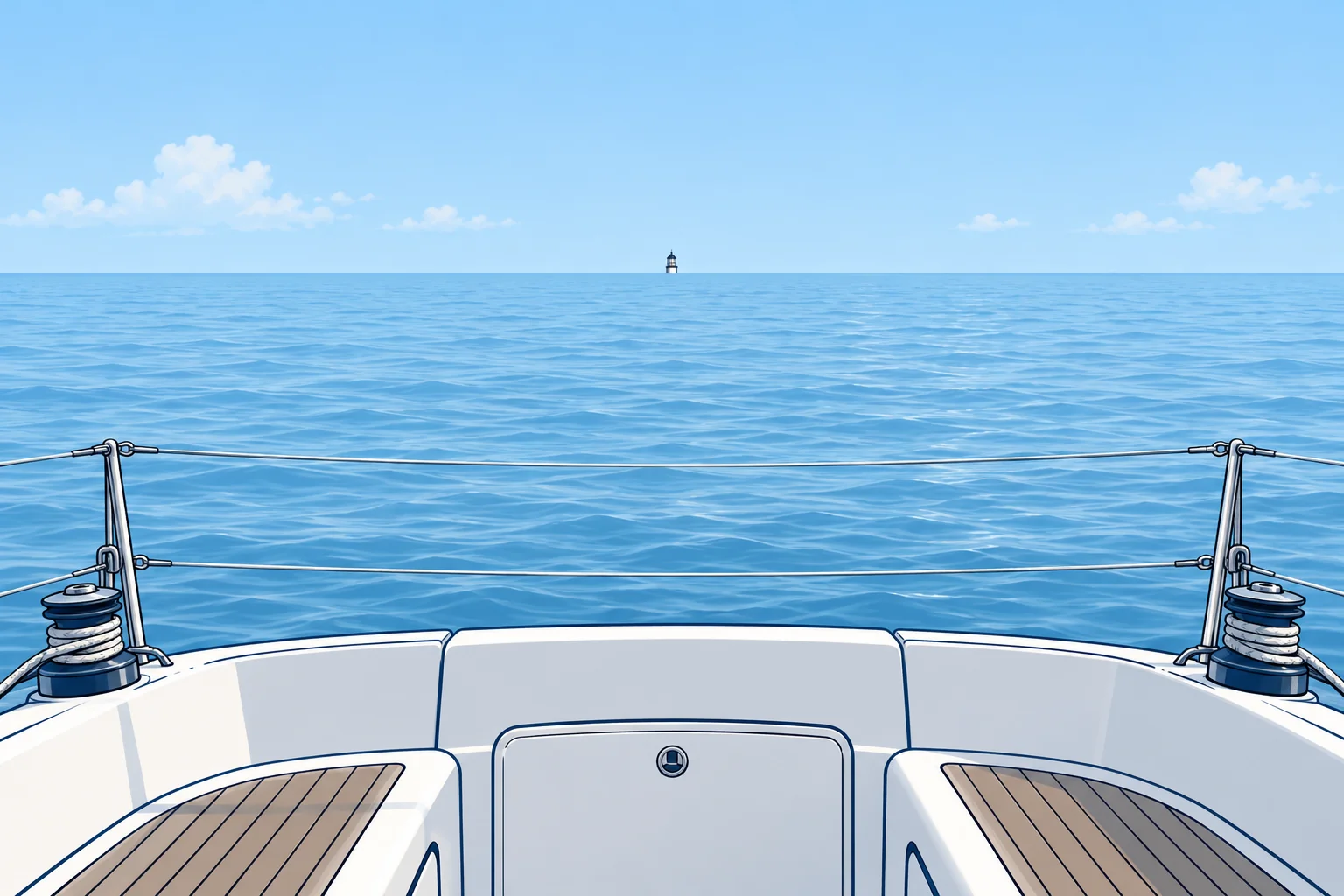
Far off, you may first see the loom of a light, its glow in the sky. As you close it, the light itself appears on the horizon: it is rising. Going away, it disappears below the horizon: it is dipping. At that moment your distance from it is its geographical range for your height of eye. Spanish courses call this a faro en el horizonte.
The formula
Distance to the horizon in miles ≈ 2.08 × √h, with h in metres; the constant includes average refraction. Add the light’s term and yours: D = 2.08 × (√H + √h). H is the light’s height above the current water level and h is your height of eye above that water, both in metres. Other tables use constants near 2.1 or 2.12.
Worked example
A light is 49 m above the current water level and your eye is 2.5 m above the water. D = 2.08 × (√49 + √2.5) = 2.08 × (7.0 + 1.58) = 2.08 × 8.58 ≈ 17.8 M. When it rises, take its bearing. The bearing line and a 17.8 M arc round the light give your fix. Check it is truly on the horizon: lower your eye and it should disappear, raise it and it reappears.
Check it can dip
The light must reach the horizon: its luminous range, the distance visible in current conditions, must exceed its geographical range. Nominal range is luminous range in 10 M meteorological visibility. MHWS means mean high water springs. Check the stated elevation datum, the reference level for charted heights. For the formula, H must be height above the current sea surface: add the distance the tide is below that datum, or subtract the distance above it.
Tables and care
Almanacs and Spanish exam books print a table of distances of lights rising or dipping, entered with the light's elevation and your height of eye: no arithmetic at night. Unusual refraction, especially over cold water or in hot calm weather, can move the true horizon distance noticeably. Treat the result as approximate and cross-check it with a sounding or a second line.
2Key data
- Geographical range
- D (M) = 2.08 × (√H + √h), H and h in metres
- Example
- H 49 m, h 2.5 m → about 17.8 M
- Horizon from 2.5 m
- 2.08 × √2.5 ≈ 3.3 M
- Nominal range
- Luminous range in a meteorological visibility of 10 M
- Height H
- Height above current water; adjust charted elevation for tide
- Spanish terms
- Faro en el horizonte, alcance geográfico
3Key points
- 1
A light rising or dipping is at its geographical range for your height of eye.
- 2
D ≈ 2.08 × (√H + √h) with heights in metres gives miles.
- 3
It only works if the light's luminous range is greater than its geographical range.
- 4
Combine the distance with the light's bearing for a fix, and cross-check it.
4Frequent mistakes
Wrong: Use the nominal range printed on the chart as your distance off.
Right: Nominal range is about the light's power. The rising distance comes from the elevation and your height of eye.
Wrong: Leave out your own height of eye.
Right: Add both terms: the light's horizon and yours. From 2.5 m your own term alone is about 3.3 M.
Wrong: Take the first glow in the sky as the light rising.
Right: That is the loom. Wait until the light itself is on the horizon, and check by raising and lowering your eye.
5Practice case & exam keys
A light is 64 m above the water, with nominal range 12 M. Your eye is 3 m high and meteorological visibility is 10 M. It first appears at night. Can you use its first appearance and bearing for a horizon fix?
Show the answer
No. Geographical range is 2.08 × (√64 + √3) ≈ 20.2 M, but luminous range is only 12 M in 10 M visibility. The light becomes visible inside the geographical horizon, so first appearance does not give 20.2 M. Seek another position line.
Exam keys
- Geographical range D = 2.08 × (√H + √h), heights in metres, D in miles.
- H is light height above current water: adjust charted elevation for tide; h is your height of eye above water.
- Only a light whose luminous range exceeds its geographical range truly rises or dips.
- Bearing at the moment of rising + the distance = fix (faro en el horizonte).
Finish this unit
When you've read it, match the terms, then answer three questions. Get them all right to finish the unit; opening the page alone doesn't count.
My notes for this unit
No notes