

Horizontal and vertical sextant angles, and danger angles
1The lesson in plain words
On a known side of the line joining two marks, their angle puts you on a circle arc through both. Two angles from three marks can fix you without compass error.
A circle of position
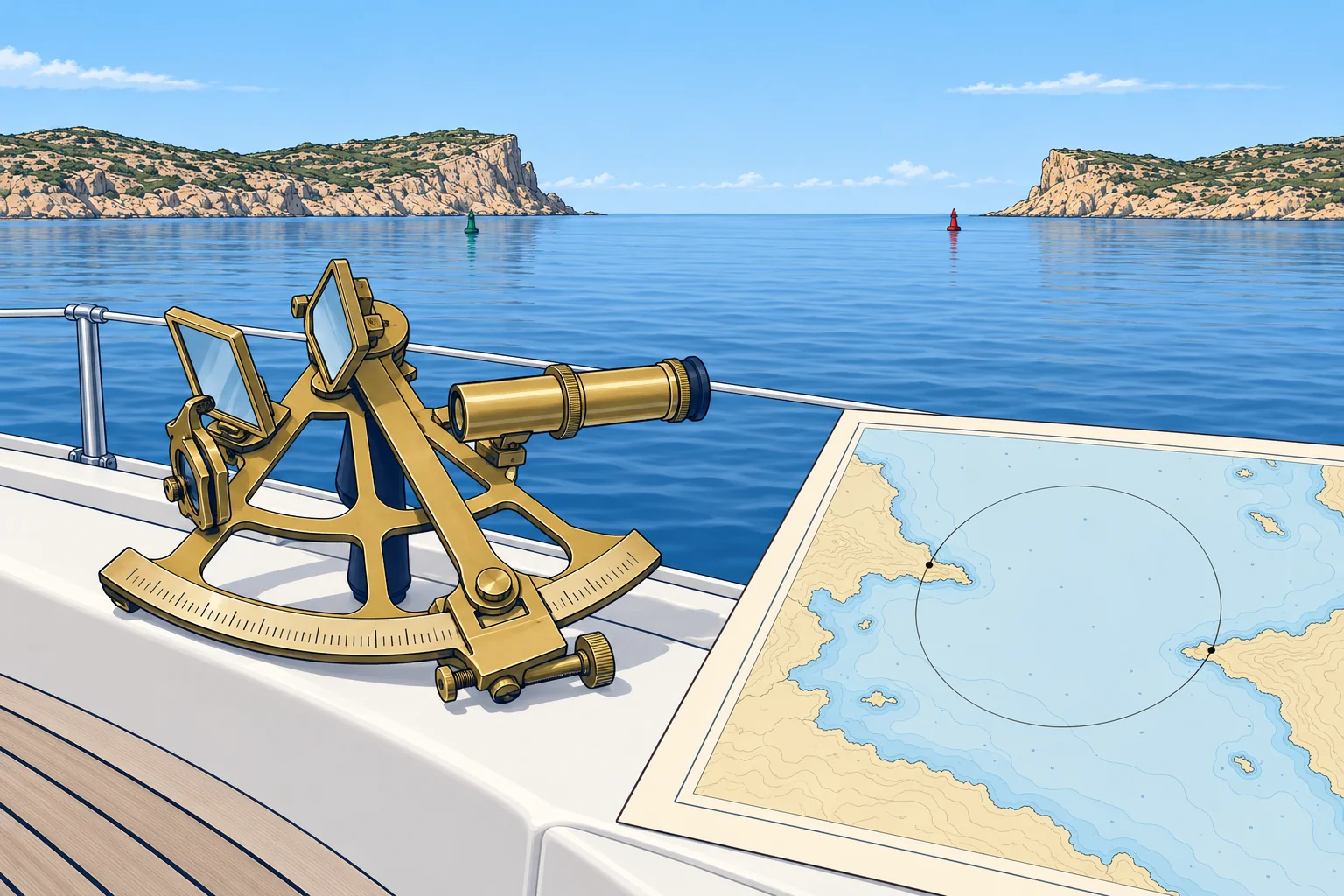
Hold a sextant horizontally and measure the angle between two charted objects, such as a beacon and a headland edge: a horizontal sextant angle. On your known side of the line joining the marks, equal measured angles define a circle arc through both marks. That arc is your position line. The opposite arc gives 180° minus that angle. No compass is needed, so variation and deviation do not matter.
Drawing the circle
Join the two marks on the chart. Below 90°, draw lines from the ends at 90° − angle to this base line, on your side; their intersection is the centre. Above 90°, use angle − 90° on the far side. At 90°, the base line is the diameter: its midpoint is the centre. Draw the circle through both marks and use only the arc on your side of the base line.
Three objects, two angles
Measure the angles between the left and middle objects and between the middle and right ones, at the same moment. The two circles cross at the middle object and at your position. Navigators used a station pointer, a three-armed protractor: set the two angles and slide it until each arm runs through its object. Tracing paper works too. Avoid objects that lie on one circle with you: the fix then becomes indeterminate.
The danger angle
A horizontal danger angle marks a limiting arc through two charted marks, clear of a hazard. Stay on the same side of their base line as the chosen arc. On that side, angles are larger inside the circle and smaller outside it. If danger is inside, keep below the limiting angle; if safe water is inside, keep above it. Allow a margin for observation error and check frequently near danger.
Vertical sextant angle
A vertical sextant angle between an object’s top and waterline gives distance off: d (M) ≈ 1.856 × H ÷ angle, H in metres above current water, angle in minutes of arc. A 60 m cliff above water at 30′ is about 3.7 M off. Check the chart’s height datum (reference level). If it uses mean high water springs (MHWS), add the tide’s shortfall below that level to get H. Use this only when the object’s foot is within your horizon.
2Key data
- Circle centre
- Below 90°: 90° − angle; at 90°: midpoint of base line
- Angle over 90°
- Centre on the far side, at angle − 90°
- Danger inside the circle
- On the chosen side of the base line, keep below the danger angle
- Vertical sextant angle
- d (M) ≈ 1.856 × H (m) ÷ angle (minutes)
- Example
- 60 m at 30′ → about 3.7 M
- No compass needed
- No variation or deviation in sextant angles
3Key points
- 1
On a known side of the marks’ base line, a horizontal angle puts you on an arc of a circle through both.
- 2
Two angles from three marks give a fix with no compass error.
- 3
Stay on the chosen side of the marks’ base line when using a danger angle to keep clear.
- 4
A vertical sextant angle of a charted height gives your distance off.
4Frequent mistakes
Wrong: Draw the circle centre at the measured angle from the base line.
Right: Below 90°, use 90° minus the angle on your side; above 90°, use angle minus 90° on the far side. At 90°, use the base line’s midpoint.
Wrong: Pick three marks that lie on a circle through your position.
Right: Then both circles coincide and give no fix. Choose marks well spread, with the middle one nearest you.
Wrong: Use a charted height for a vertical angle without any tide correction.
Right: Check the chart’s height datum. If it is mean high water springs (MHWS), add the tide’s shortfall below it to get height above water; subtract any excess above it.
5Practice case & exam keys
Two beacons stand on a straight shore. A reef lies offshore between them. You draw a circle through both beacons that passes just outside the reef, on the seaward side, and measure 38° on it. Sailing along the coast, what must your horizontal sextant angle stay?
Show the answer
Stay on the seaward side of the beacons’ base line. On that side, the angle inside the circle is larger than 38°. Keep below 38° with a margin: if it grows towards 38°, turn away from shore. Check frequently enough for your speed and clearance.
Exam keys
- Horizontal angle: use the arc on your known side. Centre: below 90°, use 90° − angle; above 90°, angle − 90° on the far side; at 90°, base line midpoint.
- Two angles from three marks give a fix (station pointer); no compass error.
- Danger angle: on the chosen side of the marks’ base line, danger inside the circle → keep the angle less.
- Vertical sextant angle: d (M) ≈ 1.856 × H (m) ÷ angle (′), H corrected for tide.
Finish this unit
When you've read it, match the terms, then answer three questions. Get them all right to finish the unit; opening the page alone doesn't count.
My notes for this unit
No notes