

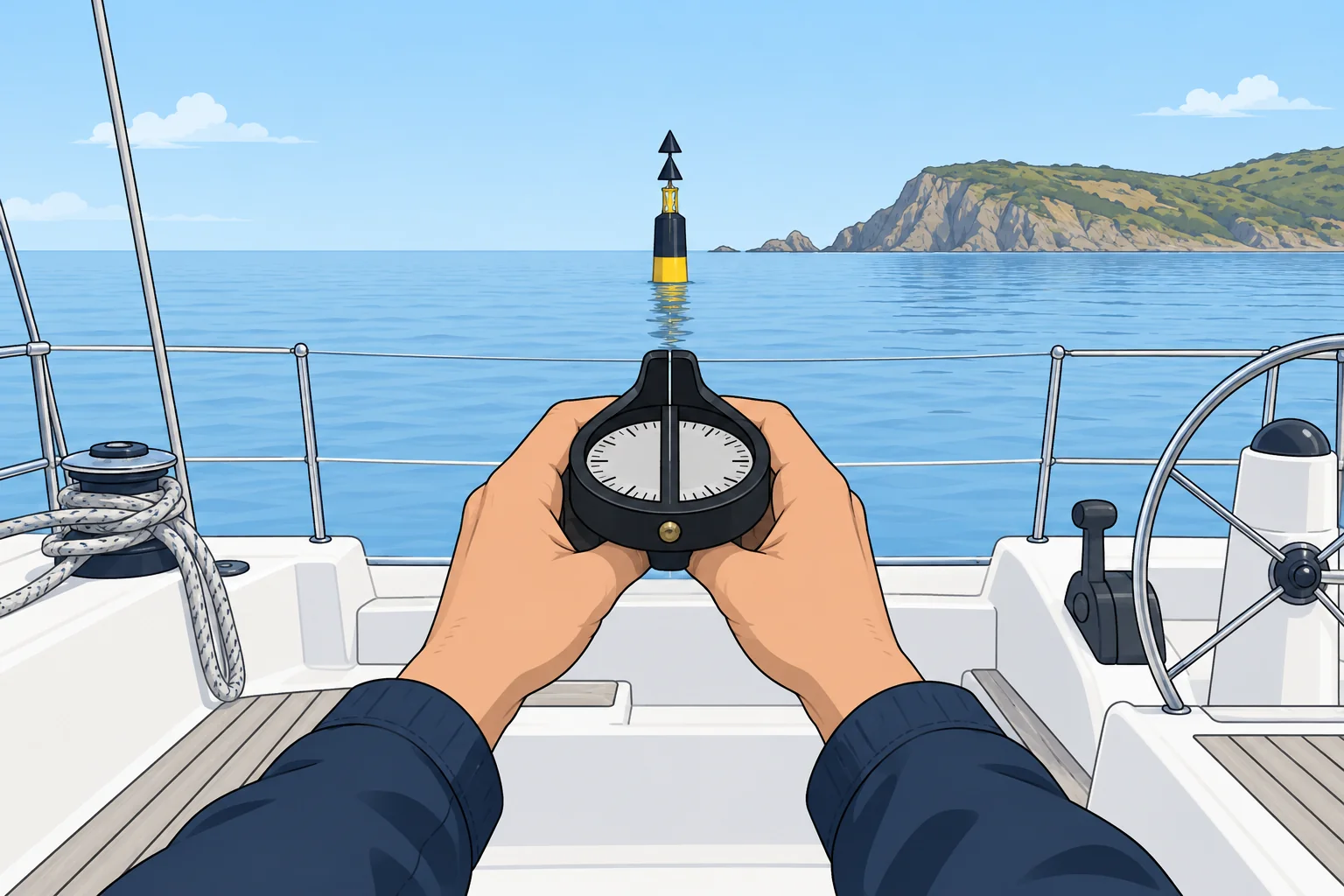
Taking a bearing with a hand-bearing compass
1The lesson in plain words
A bearing is the direction from you to an object. Take it clear of metal, write it down with the time, and use repeated bearings to judge collision risk.
What a bearing is
A bearing is the direction from you to an object, measured clockwise from north, from 000° to 359°. It needs a reference. Nearby magnetic material can cause deviation, an error in the compass reading. With negligible deviation, record hand-bearings as magnetic bearings, such as 125°M. For chart plotting, the bearing must first be expressed relative to true north. A line through the charted object then gives a position line: you are somewhere along it.
Taking it
Stand where you can see the object and are clear of steel, electrics and electronics: the engine, loudspeakers, winch handles and your phone all deflect a compass. Hold the hand-bearing compass at eye level, sight the object, let the card settle and read the figure. Read it twice and write it down at once with the time.
Choose good objects
Use objects that are charted and easy to identify: a tower, a headland edge, a beacon. Buoys can be out of position, so prefer fixed marks. Closer objects give better lines. Here M means nautical miles, and a cable is 0.1 M. A 1° error shifts the line about 1 cable at 6 M, or 2 cables at 12 M. Position fixing covers crossing bearings.
Bearings and collisions
Bearings also warn of danger. Take repeated compass bearings of an approaching vessel. If the bearing does not change appreciably and the distance is closing, risk of collision exists (COLREG Rule 7). Risk can still exist with a changing bearing, especially with a very large vessel, a tow, or at close range. The COLREG module says what to do.
Write it down
Record the object, the bearing and the time, for example "Church tower 052°M 14:20". Do not round to the nearest 5°.
2Key data
- Magnetic bearing
- Written with M: 125°M
- 1° error at 6 M
- Position line about 1 cable out
- Collision check (Rule 7)
- Steady bearing + closing range = risk of collision
- Record
- Object, bearing, time
3Key points
- 1
Bearings measured from magnetic north use M, for example 125°M.
- 2
Take it clear of metal and electronics, read twice, write it with the time.
- 3
Prefer close, fixed, charted objects: 1° error ≈ 1 cable at 6 M.
- 4
Steady bearing and closing range = risk of collision (COLREG Rule 7).
4Frequent mistakes
Wrong: Take the bearing beside the engine box, where you can brace yourself.
Right: The engine and nearby electronics deflect the compass. Move to a clear spot, even if it is less comfortable.
Wrong: A bearing that changes a little means no risk of collision.
Right: With a big ship, a tow or at close range, risk can exist even while the bearing changes.
5Practice case & exam keys
Crossing a busy channel, you see a ship just to the left of your bow. Your hand-bearing compass reads 300°M at 10:05 and 300°M again at 10:08, and she looks bigger. What does this tell you?
Show the answer
The compass bearing is steady and the ship appears to be getting closer, so risk of collision exists. Record the bearings and times. A changing bearing would not automatically rule out risk, especially at close range. Collision-avoidance action belongs in the COLREG module.
Exam keys
- A bearing is the direction to an object; °M means magnetic. Here we assume nearby magnetic objects cause no significant error.
- Take bearings clear of metal and electronics; record object, bearing, time.
- Close, fixed, charted objects give the best position lines.
- Compass bearing not appreciably changing and range closing: risk of collision (Rule 7).
Finish this unit
When you've read it, match the terms, then answer three questions. Get them all right to finish the unit; opening the page alone doesn't count.
My notes for this unit
No notes