

True north, magnetic north and the compass safe distance
1The lesson in plain words
Charts use true north. Variation is the angle to magnetic north. Nearby magnetic items cause deviation: an error in your compass reading. Keep them away.
Two norths
True north is the direction of the geographic North Pole; chart meridians, the north–south lines, point to it. Magnetic north follows the Earth's magnetic field, which is not lined up with true north. Chart directions use true north (°T). Magnetic directions use magnetic north (°M). A raw compass reading uses °C. It equals the magnetic direction (°M) only when deviation is negligible. Allowing for deviation gives a magnetic direction.
Variation
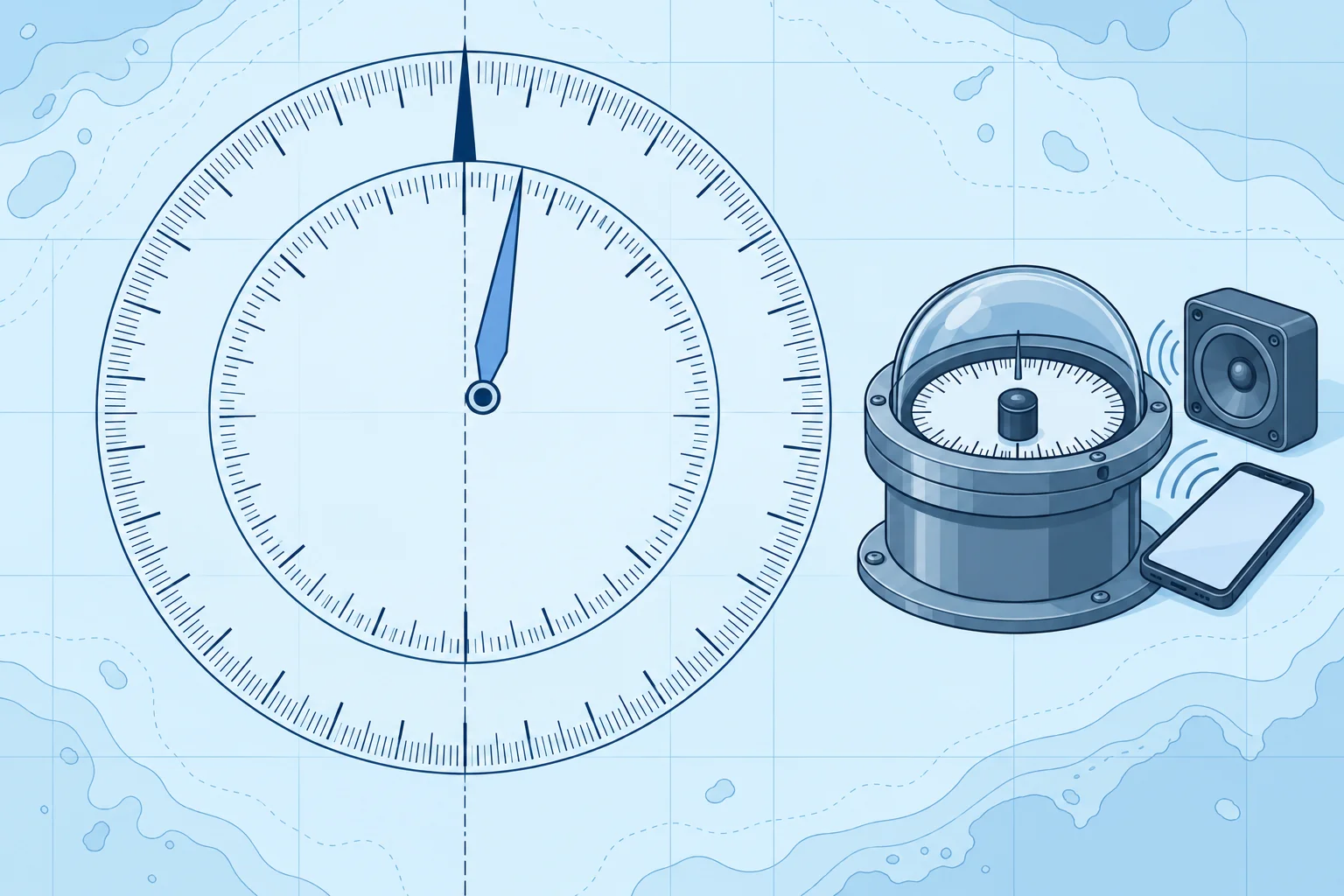
The angle between true and magnetic north at a place is variation (also called declination), named east or west. It changes from place to place and slowly year by year. The chart's compass rose shows it: an outer true ring, an inner magnetic ring and a note such as "2°30′W 2015 (8′E)": 2°30′ west in 2015, changing 8′ eastward each year, so the west variation shrinks.
Deviation
Your boat adds its own error, deviation, caused by iron, steel and electrical equipment near the compass. It differs on each heading. A compass adjuster can reduce it and record what is left on a deviation card. Converting courses between true, magnetic and compass is taught in the unit Compass course, variation and deviation.
Compass safe distance
A manufacturer may specify a compass safe distance on equipment or in its instructions: the minimum gap from a compass. Respect it when fitting gear. If no distance is given, keep the item well away and ask the maker before fitting it near a compass. Keep phones, handheld radios, magnetic tools and power cables away too.
Small figures, big errors
Distance here is in nautical miles (M). An unnoticed 5° error puts you about 1 M off track after 12 M. Always know which north a figure uses.
2Key data
- Chart directions
- True (°T), from the meridians
- Compass reading
- Raw reading: °C; corrected for deviation: °M
- Variation
- True vs magnetic north; changes with place and year
- Deviation
- The boat's own error; changes with heading
- 5° error over 12 M
- About 1 M off track
3Key points
- 1
Charts use true (°T). A raw reading is compass (°C); correcting for deviation gives magnetic (°M).
- 2
Variation: true vs magnetic north; it changes with place and year (see the compass rose).
- 3
Deviation: the boat's own error; it changes with heading.
- 4
Keep magnetic items well away and respect any maker's compass safe distance.
- 5
A 5° error puts you about 1 M off track after 12 M.
4Frequent mistakes
Wrong: Variation and deviation are the same thing.
Right: Variation comes from the Earth and depends on place and year. Deviation comes from the boat and depends on heading.
Wrong: The variation printed on an old chart is still right today.
Right: Use the year and annual change on the rose to bring it up to date.
Wrong: A phone on the cockpit seat by the compass is harmless.
Right: Phones, speakers and tools can deflect the compass several degrees. Keep them well away and respect any maker's compass safe distance.
5Practice case & exam keys
After a refit, the steering compass reading changes by 8° when a new portable speaker is placed beside it, although the boat has not turned. What should you suspect and do?
Show the answer
Suspect deviation from the speaker's magnet. Move it well away; respect any maker's compass safe distance. Recheck the compass against a known direction. If the error remains or fixed equipment has changed, have a qualified adjuster check it and its deviation card.
Exam keys
- True (°T) uses true north; magnetic (°M) uses magnetic north. Compass readings (°C) may include deviation.
- Variation: from the compass rose, updated for the year; named E or W.
- Deviation: caused by the boat, changes with heading, recorded on a deviation card.
- Compass safe distance: the minimum gap between equipment and a compass.
Finish this unit
When you've read it, match the terms, then answer three questions. Get them all right to finish the unit; opening the page alone doesn't count.
My notes for this unit
No notes