

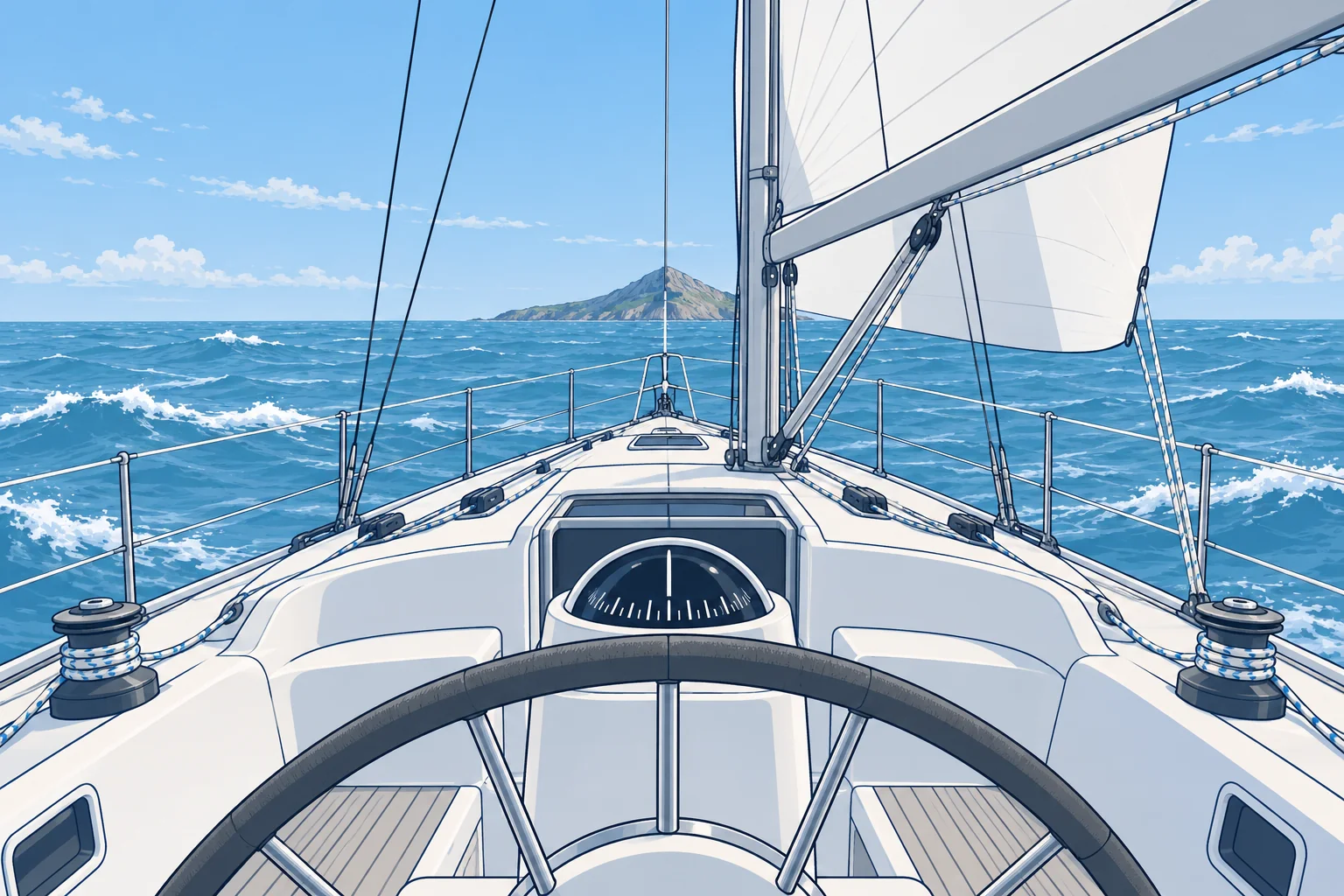
Steering a compass course
1The lesson in plain words
Turn until the course is on the lubber line, then hold a steady average. Figures wrap at north. Steer by a mark ahead and do not chase the card.
Getting on course
To steer a compass course, turn until the course figure sits against the lubber line, then hold it there. Headings increase clockwise as you turn to starboard (right), wrapping from 359° to 000° at north. Turning to port (left) reverses this. From 090° to 100°, turn 10° to starboard. From 350° to 010°, the shortest turn is 20° to starboard.
Don't chase the card
The card lags and swings in waves. If you steer to every flicker you zigzag and tire yourself. Make small, early corrections and watch the average heading over several seconds. In a seaway the card will swing either side of the course; your job is a steady mean heading.
Use a mark ahead
Once you are on course, pick something ahead that lines up with the bow: a distant headland, a cloud, a star at night. Steer by it and glance at the compass now and then. Clouds and stars move, so check the compass and choose a new mark often.
Under sail
When sailing as close to the wind as the boat can, the wind sets the best heading you can make. Steer by the sails and the wind. Note your actual average compass heading and tell the navigator, who needs it to plot your position. Say so at once if you cannot hold the course you were given.
Saying it clearly
Give courses digit by digit with their reference: "steer two-seven-zero compass". The helm, the person steering, repeats it back. Record each course change, the time and the log reading (distance travelled through the water).
2Key data
- Turn to starboard
- Heading increases, wrapping from 359° to 000° at north
- Turn to port
- Heading decreases, wrapping from 000° to 359° at north
- Spoken course
- Digit by digit: "two-seven-zero compass"
- In a seaway
- Hold a steady mean heading, not every swing
3Key points
- 1
Headings increase to starboard and decrease to port, wrapping at north between 359° and 000°.
- 2
Do not chase the card: small corrections, a steady mean heading.
- 3
Steer by a mark ahead and check the compass often.
- 4
Give courses digit by digit with the reference, "two-seven-zero compass", and have the helm repeat them.
4Frequent mistakes
Wrong: Follow the card in the direction you want to go.
Right: Headings increase to starboard and decrease to port, wrapping at north between 359° and 000°. Steer by the heading figure.
Wrong: Correct hard every time the card swings.
Right: The card lags. Hard corrections make a zigzag. Steer gently to an average heading.
Wrong: When you cannot hold the course, just do your best quietly.
Right: Tell the navigator the heading you are actually making. A wrong heading in the log gives a wrong position.
5Practice case & exam keys
You take the helm at night: "steer two-one-five compass". The card swings 8° either side in the waves and you keep overcorrecting. What do you do?
Show the answer
Repeat “steer two-one-five compass” back. Ease your corrections: steer small and early, watching the average heading over several seconds rather than each swing. Find a star close to the bow on 215° and steer by it, checking the compass often and picking a new star as it moves. Tell the navigator the mean heading you are holding.
Exam keys
- Headings increase to starboard and decrease to port, wrapping at north between 359° and 000°.
- Steer a steady mean heading; do not chase every swing of the card.
- Use a mark ahead and check the compass often.
- Courses are spoken digit by digit and repeated back.
Finish this unit
When you've read it, match the terms, then answer three questions. Get them all right to finish the unit; opening the page alone doesn't count.
My notes for this unit
No notes