

The magnetic compass: how it works and its types
1The lesson in plain words
A magnetic compass card lines up with the Earth's magnetic field while the boat turns around it. The figure on the lubber line is your heading.
How it works
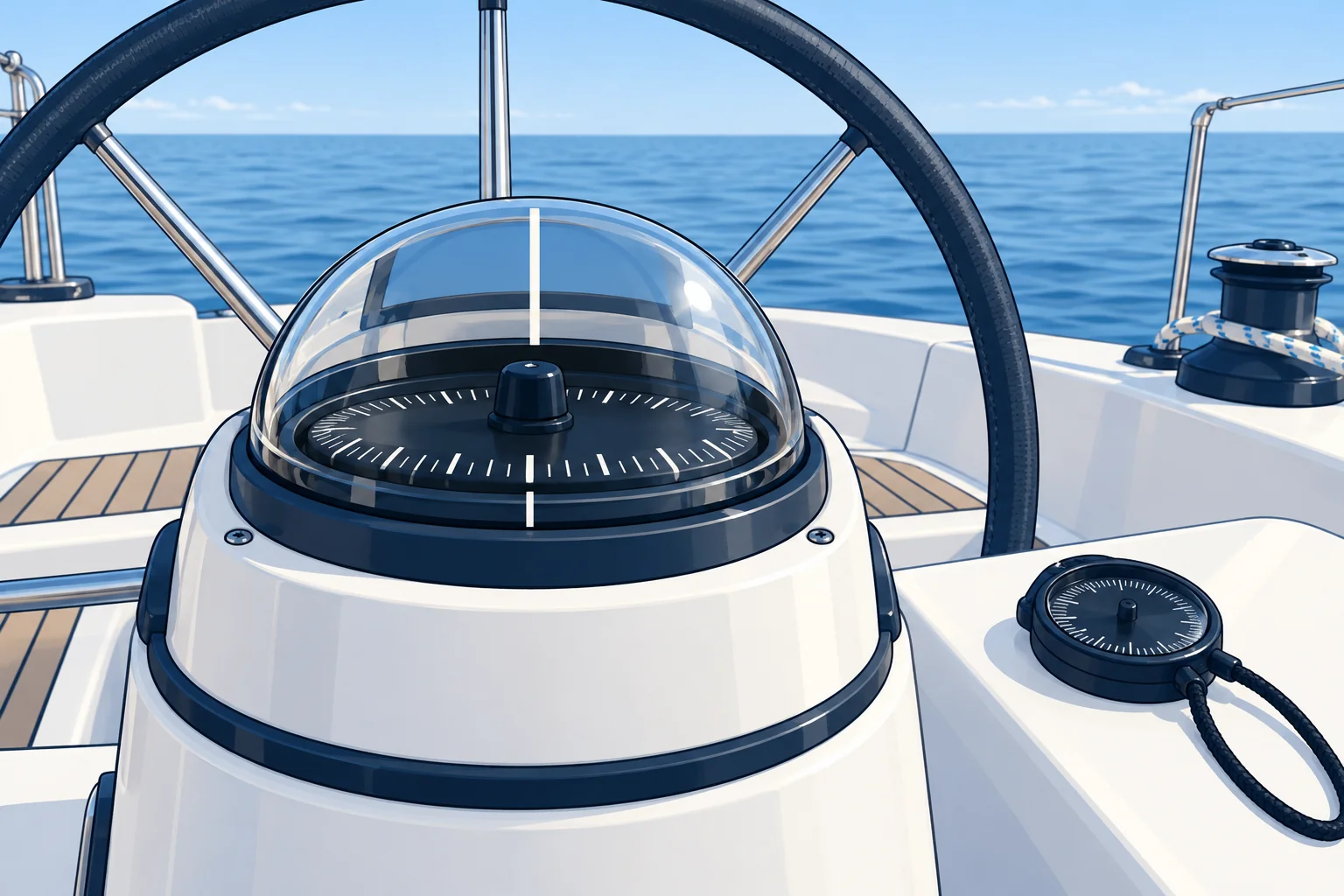
A magnetic compass has magnets fixed under a round card marked in degrees clockwise from north. The magnets line up with the Earth's magnetic field, so the card keeps pointing north while the boat turns around it. Liquid supports the pivoted card and slows its swinging in waves. A gimbal, a set of pivoting rings, lets the bowl stay level as the boat rolls and heels.
The lubber line
The lubber line is a fixed mark in the compass bowl, lined up with the boat's fore-and-aft centre line. The card figure against it is your heading: the direction the bow is pointing. The compass must be mounted with the lubber line exactly parallel to the centre line, or every heading you read will be wrong.
Types on board
The steering compass is fixed where the person steering can see it, in a binnacle (compass housing) at the wheel or on a bulkhead (cabin wall). A hand-bearing compass is a small portable magnetic compass for taking bearings of objects. A fluxgate compass is electronic: a sensor measures the magnetic field and sends the heading to other instruments. It needs power and calibration, so keep the magnetic compass as your backup.
Look after it
A large or persistent bubble needs inspection; it may indicate lost liquid. Keep the cover on when the compass is not in use, especially in strong sun. Check the compass light before a night passage. For a check, line up two charted fixed objects: this is a transit. When safe, point the bow along that line. Compare your compass heading with the transit's compass direction supplied by your navigator.
2Key data
- Card
- Degrees clockwise from north, 000°–359°
- Heading
- Card figure against the lubber line
- Cardinal points
- 000° N, 090° E, 180° S, 270° W
- Writing it
- Three digits plus reference: 045°C (compass)
3Key points
- 1
The card holds magnetic north; the boat and the lubber line turn around it.
- 2
Heading = the card figure against the lubber line.
- 3
Steering compass, hand-bearing compass and electronic fluxgate compass.
- 4
A fluxgate needs power: keep the magnetic compass as the backup.
4Frequent mistakes
Wrong: The card turns when the boat turns.
Right: The card stays lined up with magnetic north. The boat and the lubber line turn around it.
Wrong: An electronic fluxgate makes the magnetic compass unnecessary.
Right: A fluxgate needs power and calibration. The magnetic compass works when everything electric has failed.
5Practice case & exam keys
On a night passage a battery fault blanks the plotter and the autopilot, and the fluxgate heading is lost. How do you keep navigating?
Show the answer
Hand-steer by the magnetic steering compass: it needs no electrical power. Use its light if power remains, or a dim torch kept clear of the compass. Read the card against the lubber line and hold the ordered compass heading.
Exam keys
- Heading: the card figure against the lubber line.
- The card stays aligned with magnetic north as the boat turns.
- Fluxgate: electronic heading sensor, needs power and calibration.
- A large or persistent bubble needs inspection; it may indicate lost liquid.
Finish this unit
When you've read it, match the terms, then answer three questions. Get them all right to finish the unit; opening the page alone doesn't count.
My notes for this unit
No notes