

How accurate is an estimated position?
1The lesson in plain words
Every input to an EP is an estimate, and the errors add up with time. Calibrate the log, keep runs short and fix as soon as you can.
Errors add up
An EP rests on estimates: how well the helm held the heading, the leeway angle, the accuracy of the log, and a predicted tidal stream. Each error grows with time and distance. The 1 in 60 rule gives a feel for it: a 1° direction error puts you about 1 M off for every 60 M you run, so a 5° error over 12 M puts you about 1 M off.
The log
A log measures speed through the water with a small paddlewheel or an ultrasonic sensor. Weed, fouling and poor calibration make it read high or low. Calibrate it: run a known distance between charted marks both ways (reciprocal runs) near slack water, when the tidal stream is negligible, keeping your speed steady. Compare the readings. If it shows 2.2 M over a true 2.0 M, multiply future readings by 2.0 ÷ 2.2 ≈ 0.91. Spanish courses call this factor the coeficiente de corredera.
The stream
Stream predictions describe the expected tidal flow. Wind, air pressure and local eddies change the real stream, especially off headlands and in channels, and the stream close inshore can differ from the diamond further out. EP uncertainty grows when the actual stream differs from your estimate, especially over a long run.
Showing the doubt
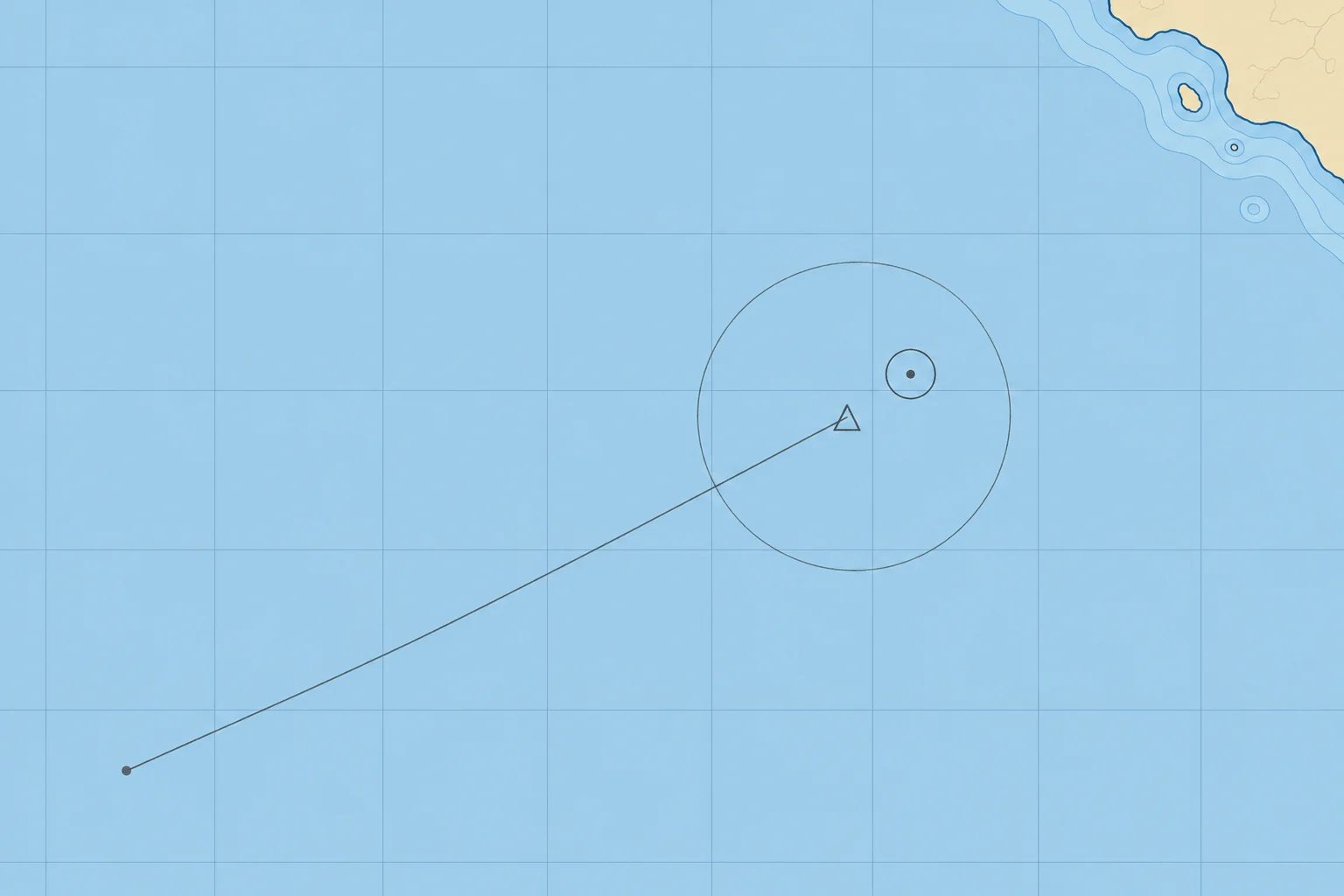
Treat an EP as the centre of an area, not a point, and that area grows the longer you run without a fix. Many navigators sketch a rough circle of uncertainty around it. Keep further from danger than that circle.
Fix soon
A good fix resets the errors. Fix as soon as you can and compare the fix with your EP for the same time: the gap shows the combined error of your estimates. A repeated offset suggests a systematic error in heading, log distance, leeway, stream or fixing; check each input.
2Key data
- 1 in 60 rule
- 1° error ≈ 1 M off track per 60 M run
- Example
- 5° error over 12 M ≈ 1 M off
- Log factor
- True distance ÷ log distance over a known run
- Calibrate
- Known distance, both ways, at slack water
3Key points
- 1
EP errors grow with time and distance: treat an EP as an area, not a point.
- 2
1 in 60 rule: a 1° error puts you about 1 M off for every 60 M run.
- 3
Calibrate the log over a known distance, both ways, at slack water.
- 4
Fix as soon as you can and compare the fix with the EP.
4Frequent mistakes
Wrong: A carefully plotted EP is as good as a fix.
Right: Its inputs are estimates. Keep a margin from danger and fix as soon as you can.
Wrong: Calibrate the log by running in one direction only.
Right: Run both ways near slack water, with negligible stream. Compare the readings and repeat if they disagree.
5Practice case & exam keys
Your EP lies 0.4 M from a shoal. You estimate position uncertainty at 0.6 M, and no good fix is available. Does the plotted point confirm safe clearance?
Show the answer
No. Your estimated area of uncertainty reaches the shoal, so the EP point does not establish clearance. Keep a larger margin from danger and obtain a reliable fix as soon as possible. Compare that fix with the EP before relying on the next estimate.
Exam keys
- EP accuracy falls with time and distance since the last fix.
- 1 in 60 rule: a 1° error ≈ 1 M off per 60 M run.
- Log factor = true distance ÷ log distance; calibrate both ways at slack water.
- Fix as soon as possible; the gap from the EP shows the error.
Finish this unit
When you've read it, match the terms, then answer three questions. Get them all right to finish the unit; opening the page alone doesn't count.
My notes for this unit
No notes