

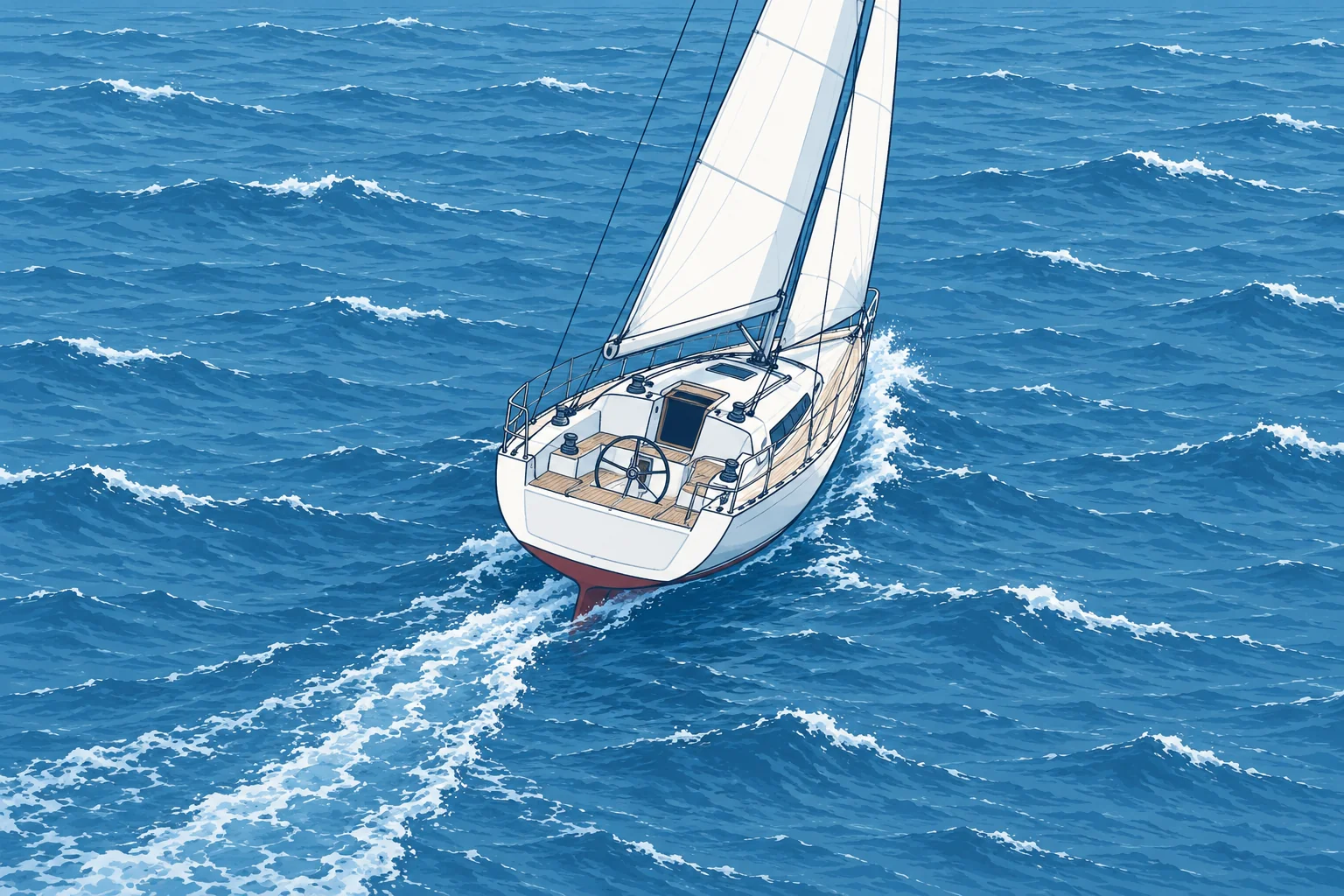
Leeway: from heading to water track
1The lesson in plain words
Wind pushes the boat sideways, so it moves through the water at an angle to its heading. That angle is leeway; the boat's path is the water track.
What leeway is
Wind on the sails, hull and superstructure pushes a boat to leeward (downwind) as it moves ahead. The angle between the heading and the boat's actual path through the water is leeway. That path is the water track. Leeway comes from the wind only; the tidal stream is dealt with separately.
How much
Leeway depends on the boat, its angle to the wind and the wind strength. A deep-keeled yacht close-hauled (sailing as near the wind as you can) in a moderate breeze may make about 5°. A boat with little depth below the water, a motorboat with high sides above the water, or any boat in a strong wind may make 10° or more. Running downwind there is almost none. Leeway also grows as the boat slows.
Estimating it
Hold a steady, straight course and inspect the wake behind the boat. Estimate its angle to the boat's centreline. For a compass check, take a hand-bearing compass bearing along the straight, recent wake and reverse it by 180°. Compare that direction with your heading, using the same north reference for both. Allow for compass errors as taught in Compass course. Repeat in steady conditions and record estimates for your boat in different conditions.
Applying it
Leeway always moves the track downwind of the heading; a small wind arrow drawn on the chart shows which way. Port is left and starboard is right when you face the bow. Wind on the port side pushes you to starboard: add the leeway to the heading. Wind on the starboard side pushes you to port: subtract it. Heading 100°T, wind from the north on the port side, 5° leeway: water track 105°T.
Arrows and words
RYA-style plots mark the water track with one arrowhead, the ground track with two and the tidal stream with three. Spanish courses call leeway abatimiento and the water track rumbo de superficie.
2Key data
- Wind on port side
- Water track = heading + leeway
- Wind on starboard side
- Water track = heading − leeway
- Typical close-hauled
- About 5°; 10° or more in a strong wind
- RYA arrowheads
- Water track one, ground track two, stream three
- Spanish terms
- Abatimiento (leeway), rumbo de superficie (water track)
3Key points
- 1
Leeway is the angle between heading and water track, caused by the wind.
- 2
It always moves the track downwind: draw a wind arrow to check.
- 3
Wind on the port side: add leeway. On the starboard side: subtract it.
- 4
Estimate leeway from the angle of the wake.
4Frequent mistakes
Wrong: Leeway includes the effect of the tidal stream.
Right: Leeway is wind only. The stream is added as a separate line.
Wrong: Add leeway whichever side the wind is on.
Right: Wind on the port side: add. Wind on the starboard side: subtract. The track always moves downwind.
5Practice case & exam keys
Heading 040°T with wind on the starboard side, you estimate 8° leeway from the wake. A crewmate plots 048°T. Do you accept it?
Show the answer
No. The wind pushes you to port, so the water track must lie downwind of the heading. Subtract: 040 − 8 = 032°T. The proposed 048°T puts the track towards the wind. Plot 032°T with one arrowhead and lay the log distance along it.
Exam keys
- Leeway: the angle between heading and water track, caused by wind.
- Wind on the port side: add; on the starboard side: subtract.
- Water track: one arrowhead.
- Estimate leeway from the wake on a steady course; check that the water track lies downwind.
Finish this unit
When you've read it, match the terms, then answer three questions. Get them all right to finish the unit; opening the page alone doesn't count.
My notes for this unit
No notes