

Jamming, spoofing and keeping a backup
1The lesson in plain words
GNSS can be jammed or spoofed. Know the signs, check by other means and log at least hourly, more often near hazards. Carry paper charts.
Jamming and spoofing
Jamming drowns the weak satellite signals in radio noise: the receiver loses its fix, shows an alarm or freezes. Spoofing sends fake signals: the receiver shows a wrong position that can look normal, drift slowly or jump miles, sometimes onto land. Both have become common since 2022.
Where it happens
In 2024 and 2025 interference was reported almost daily in parts of the Baltic Sea, the Black Sea, the eastern Mediterranean off Israel, Lebanon and Cyprus, the Red Sea and the Persian Gulf. On AIS, ships have appeared at airports and far inland. Read the navigational warnings for your area before you go.
Signs
Suspect interference when the position jumps, or drifts away from where the depth and the view say you are; when SOG shows a speed you are not doing; when the time or date is wrong; when an alarm reports position lost; or when AIS shows other ships on land or in circles. The same false signals can fool several receivers; agreement alone does not rule out spoofing.
First actions
Stop trusting the screen. Check your position by eye, by depth, by compass bearings and by radar if you have it. Work on from your last trusted logged position using heading, log speed and time (dead reckoning, in the Dead reckoning and estimated position unit). Slow down near hazards and report the interference to the coastguard. A DSC alert may carry a false GNSS position; give your best position by voice in a distress call.
Keep a backup
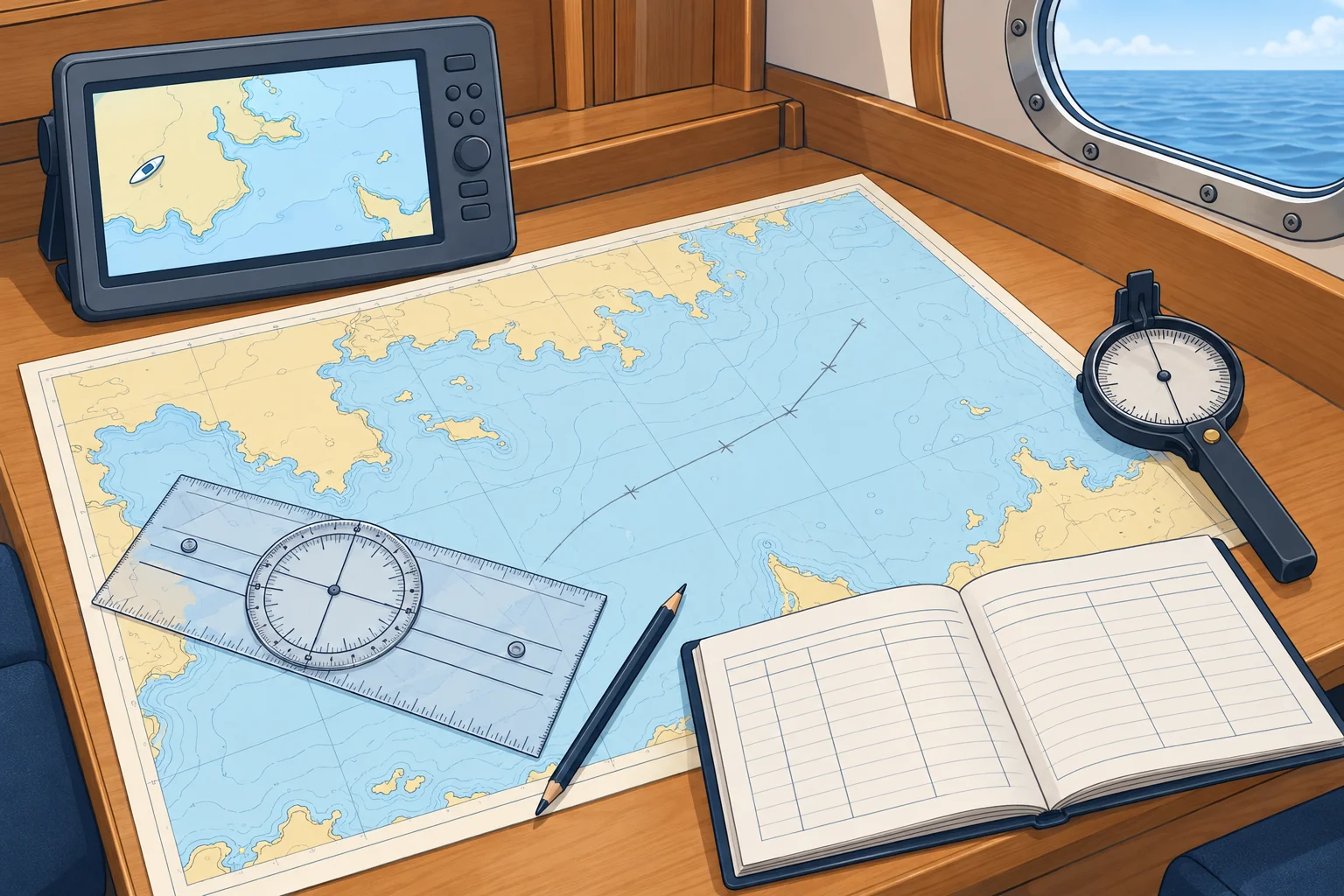
Write a log entry at least hourly and at each course change; log more often near hazards. Record time, a checked position, log reading, heading, COG, SOG and depth. Carry paper charts, pencils, a plotting tool and a hand-bearing compass (a handheld compass for taking bearings), and practise using them. These backups help you keep navigating if GNSS fails. Electronic navigation covers further checks.
2Key data
- Jamming
- Noise: no fix, an alarm or a frozen position
- Spoofing
- Fake signals: a wrong position that may look normal
- Log entries
- At least hourly and at course changes; more often near hazards
- Cross-checks
- Eyes, depth, compass bearings, radar
3Key points
- 1
Jamming = noise, no fix. Spoofing = fake signals, a wrong position that may look right.
- 2
Known hot spots: Baltic, Black Sea, eastern Mediterranean, Red Sea, Persian Gulf.
- 3
Several receivers may follow the same false signals; agreement does not rule out spoofing.
- 4
Log at least hourly and at course changes, more often near hazards; check positions independently and carry paper charts.
4Frequent mistakes
Wrong: Two receivers that agree must be right.
Right: The same spoofing attack can fool several receivers. Agreement does not rule it out; check against independent observations.
Wrong: When GNSS fails, wait for it to come back.
Right: Work on from your last trusted logged position, independently checked, rather than replacing it with a later suspect fix.
Wrong: A DSC alert always sends the right position.
Right: An alert may carry a false GNSS position. If GNSS is suspect, give your best position by voice.
5Practice case & exam keys
At night in the eastern Mediterranean, 8 M off the coast, the plotter suddenly puts you 3 M inland, then back at sea 1 M north of your last position. The depth reads 60 m. What do you do?
Show the answer
Suspect spoofing and treat GNSS positions as unreliable. Plot on from your last trusted logged position using heading, log distance and time. Check that the depth fits the chart along that track, take bearings of lights you can identify and use radar if fitted. Keep well offshore, log the event and report it to the coastguard.
Exam keys
- Jamming blocks the signals; spoofing fakes them.
- Signs: jumps, impossible SOG, wrong time, AIS targets on land.
- Cross-check with depth, bearings or radar; work on by dead reckoning from the last trusted logged position.
- Log at least hourly and at course changes, more often near hazards; check positions and carry paper charts.
Finish this unit
When you've read it, match the terms, then answer three questions. Get them all right to finish the unit; opening the page alone doesn't count.
My notes for this unit
No notes