

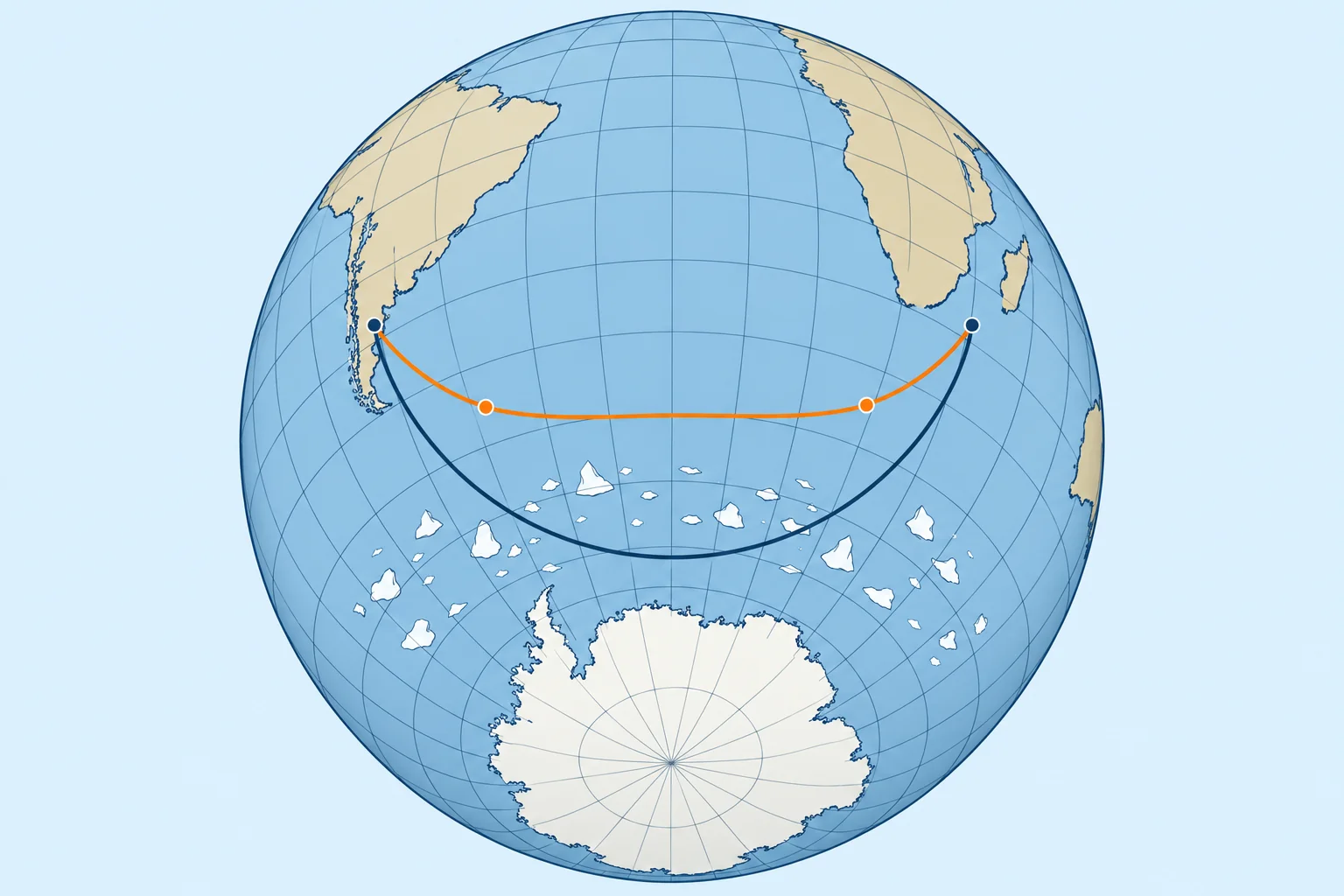
The composite great circle: a limiting latitude
1The lesson in plain words
When the great circle goes too far towards the pole, set a limiting latitude. Sail a great circle to it, along it, and a great circle away from it.
Why
A great circle in high latitudes may run into ice, icebergs or the worst gales. Then you choose a limiting latitude, a parallel you will not cross. The composite great circle is the shortest route that respects it: a great circle from the start with its vertex on the limit, along the limit, and a great circle from the limit to the destination.
The formulas
Let L be the port latitude and Llim the limiting latitude. For each great-circle leg, cos Δλ = tan L ÷ tan Llim and cos d = sin L ÷ sin Llim. Here Δλ is longitude difference to the vertex and d is angular distance. Use degree mode; d × 60 gives nautical miles. For the parallel leg, longitude difference in degrees × 60 × cos Llim gives nautical miles.
Worked: the problem
From south of Cape Agulhas, 35°00′S 020°00′E, to south-east Tasmania, 43°40′S 146°50′E. The great circle is 5,259.7 M, but its vertex is at 61°40′S, deep in iceberg waters. You set a limit of 47°S.
Worked: the answer
Leg 1: d.long 49°14′, 2,300.8 M, to 47°S at 069°14′E. Along 47°S to 119°43′E: 50°29′ × 60 × cos 47° = 2,065.8 M. Leg 2: d.long 27°07′, 1,155.0 M. Total 5,521.6 M: 262 M more than the great circle, 374 M less than the rhumb line.
Choosing the limit
The limit comes from ice charts and ice limits for the season, the weather, the boat and crew, and any race rules (Meteorology: global winds and sea ice). Check the latest ice information before departure and during the passage.
2Key data
- Composite
- Great circle to the limit, along it, great circle from it
- Leg to limit
- cos Δλ = tan L ÷ tan Llim; cos d = sin L ÷ sin Llim; d° × 60 = M
- Parallel leg
- 60 × d.long (degrees) × cos Llim = nautical miles
- Worked limit
- Agulhas → Tasmania, limit 47°S; great-circle vertex 61°40′S
- Worked distances
- 2,300.8 + 2,065.8 + 1,155.0 = 5,521.6 M
- Comparison
- Great circle 5,259.7 M; composite 5,521.6 M; rhumb 5,895.9 M
3Key points
- 1
A limiting latitude caps poleward travel; choose it using current ice and weather information.
- 2
The composite route: great circle to the limit, along it, great circle away.
- 3
Each great-circle leg has its vertex on the limit: cos d.long = tan L ÷ tan Llim.
- 4
Worked: 5,521.6 M against 5,259.7 M direct and 5,895.9 M by rhumb line.
4Frequent mistakes
Wrong: Sail the great circle and simply turn back north when you reach the limit.
Right: That is longer. The composite route meets the limit along great circles whose vertices lie on it.
Wrong: Measure the parallel leg as d.long in minutes.
Right: Along a parallel, distance = d.long in degrees × 60 × cos Llim: here (50 + 29/60) × 60 × cos 47° ≈ 2,066 M.
5Practice case & exam keys
Cape Agulhas to Tasmania. The great circle reaches 61°40′S. A crew member suggests the rhumb line instead, to stay north. With a limit of 47°S, what do you recommend and why?
Show the answer
The composite great circle. It keeps you north of 47°S, as the rhumb line does, but saves about 374 M: 5,521.6 M against 5,895.9 M. It costs 262 M over the direct great circle, which is the cost of respecting the chosen latitude limit. Confirm the limit against the latest ice information.
Exam keys
- Composite great circle: great circle to the limiting latitude, along it, great circle away.
- cos Δλ = tan L ÷ tan Llim; cos d = sin L ÷ sin Llim; d° × 60 = M; parallel M = 60 × d.long (degrees) × cos Llim.
- Choose and review the limit using current ice information.
- Worked: limit 47°S, total 5,521.6 M (great circle 5,259.7 M, rhumb 5,895.9 M).
Finish this unit
When you've read it, match the terms, then answer three questions. Get them all right to finish the unit; opening the page alone doesn't count.
My notes for this unit
No notes