

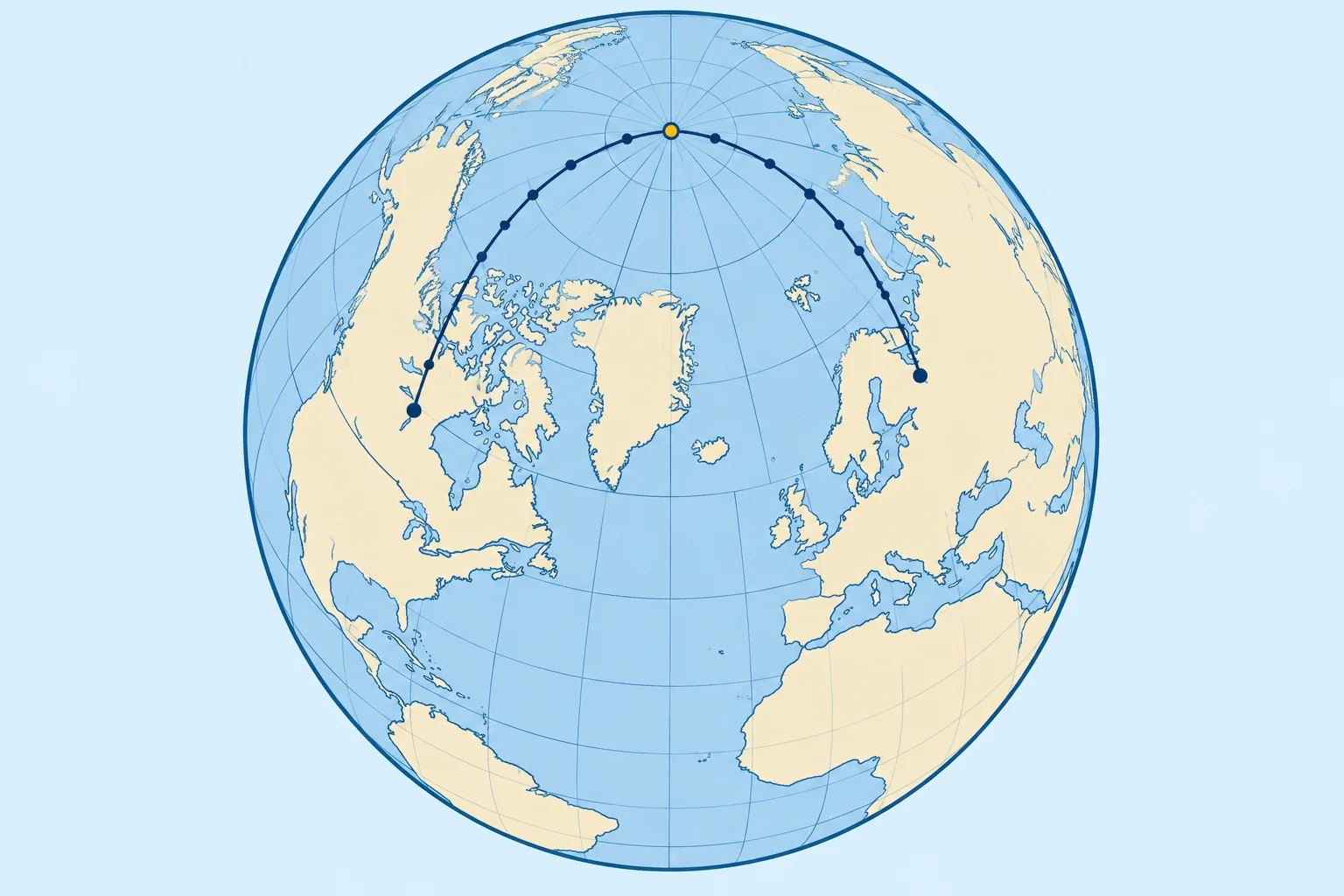
The vertex and waypoints along the track
1The lesson in plain words
A vertex marks a great circle’s poleward extreme. It may lie outside your sailed arc. Use it to calculate waypoint latitudes.
The vertex
On a non-meridional great circle other than the equator, a vertex is a point of greatest north or south latitude, where the track is due east or west. The two vertices are opposite. A vertex may lie outside your sailed arc. Only a vertex on that arc gives its greatest poleward latitude; otherwise use the endpoints. Meridional great circles pass through the poles, where true course is undefined.
Finding it
Use the vertex in your departure hemisphere. With initial angle C (0°–180°) measured from north, cos Lv = cos L1 × sin C gives its latitude magnitude. sin d.long v = |cos C| ÷ sin Lv gives a separation of 0°–90°. The vertex is ahead when you head poleward, behind when you head equatorward. North: C < 90° is poleward. South: C > 90° is poleward. At C = 90° you are at the vertex. Use a negative Lv for a southern vertex in the waypoint formula.
Worked: the vertex
Las Palmas to Rodney Bay: using the unrounded initial angle, Lv = 29°19.8′N. d.long = 17°56′. From this northern start, C is over 90°, so the northern vertex lies 17°56′ east of Las Palmas, at 002°31′E, behind the start. All the way to Saint Lucia, the latitude falls.
Waypoints
Measure longitude from the vertex: tan L = tan Lv × cos (d.long from the vertex). For this Atlantic crossing: 030°W, 25°21.1′N; 045°W, 20°46.8′N; 060°W, 14°32.2′N. Choose waypoints every 5° or 10° of longitude, and steer the rhumb line between each pair.
Course along the track
sin (course angle) = cos Lv ÷ cos L; choose the quadrant from the track direction. On this westbound, equatorward northern track, true course is 180° + arcsin(cos Lv ÷ cos L): 261.3°T at departure, 254.7°T at 030°W, 248.8°T at 045°W and 244.0°T on arrival. These are tangent courses: the direction at each point on the great circle. Calculate the rhumb-line course separately for each waypoint leg.
2Key data
- Vertex latitude
- cos Lv = cos L1 × sin C
- D.long to vertex
- sin d.long v = cos C ÷ sin Lv (magnitudes)
- Waypoint latitude
- tan L = tan Lv × cos (d.long from vertex)
- Worked vertex
- 29°19.8′N at 002°31′E, behind Las Palmas
- Worked waypoints
- 30°W 25°21.1′N; 45°W 20°46.8′N; 60°W 14°32.2′N
- Worked courses
- 261.3° start, 254.7° at 30°W, 248.8° at 45°W, 244.0° end
3Key points
- 1
Except on meridians or the equator, a vertex is a poleward extreme where the track is due east or west.
- 2
cos Lv = cos L1 × sin C; it may lie between your points or outside them.
- 3
Waypoints: tan L = tan Lv × cos (d.long from the vertex).
- 4
Steer rhumb lines between waypoints every 5° or 10° of longitude.
4Frequent mistakes
Wrong: The vertex always lies somewhere between the two ports.
Right: It can lie outside them. From Las Palmas, the vertex is behind the start, at 002°31′E.
Wrong: Measure d.long for the waypoint formula from the departure point.
Right: The formula tan L = tan Lv × cos (d.long) uses d.long measured from the vertex.
5Practice case & exam keys
A crew member says the Las Palmas to Rodney Bay great circle “goes up to 29°N in mid-ocean”. Is that right?
Show the answer
No. The vertex, 29°19.8′N, lies at 002°31′E, behind Las Palmas. The part you sail is entirely on the descending side: the latitude falls from 28°08′N to 14°05′N, passing 25°21′N at 030°W and 20°47′N at 045°W. The great circle runs north of the rhumb line, by up to about 1°48′ of latitude near 038°W, but never above your start latitude.
Exam keys
- Non-meridional great circle, except the equator: vertex at greatest N or S latitude; cos Lv = cos L1 sin C.
- sin d.long v = |cos C| ÷ sin Lv (latitude magnitude). Same-hemisphere vertex behind when equatorward: N, C > 90°; S, C < 90°. At C = 90° it is at departure.
- Waypoints: tan L = tan Lv cos (d.long from vertex).
- Worked: vertex 29°19.8′N 002°31′E; waypoints 25°21.1′N at 30°W, 20°46.8′N at 45°W.
Finish this unit
When you've read it, match the terms, then answer three questions. Get them all right to finish the unit; opening the page alone doesn't count.
My notes for this unit
No notes