

Offshore categories and the passage checklist
1The lesson in plain words
World Sailing's Offshore Special Regulations grade races from Category 0 to 4. They are a useful benchmark for preparing any offshore passage.
What the OSR are
World Sailing's Offshore Special Regulations (OSR) set minimum equipment and training for offshore races. The 2026–2027 edition took effect on 1 January 2026; check for later versions before using it. A race organiser chooses the category. They are rules for racing, but cruising sailors and schools use them as a benchmark.
Categories 0 to 2
Category 0: trans-ocean races, including cold areas (air or sea below 5 °C other than temporarily), where boats must be fully self-sufficient for very extended periods and ready for heavy storms and serious emergencies without outside help. Category 1: long races well offshore, with the same self-sufficiency for extended periods. Category 2: races of extended duration along or not far from shorelines, or in large unprotected bays or lakes, needing a high degree of self-sufficiency.
Categories 3 and 4
Category 3: races across open water, mostly relatively protected or close to shorelines. Category 4: short races close to shore, in relatively warm or protected waters, normally in daylight. Separate appendices cover inshore racing.
Examples of what changes
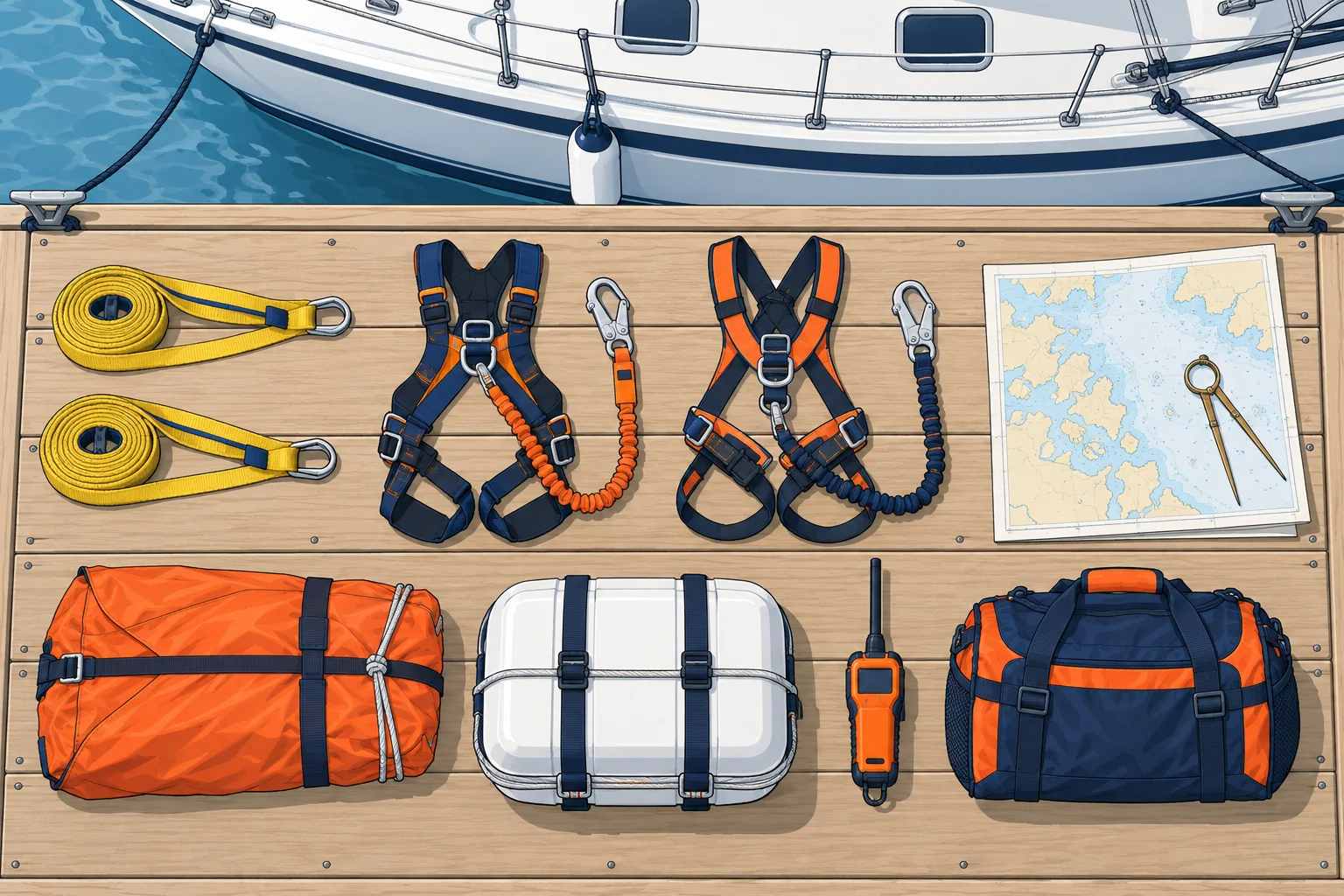
Requirements rise with the category. For Categories 0 to 3 the OSR require fixed jackstays and clipping points, a harness and tether for each crew member, and paper charts, not electronic only. Category 0 adds an active radar target enhancer. Storm sails differ by category; the Reefing and rigging unit lists them.
Your own checklist
Before an offshore passage, work through the boat, the crew, the plan and the communications. The procedure below adds the offshore points to the Passage planning unit's APEM plan and the Safety equipment unit's kit.
2Step by step
Offshore passage checklist (adds to the APEM plan)
- 1
Compare the boat and kit with the OSR category that matches the passage.
It gives an independent, tested standard for equipment and preparation.
- 2
Plan watches, standing orders and the skipper's rest from departure.
Fatigue grows over days; landfall needs a rested skipper.
- 3
Rig jackstays, check navigation lights, and prepare reefs and storm sails before dark.
Jobs that are easy in daylight are hard and risky at night.
- 4
Plan the landfall: aim-off side, clearing lines, lights and daylight timing.
Near land, a position error can put you close to danger.
- 5
Brief the crew on the man-overboard, fire, flooding and abandon-ship plans.
Offshore you must manage serious emergencies without quick outside help.
- 6
Leave the plan, crew list and expected arrival with a shore contact.
Someone knows when to raise the alarm if you are overdue.
3Key data
- OSR edition
- 2026–2027, effective 1 January 2026 (check for later versions)
- Categories
- 0 trans-ocean; 1 well offshore; 2 near shore, extended
- Lower categories
- 3 open water, fairly protected; 4 short, normally daylight
- Spanish licence distance limits
- Patrón de Yate: 150 NM from coast; Capitán: no distance limit
4Key points
- 1
OSR Categories 0–4 range from trans-ocean races to short coastal races normally held in daylight.
- 2
The OSR are racing rules but a good benchmark for cruising offshore.
- 3
Categories 0–3 require jackstays, harnesses and tethers, and paper charts.
- 4
Add watches, night preparation, landfall and a shore contact to the APEM plan.
5Frequent mistakes
Wrong: The OSR are law for every yacht going offshore.
Right: They apply to races that adopt them. For cruising they are a voluntary benchmark; your flag state sets the legal rules.
Wrong: Category 4 kit is enough for a 300 NM crossing.
Right: Category 4 is for short coastal races, normally in daylight. Match the category to the passage.
6Practice case & exam keys
A friend plans a 400 NM crossing well offshore with three days at sea, and says his boat is fine because it passed the safety check for a Category 4 club race. What do you suggest?
Show the answer
Category 4 is for short races close to shore, normally in daylight. A three-day passage well offshore is closer to Category 1 or 2, depending on how far from shore it runs. Compare the boat with that category's list: jackstays, harnesses and tethers, paper charts, liferaft, beacons, storm sails. Then add a watch plan, night preparation, a landfall plan and a shore contact.
Exam keys
- OSR 2026–2027: 0 trans-ocean; 4 short coastal races, normally daylight.
- Category 1: long distance, well offshore, fully self-sufficient.
- Category 3: open water, mostly relatively protected or close to shore.
- Offshore checklist adds watches, night, landfall and shore contact to APEM.
Finish this unit
When you've read it, match the terms, then answer three questions. Get them all right to finish the unit; opening the page alone doesn't count.
My notes for this unit
No notes