

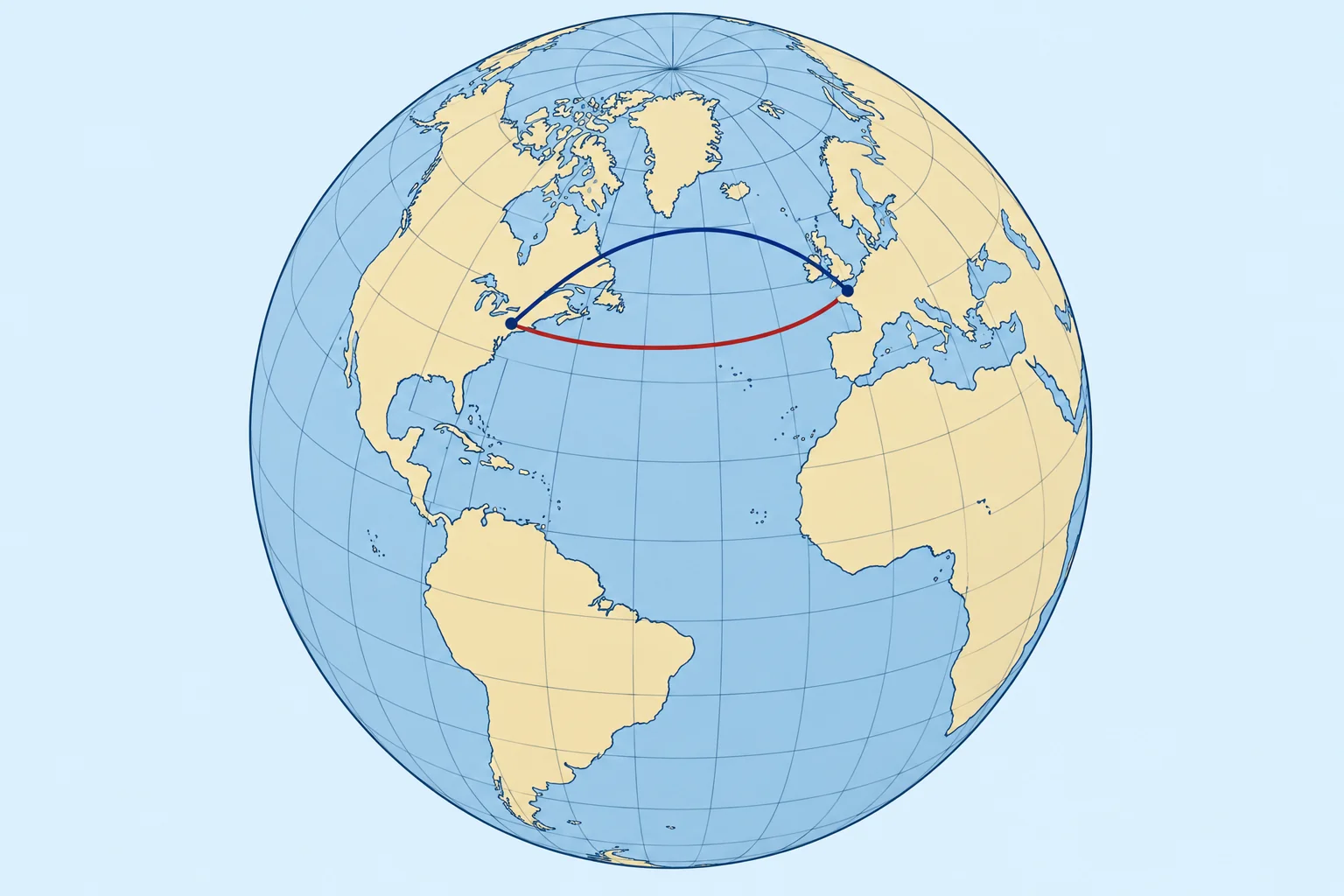
Great circles and rhumb lines
1The lesson in plain words
A great circle gives the shortest route on a sphere. Its course changes except along a meridian or the equator. Savings grow with latitude and east–west span.
Great circle
A great circle is any circle on the Earth whose centre is the Earth's centre: the equator, every meridian, and countless slanting ones. The shorter arc of the great circle through two points is the shortest route between them on a sphere. Sailing along it is great-circle sailing.
Rhumb line
A rhumb line crosses every meridian at the same angle, so you steer one true course. On a Mercator chart it is a straight line (Navigation: rhumb-line sailing). Except along a meridian or the equator, it is longer than the great circle.
Changing course
Except along meridians or the equator, a great circle’s true course changes. A northern-hemisphere arc bends poleward compared with the rhumb line. On Mercator it looks curved. In practice you split it into rhumb-line legs between waypoints and alter course at each.
When it pays
The saving grows with latitude and with the east–west span. From Newport, Rhode Island to Falmouth, England, the great circle is 2,730 M and the rhumb line 2,815 M: 85 M shorter. From Las Palmas to Saint Lucia, nearer the equator, it saves only about 10 M. M means nautical miles.
Wind first
For a sailing yacht, wind, current and weather usually decide the route; the great circle is the baseline you compare against. Motor vessels and ships gain most from following it (Navigation: ocean passage planning).
2Key data
- Great circle
- Circle centred on the Earth's centre; shortest route on a sphere
- Rhumb line
- Constant true course; straight on a Mercator chart
- Same route when
- Along a meridian or the equator
- Newport → Falmouth
- Great circle 2,730 M, rhumb line 2,815 M: saves 85 M
- Las Palmas → Saint Lucia
- Saves only about 10 M (low latitude)
3Key points
- 1
The great circle is shortest on a sphere; its course changes except along a meridian or the equator.
- 2
The rhumb line keeps one course; it is straight on a Mercator chart and usually longer.
- 3
Savings grow with latitude and east–west span; they are small near the equator.
- 4
Sail a great circle as a series of rhumb-line legs between waypoints.
4Frequent mistakes
Wrong: The straight line on a Mercator chart is the shortest route.
Right: Usually the shortest route curves poleward. Along a meridian or the equator, the straight rhumb line is also the great circle.
Wrong: A great circle always saves hundreds of miles on an ocean crossing.
Right: Near the equator the saving is small: about 10 M from Las Palmas to Saint Lucia.
Wrong: On a great circle you steer the initial course all the way.
Right: Except along a meridian or the equator, the course changes. Steer rhumb-line legs and alter course at each waypoint.
5Practice case & exam keys
A motor-yacht skipper plans Newport, Rhode Island to Falmouth by drawing a straight line on a Mercator ocean chart and steering 079°T throughout. What do you point out?
Show the answer
That straight line is the rhumb line, about 2,815 M. The great circle is about 2,730 M, some 85 M shorter, starting near 055°T and bending north of the rhumb line. For a motor yacht, fuel and time favour it, ice and weather permitting. Plan it as rhumb-line legs between waypoints along the great circle.
Exam keys
- Great circle: shortest route on a sphere; course changes except along a meridian or the equator.
- Rhumb line: constant course, straight on Mercator; equal to the great circle only along a meridian or the equator.
- Saving grows with latitude and east–west distance.
- Sail the great circle as rhumb-line legs between waypoints.
Finish this unit
When you've read it, match the terms, then answer three questions. Get them all right to finish the unit; opening the page alone doesn't count.
My notes for this unit
No notes