

Air emissions and antifouling paint
1The lesson in plain words
The Mediterranean sulphur ECA began on 1 May 2025. TBT antifouling is banned; new cybutryne coats have been banned since 1 January 2023.
Annex VI and emission control areas
MARPOL Annex VI limits air pollution from ships. Without an approved equivalent compliance system, such as exhaust cleaning, fuel sulphur limits are 0.50 % globally and 0.10 % in an emission control area (ECA). The Mediterranean Sea became a sulphur ECA on 1 May 2025, joining the Baltic, the North Sea, the North American and US Caribbean areas. These requirements apply to yachts too.
What it means on a yacht
Do not assume marina diesel has road-diesel sulphur content; check the supplier’s fuel specification against the applicable limit. Keep the engine serviced, do not run it at idle for hours, and keep generators off at anchor when you can. Black smoke means poor combustion and wasted fuel.
Why antifouling is regulated
Antifouling paint stops weed and barnacles growing on the hull. Many paints work by releasing a biocide, a substance that kills or repels them. Some biocides harm far more than the fouling. TBT (tributyltin) deformed oyster shells and caused female sea snails to develop male sexual organs, disrupting reproduction. That damage led to an IMO convention.
The AFS Convention
The AFS Convention (International Convention on the Control of Harmful Anti-fouling Systems on Ships) bans organotin paints such as TBT. It entered into force in 2008. Since 1 January 2023 it also bans new coats of paint containing cybutryne, a weedkiller that harmed seagrass and algae.
Painting and cleaning
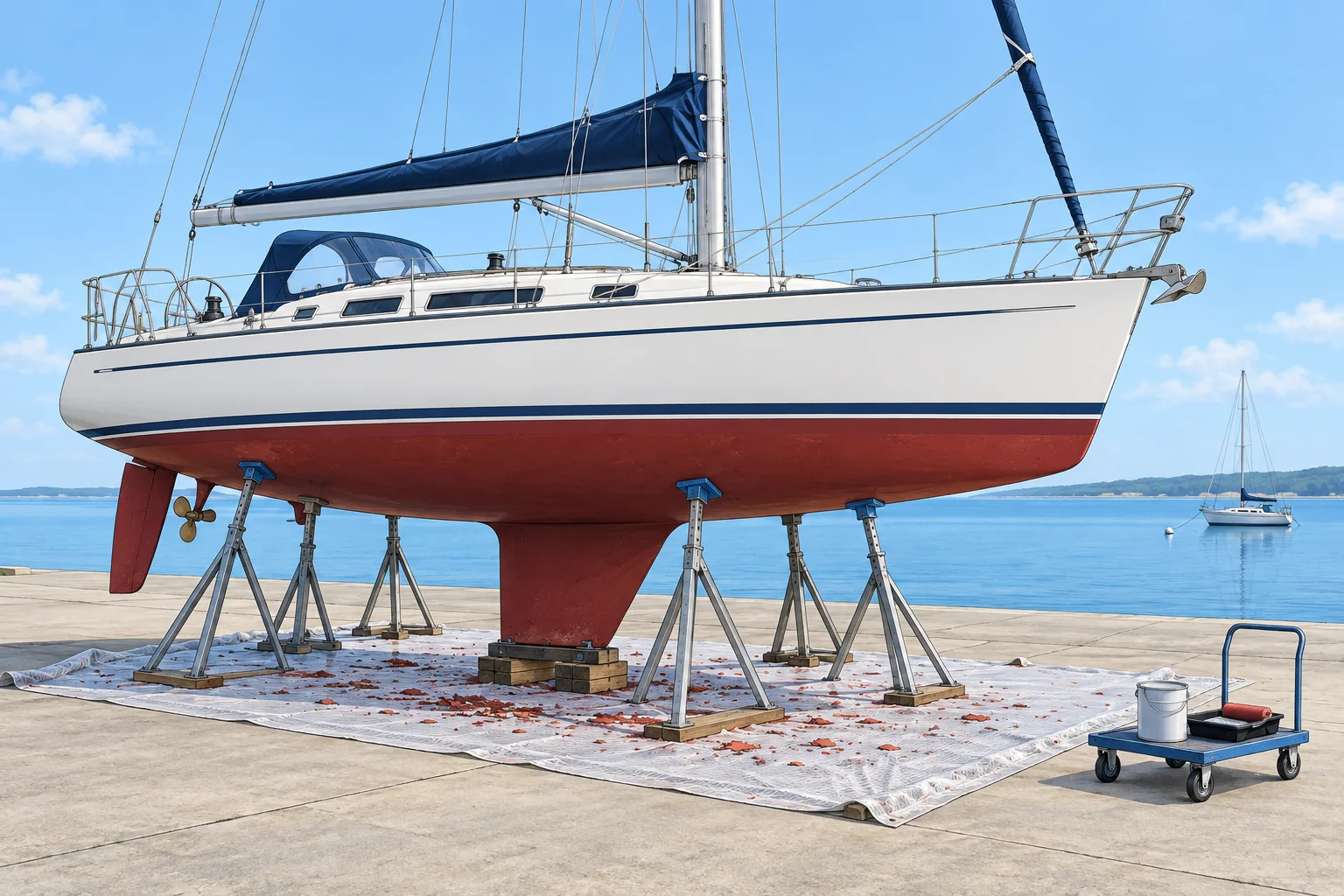
Do hull work ashore, on a hard standing that collects scrapings and wash water. Never scrape or pressure-wash antifouling into the sea. Many marinas ban in-water hull scrubbing.
2Key data
- Sulphur limit, global
- 0.50 % by mass, unless using an approved equivalent
- Sulphur limit inside an ECA
- 0.10 % by mass, unless using an approved equivalent
- Mediterranean sulphur ECA
- In effect since 1 May 2025
- TBT (organotin) paint
- Banned under the AFS Convention, in force since 2008
- Cybutryne paint
- New applications banned since 1 January 2023
3Key points
- 1
Without an approved equivalent, fuel sulphur limits are 0.50 % globally and 0.10 % in ECAs.
- 2
The Mediterranean has been a sulphur ECA since 1 May 2025.
- 3
TBT antifouling is banned; new cybutryne coats have been banned since 1 January 2023.
- 4
Scrape and wash the hull ashore, where the waste is collected.
4Frequent mistakes
Wrong: An old tin of cybutryne paint is still legal to apply.
Right: Do not apply it: new cybutryne coats have been banned since 1 January 2023.
Wrong: Scraping the hull in the water on a mooring is harmless.
Right: Paint flakes and biocide go straight into the sea. Do hull work on a hard standing that collects them.
5Practice case & exam keys
You buy a second-hand yacht in Greece. The old owner left a tin of antifouling dated 2016, labelled with cybutryne (Irgarol). Your friend suggests scrubbing the hull on the mooring and then applying it at the yard.
Show the answer
Do not apply it. Since 1 January 2023 the AFS Convention bans new coats of cybutryne paint. Dispose of the tin as hazardous waste at the yard. Clean the hull ashore on a hard standing that collects the scrapings, not on the mooring.
Exam keys
- Without an approved equivalent: fuel sulphur 0.50 % globally, 0.10 % in ECAs; Mediterranean ECA since 1 May 2025.
- AFS Convention: TBT (organotin) banned; cybutryne banned for new coats since 1 January 2023.
- Hull scraping and washing ashore with collection; never into the sea.
Finish this unit
When you've read it, answer three questions. Get all three right to finish the unit; opening the page alone doesn't count.
My notes for this unit
No notes