

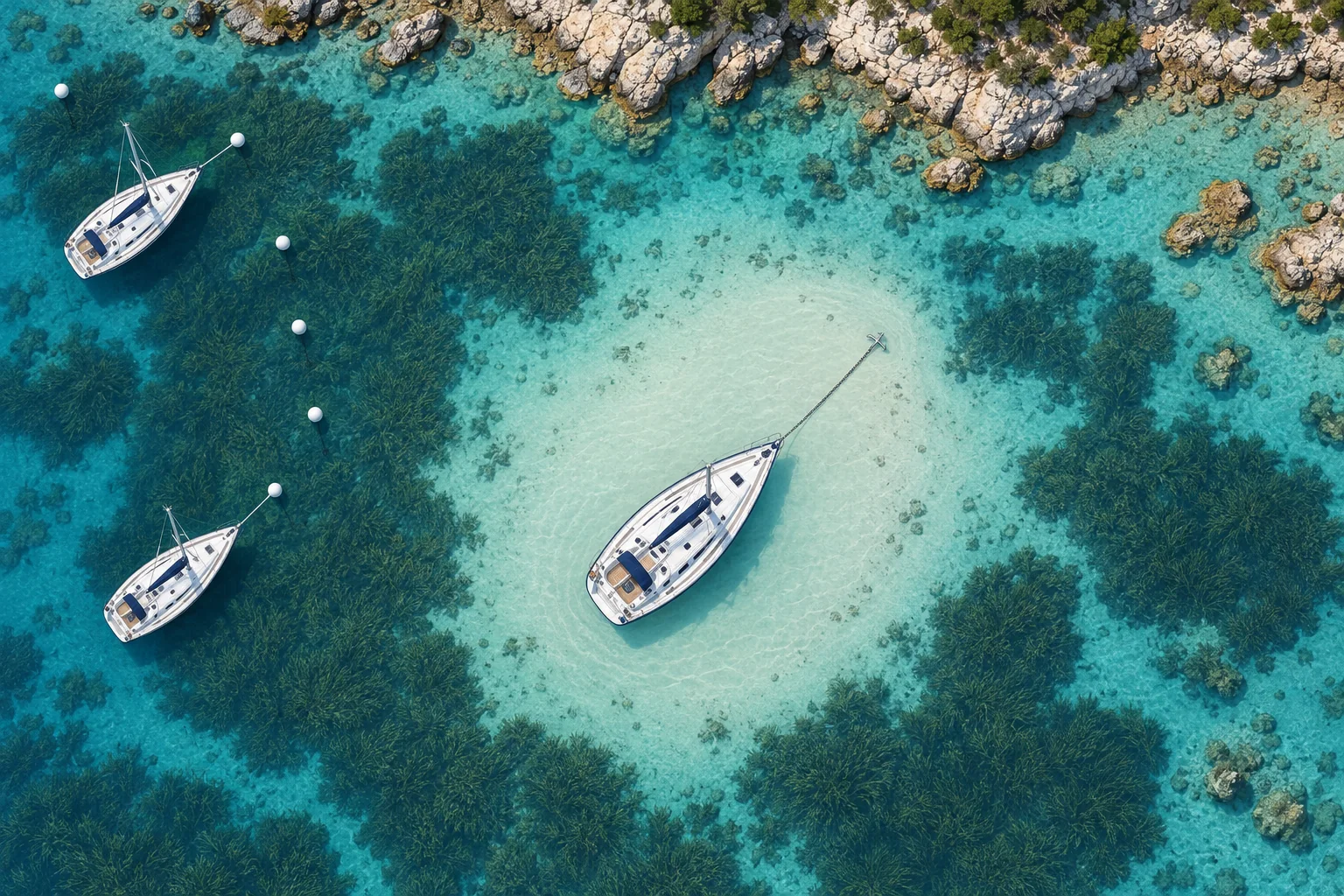
Anchoring without harming seagrass
1The lesson in plain words
Anchors and chains tear up seagrass meadows that take centuries to grow. Anchor on sand, use buoy fields, and know the local bans.
The damage
Posidonia oceanica is a seagrass found only in the Mediterranean. Its meadows grow a few centimetres a year, so a scar left by an anchor can take decades to close. The damage comes from the anchor dragging and from the chain sweeping the seabed as the boat swings. The Marine life lesson explains why these meadows matter.
Balearic Islands
Decree 25/2018 of the Balearic Islands bans anchoring on Posidonia meadows in general. Where the meadow is large, buoy fields replace anchoring: in those zones you must pick up a buoy and may not drop anchor. Since 2022 the regional port authority, Ports de les Illes Balears, manages and takes bookings for these fields in summer. Surveillance boats patrol and fine offenders.
France and other coasts
French Mediterranean prefectural orders set local anchoring restrictions on Posidonia, commonly for vessels 24 m and over, sometimes with lower limits. Smaller boats must also avoid damaging protected Posidonia. Check the current local order. Many marine parks, such as Cabrera National Park in Spain, require a permit to navigate and allow mooring only on their buoys.
Find the sand
In clear water, seagrass often looks dark and sand light, but colour alone does not identify the bottom. Look down from the bow, and choose a sand patch large enough for the boat and chain to swing over sand. Use official meadow maps, and follow the Seamanship lesson for setting and holding checks. Weigh anchor (raise it) with the boat directly above it, so it lifts straight up instead of dragging through the meadow.
Using buoy fields
Charts usually show buoy fields. Yellow special marks may indicate them (see the IALA Special marks lesson). Check the buoy’s permitted vessel size, book where required, and attach as the operator instructs, using the designated load-bearing fitting or mooring rope (strop). Leave when the time limit expires or conditions become unsafe.
2Step by step
Protecting seagrass when anchoring
- 1
Check the chart, pilot book and local rules for meadows, bans and buoy fields.
Many anchorages have mapped meadows or a buoy field you must use.
- 2
Approach slowly and confirm a sand patch from the bow.
Pale rock can resemble sand. Confirm the bottom using a clear view and official meadow maps; if unsure, use an authorised buoy or another anchorage.
- 3
Drop the anchor in the middle of the sand, allowing for the swinging circle.
The chain sweeps the bottom as the boat swings, not just the anchor.
- 4
Weigh anchor with the boat right above it.
The anchor then lifts straight up instead of tearing through the seabed.
3Key points
- 1
Posidonia meadows grow a few centimetres a year; anchor scars take decades to heal.
- 2
Anchor in the middle of a sand patch large enough for the swinging circle.
- 3
In a regulated buoy field, pick up a buoy; anchoring there is banned.
- 4
The Balearics ban anchoring on Posidonia in general (Decree 25/2018).
- 5
Weigh anchor from directly above it, so it does not drag.
4Frequent mistakes
Wrong: Only the anchor touches the bottom, so a small anchor does no harm.
Right: The chain sweeps the seabed as the boat swings. Anchor where the whole swinging circle is sand.
Wrong: If the buoy field is full, anchor next to it on the seagrass.
Right: Anchoring on the meadow is still banned. Find sand elsewhere or another anchorage.
5Practice case & exam keys
You arrive at a Balearic cove at midday in an 11 m yacht. Most of the bottom is dark, with one small light patch near the rocks. A buoy field covers the centre of the cove and you have not booked a buoy.
Show the answer
Do not anchor on the dark seagrass. The light patch looks too small for your swinging circle near the rocks. Check whether a buoy is free to book through Ports de les Illes Balears. If not, go to another anchorage with a sand bottom. In the buoy field zone itself, anchoring is not allowed.
Exam keys
- Posidonia: Mediterranean seagrass; anchors and sweeping chains destroy meadows that grow very slowly.
- Anchor on sand with room to swing; weigh anchor from directly above it.
- Balearics Decree 25/2018: no anchoring on Posidonia; use buoys in regulated fields. French Mediterranean orders set local anchoring limits, commonly from 24 m; smaller boats must avoid damage too. Check local orders.
Finish this unit
When you've read it, answer three questions. Get all three right to finish the unit; opening the page alone doesn't count.
My notes for this unit
No notes