

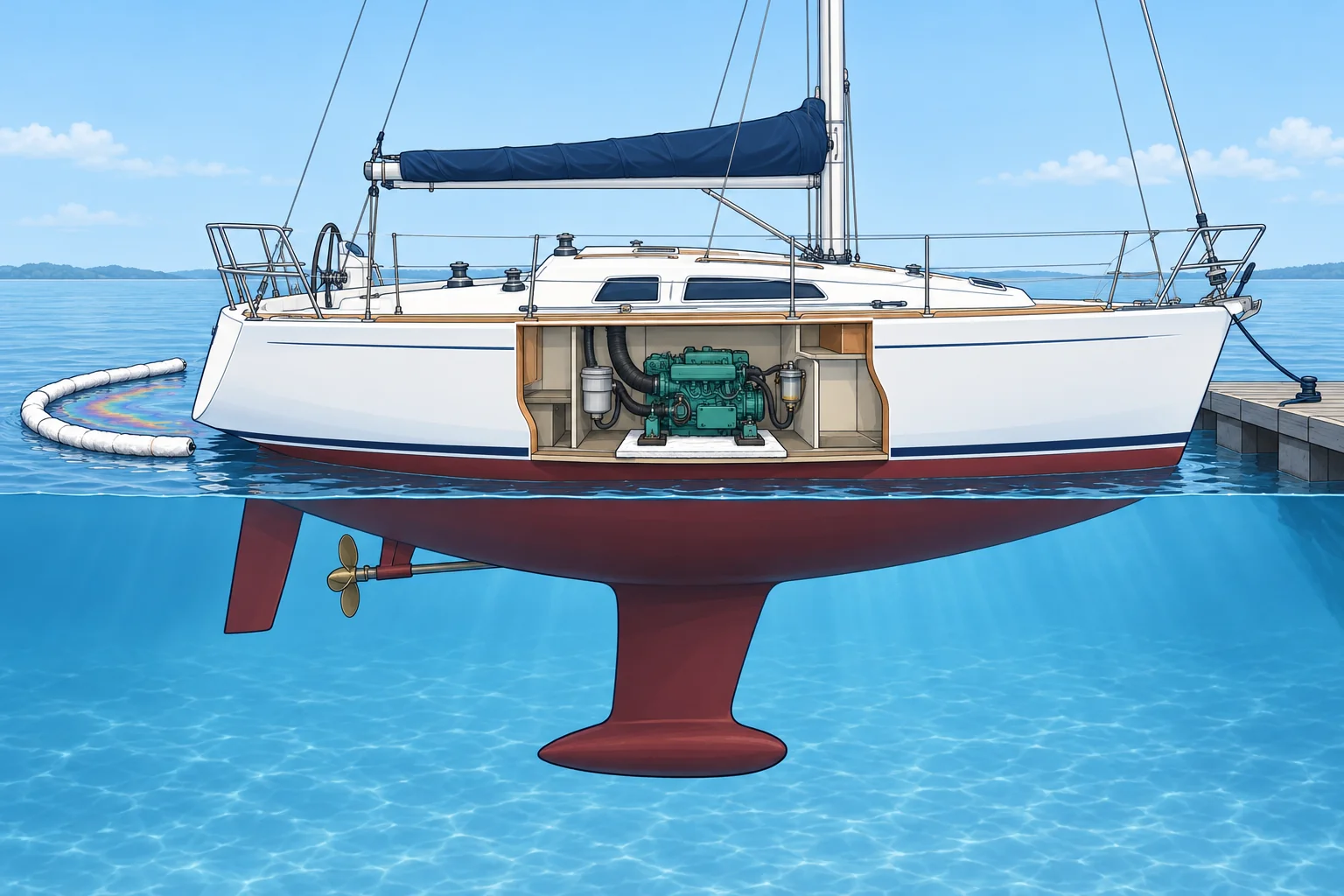
Oil: bilges, fuelling and spills
1The lesson in plain words
Even a small boat must keep oil out of the sea. Never pump oily bilge water overboard, fuel with care, and report any spill you cause or see.
MARPOL in one line
MARPOL is the IMO (International Maritime Organization) convention on pollution from ships. Its annexes (sections) cover oil (Annex I), sewage (Annex IV), garbage (Annex V) and air (Annex VI). Oil and garbage rules reach yachts; small-boat sewage rules usually come from national law. Coastal states may set stricter rules. See Law for the convention.
Oily bilge water
Fuel and lubricating oil end up in the bilge, the lowest part of the hull. Under Annex I a small ship may discharge oily water only while en route (making progress on your voyage), through approved equipment keeping oil at or below 15 ppm (parts per million). Yachts rarely carry such a separator. Keep the bilge clean, put absorbent pads under the engine, and land oily water and used pads at a port reception facility.
The automatic bilge pump
An automatic bilge pump can discharge leaked oil. If the water level is safe, stop automatic discharge using your pump’s controls. Manual/on may run it continuously. Monitor the bilge while you stop the leak and absorb the oil with pads; maintain essential pumping if safety requires it. Restore automatic operation once contamination is removed. Land oily water and pads ashore. Never add detergent: it disperses oil rather than removing it.
Fuelling
Most small spills happen at the fuel berth. A tank overflows through its vent, a small fitting on the hull side or deck, so know where yours is. Fill slowly near the end and stop short of full, because fuel expands as it warms. Keep a pad round the nozzle and one at the vent. The Ship module’s refuelling lesson gives the full safety routine.
Report it
A sheen, a thin rainbow film on the water, is enough to show oil. If you cause a spill, stop the source, contain it with pads and report it at once: to the harbour office in port, or to the coastguard on VHF channel 16 at sea. In the United States the National Response Center (1-800-424-8802) takes reports. Report spills you see too, with position, time and size.
2Key data
- Annex I limit for small ships
- 15 ppm oil, en route, through approved equipment only
- Practical yacht rule
- No oily bilge water overboard; land it ashore
- Detergent on a sheen
- Never: it hides the oil and can itself be an offence
- US spill reports
- National Response Center, 1-800-424-8802
3Key points
- 1
MARPOL oil and garbage rules reach yachts; small-boat sewage rules usually come from national law.
- 2
Discharge needs approved 15 ppm equipment while en route; yachts rarely have it.
- 3
If safe, stop automatic discharge and monitor the bilge; absorb oil with pads. Maintain essential pumping.
- 4
Never use detergent on a sheen; contain the oil and report it.
- 5
Report any spill you cause or see to the harbour office or the coastguard.
4Frequent mistakes
Wrong: A little diesel in the bilge can go overboard; it evaporates.
Right: Oily bilge water stays on board. Soak it up with pads and land it at a reception facility.
Wrong: A squirt of washing-up liquid clears a sheen.
Right: Detergent only spreads the oil through the water. Contain it with pads and report the spill.
Wrong: Only the person who caused a spill needs to report it.
Right: Report any spill you see. Position, time and size help the authority respond quickly.
5Practice case & exam keys
Motoring into harbour, your crew sees a rainbow film spreading behind the boat. In the engine space the automatic bilge pump is running and the bilge water smells of diesel.
Show the answer
If the water level is safe, stop automatic discharge using the pump’s controls. Manual/on may keep it running. Monitor the bilge and maintain essential pumping if needed. Stop the leak and absorb the oil with pads; never add detergent. Report the spill to the harbour office or coastguard with position, time and size. Land oily water and pads ashore. Restore automatic operation once contamination is removed.
Exam keys
- MARPOL Annex I: oily water only through approved 15 ppm equipment, en route; yachts normally land it ashore.
- If safe, stop automatic discharge and monitor the bilge; maintain essential pumping. Manual/on may run continuously. Absorb oil; never add detergent.
- Report spills to the harbour office or coastguard (VHF 16); in the US to the National Response Center.
Finish this unit
When you've read it, answer three questions. Get all three right to finish the unit; opening the page alone doesn't count.
My notes for this unit
No notes