

 See units
Ship mooring and anchoring stations: mooring and tug lines, safe working loads, the windlass and buoy mooring (STCW A-II/5)
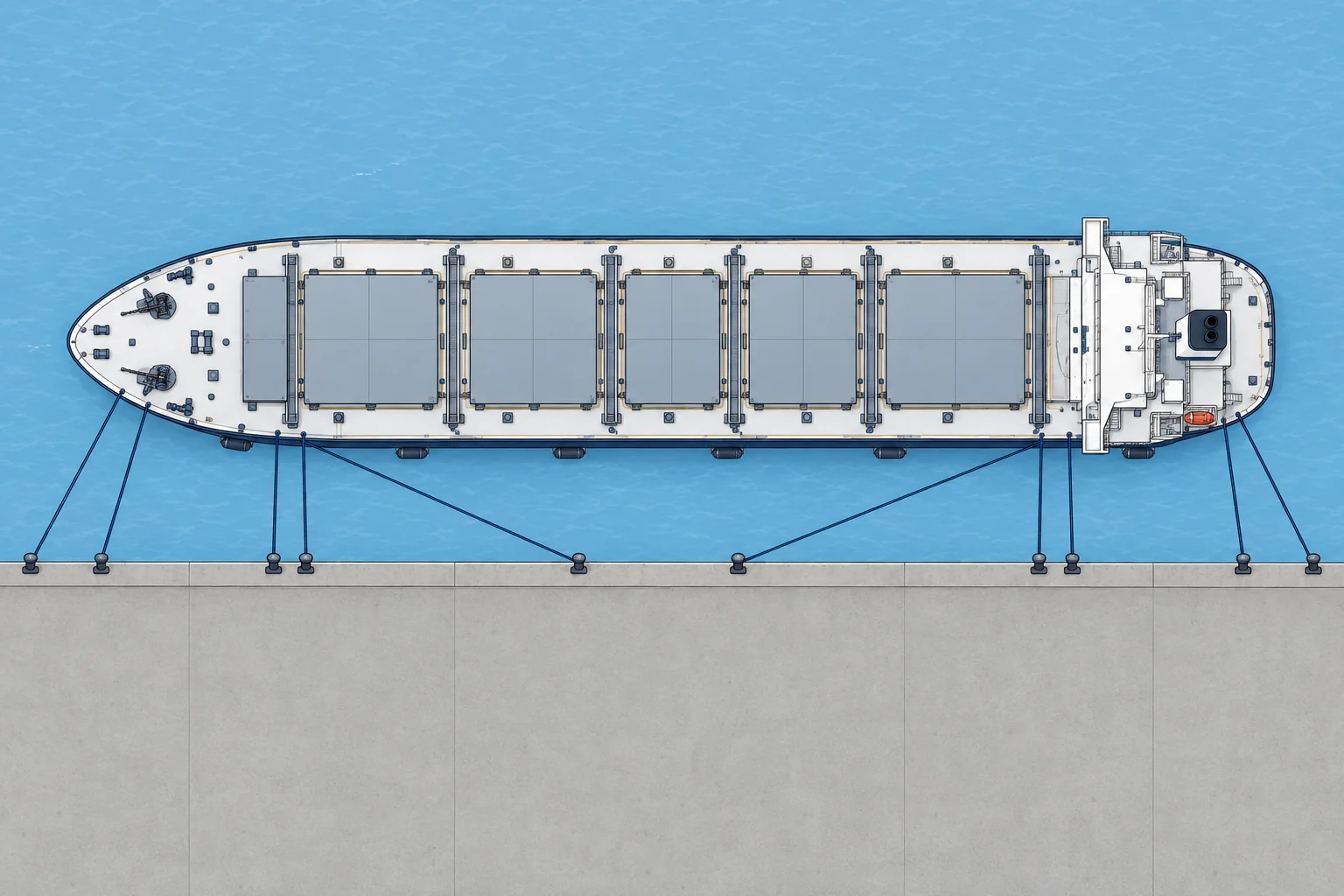
The mooring arrangement: what each line does
1The lesson in plain words
Head and stern lines, breasts and springs each hold the ship in one direction. Know their jobs, the ship's plan and your place at the station.
Lines and their jobs
You lead mooring lines through fairleads (deck guides) to shore bollards (strong posts). Head lines lead forward from the bow and resist movement astern. Stern lines lead aft from the stern and resist movement ahead. Breast lines run nearly at right angles to the ship and resist movement away from the berth: athwartships means sideways. Springs run nearly parallel to the ship and resist movement ahead or astern: longitudinal means along the ship.
Springs by name
A forward spring (head spring) leads aft from the forward part of the ship. An aft spring (back spring) leads forward from the after part. Lines in the same service should match in material and diameter to share load. A short line stretches less under the same load and can take more than its share as the ship moves. Report an unusually short lead; the officer decides a suitable longer lead from the plan.
The plan and the fittings
Every ship has a towing and mooring arrangements plan (IMO MSC.1/Circ.1175/Rev.1). It shows the fairleads, bollards and bitts (paired deck posts), their safe working load (SWL), the lines carried and how they are meant to be led. The SWL is also marked on each fitting. Use the leads shown on the plan, avoid sharp or multiple angles, and never put a rope and a wire through the same lead or on the same bollard.
The mooring party
Each station, forward and aft, has a responsible person in charge, usually an officer, who can see all the lines and the team and talks to the bridge by radio, naming the ship. The winch operator works the controls with a direct view of the line. Line handlers wear personal protective equipment (PPE): helmet, safety shoes and gloves. You are briefed on the berthing plan. Anyone not in the mooring party keeps off the mooring deck.
Before arrival
Prepare the station early. Test the winches and their emergency stops. Run ropes off their storage reels and flake them in loose, clear lengths on deck (never use them straight off the reel). Lay out heaving lines (light throwing lines), stoppers (short lines that hold a load temporarily) and messengers (light lines used to haul heavier ones). Clean up oil and clutter. Where a parting line can fly, and where to stand, is covered in Ropes: deck work safely.
2Key data
- Breast lines
- Most of the athwartships restraint: hold her on the berth
- Springs
- Most of the longitudinal restraint: stop her surging
- Same service
- Same material and diameter, so the lines share the load
- Fitting limit
- SWL marked on each fitting and in the towing and mooring plan
3Key points
- 1
Head and stern lines lead off the ends; breasts hold her in; springs stop her surging fore and aft.
- 2
Lines in the same service should match in material and diameter so they share the load.
- 3
Use the leads on the towing and mooring arrangements plan and respect each fitting's marked SWL.
- 4
One responsible person per station sees all lines and talks to the bridge; others stay off the deck.
4Frequent mistakes
Wrong: Springs mainly hold the ship against the berth.
Right: Breast lines give most of the sideways restraint. Springs mainly stop the ship moving ahead or astern.
Wrong: Make each line as short as possible: shorter is stronger.
Right: Report it; use a suitable longer lead only as directed by the officer.
Wrong: Take a rope straight off its storage reel to save time.
Right: Run it off and flake it on deck first, so it runs free and there is enough slack for anything that happens.
5Practice case & exam keys
Your ship is berthing port side to, with an offshore wind and a current from ahead. The officer asks which lines will do most to stop her being blown off the berth, and which will stop the current setting her astern.
Show the answer
Breast lines give most of the restraint against being blown off the berth, so they matter most in the offshore wind. The current from ahead tries to set her astern, so lines leading forward hold her: the aft (back) spring and the head lines. Lines in each group should be of the same type and size so they share the load.
Exam keys
- Head and stern lines: off the ends. Breast lines: athwartships restraint. Springs: longitudinal restraint.
- Forward spring leads aft from forward; aft (back) spring leads forward from aft.
- Towing and mooring arrangements plan (MSC.1/Circ.1175/Rev.1): leads, fittings and their SWL, lines.
- A responsible person per station with a clear view and a radio; PPE; everyone else off the deck.
Finish this unit
When you've read it, match the terms, then answer three questions. Get them all right to finish the unit; opening the page alone doesn't count.
My notes for this unit
No notes