

 See units
Ship mooring and anchoring stations: mooring and tug lines, safe working loads, the windlass and buoy mooring (STCW A-II/5)
The anchor station: windlass, letting go and reporting the cable
1The lesson in plain words
At the windlass you check the brake, clear the stoppers, walk the anchor out and report the cable in terms the bridge can picture.
The windlass
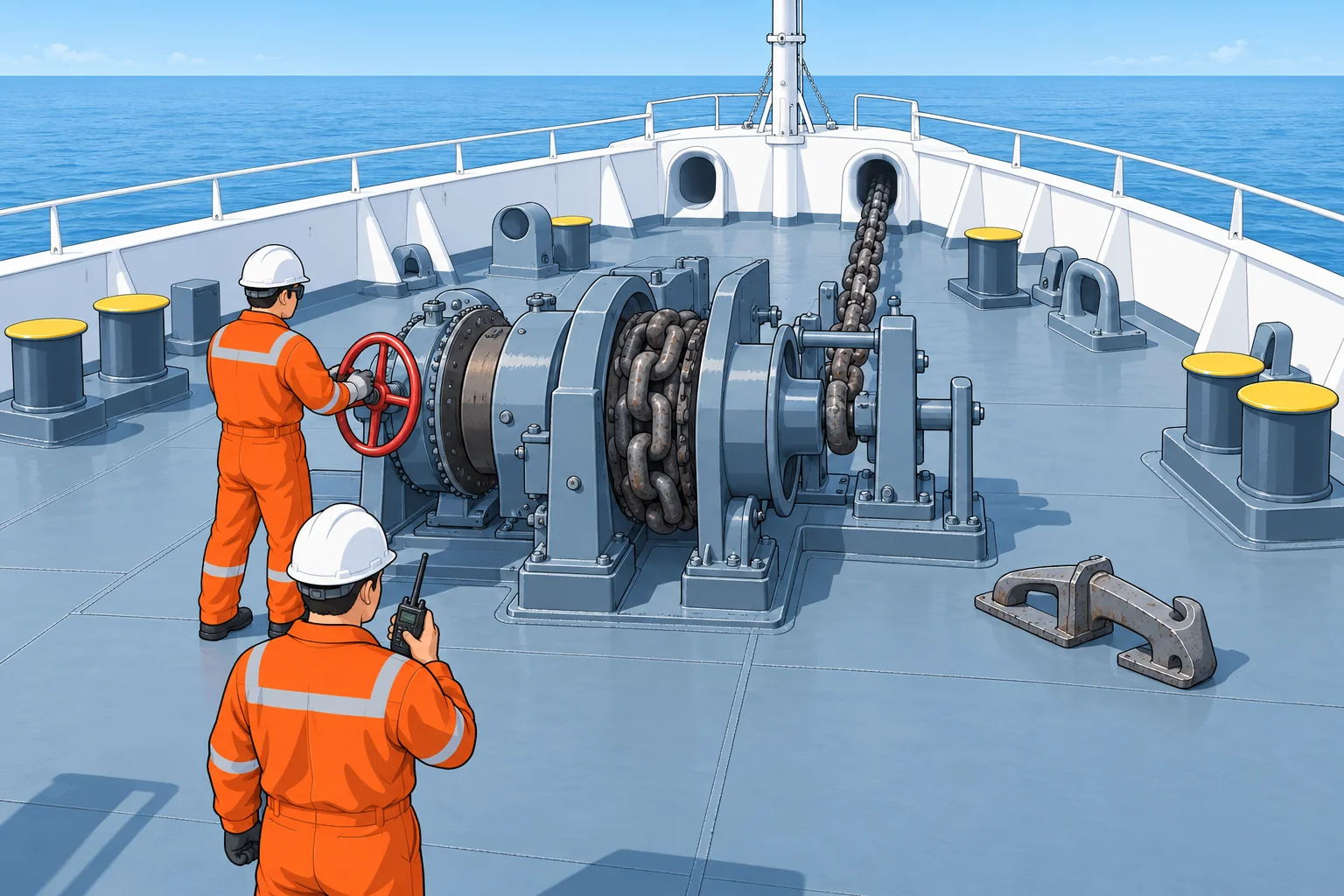
The windlass drives a gypsy (cable lifter), a wheel with shaped pockets that grip the chain cable link by link. A clutch connects the gypsy to the motor (in gear) or frees it (out of gear), so only the band brake holds it. At sea the cable is held by a chain stopper on deck and often a devil's claw, a hook that grips one link, and the anchor is lashed. The cable's inner end, the bitter end, is secured in the chain locker. Machinery: Ship: deck machinery.
Getting ready
A competent seafarer checks the brake is on before clearing lashings, devil's claw and stopper. An officer is in charge, with a bridge radio. Wear helmet, safety shoes, gloves and goggles against rust and mud. Stand aft of, or well clear of, the windlass and moving cable. Walk the anchor out in gear, clear of the hawse pipe (the hull opening the cable passes through), to prove it runs. On very large ships, follow the ship's procedure for walking out in stages or fully.
Shackles
Cable comes in shackles, usually 27.5 m (15 fathoms), joined by marked joining shackles. Count them and report 'three shackles in the water' or 'on deck', as ordered. Without deep-water anchoring notation, the standard design lift is a vertically hanging anchor plus 82.5 m of cable. Follow the ship's stated limits. The bridge uses the engine to ease excessive cable strain; the windlass must not pull the ship against wind or current.
Reporting the cable
Report how the cable leads, ahead, astern, to port or starboard, often by clock position from the bow, and whether it is slack or under strain. A ship is brought up when she is riding to her anchor: the cable tightens, then sags back as she stops moving. Heaving up, report 'up and down' when the cable is vertical, 'anchor aweigh' when it breaks out of the seabed, then 'clear of the water', whether it is clear or foul (caught in cable or debris), and 'home' when housed.
Safe habits
If the anchor does not run when the brake is released, do not shake the cable: brake on, put it in gear and walk it out. Never enter the chain locker without enclosed-space precautions. Wash mud off the cable as it comes in. When housed, secure the anchor with stopper, brake and lashings so it cannot run at sea.
2Step by step
Letting go an anchor from the brake
- 1
Confirm the order and communications with the bridge, and check the brake is on.
The brake must hold before any stopper comes off.
- 2
Engage the clutch, then clear the lashings, devil's claw and chain stopper.
With the gypsy in gear and the brake on, nothing can run unexpectedly.
- 3
Release the brake and walk the anchor out under power, clear of the hawse pipe or to the depth ordered.
This proves the anchor runs and reduces the shock on the brake.
- 4
Apply the brake, take the gypsy out of gear and report 'ready to let go'.
Now only the brake holds the cable, ready to release.
- 5
On 'let go', release the brake, then control the cable's speed with it, counting the shackles.
An uncontrolled run can overheat the brake or tear out the bitter end.
- 6
On the order, brake on and stopper on; report the lead and when she is brought up.
The stopper takes the riding load; the bridge needs the lead to know she is holding.
3Key data
- One shackle of cable
- 27.5 m (15 fathoms)
- Design lift without deep-water notation (IACS UR A3)
- Without deep-water notation: 82.5 m of vertical cable plus anchor
- PPE at the windlass
- Helmet, safety shoes, gloves, goggles; hearing protection
- Anchor will not run
- Brake on, in gear, walk it out; never shake the cable
4Key points
- 1
Brake on before clearing the stoppers; walk the anchor clear of the hawse pipe to prove it runs.
- 2
Report shackles in the water or on deck, the cable's lead and strain, and when she is brought up.
- 3
Heaving up: up and down, aweigh, clear of the water (clear or foul), home.
- 4
Stand clear of the windlass in full PPE; a chain locker is an enclosed space.
5Frequent mistakes
Wrong: Shake the cable if the anchor sticks in the hawse pipe.
Right: Put the brake on, put the gypsy in gear and walk the anchor out under power.
Wrong: 'Anchor aweigh' means the anchor is back in the hawse pipe.
Right: Aweigh means it has broken out of the seabed. It is 'home' when housed.
Wrong: The windlass can heave the ship up to her anchor in a strong wind.
Right: Without deep-water anchoring notation, the standard design lift is the anchor plus 82.5 m of vertical cable. Follow the ship's rated limits. The bridge uses the engine to ease cable strain.
6Practice case & exam keys
Anchoring in 25 m of water, the officer orders 'let go'. With five shackles in the water, the cable leads at two o'clock and comes taut, then sags back while the ship stops moving relative to the shore.
Show the answer
Report to the bridge: 'five shackles in the water, cable leading two o'clock (on the starboard bow), ship brought up'. Brought up means she is riding to her anchor. On the order, put the brake on fully and the chain stopper on so it carries the load. Keep watching the cable: if it keeps jerking taut and the ship moves, the anchor may be dragging.
Exam keys
- Gypsy (cable lifter), clutch, band brake, chain stopper, devil's claw, bitter end.
- 1 shackle = 27.5 m. Without deep-water anchoring notation: design lift is anchor + 82.5 m of vertical cable (IACS UR A3); follow the ship's limits.
- Report shackles, lead, slack or strain, brought up; then up and down, aweigh, clear or foul, home.
- Brake on, clear the stoppers, walk out clear of the pipe; never shake a stuck cable.
Finish this unit
When you've read it, match the terms, then answer three questions. Get them all right to finish the unit; opening the page alone doesn't count.
My notes for this unit
No notes