

 See units
Ship mooring and anchoring stations: mooring and tug lines, safe working loads, the windlass and buoy mooring (STCW A-II/5)
Mooring lines, tails and load limits (MEG4 and SOLAS II-1/3-8)
1The lesson in plain words
Know your lines' numbers: ship design MBL, line design break force and working load limit, and why stiff lines get softer tails.
Line types
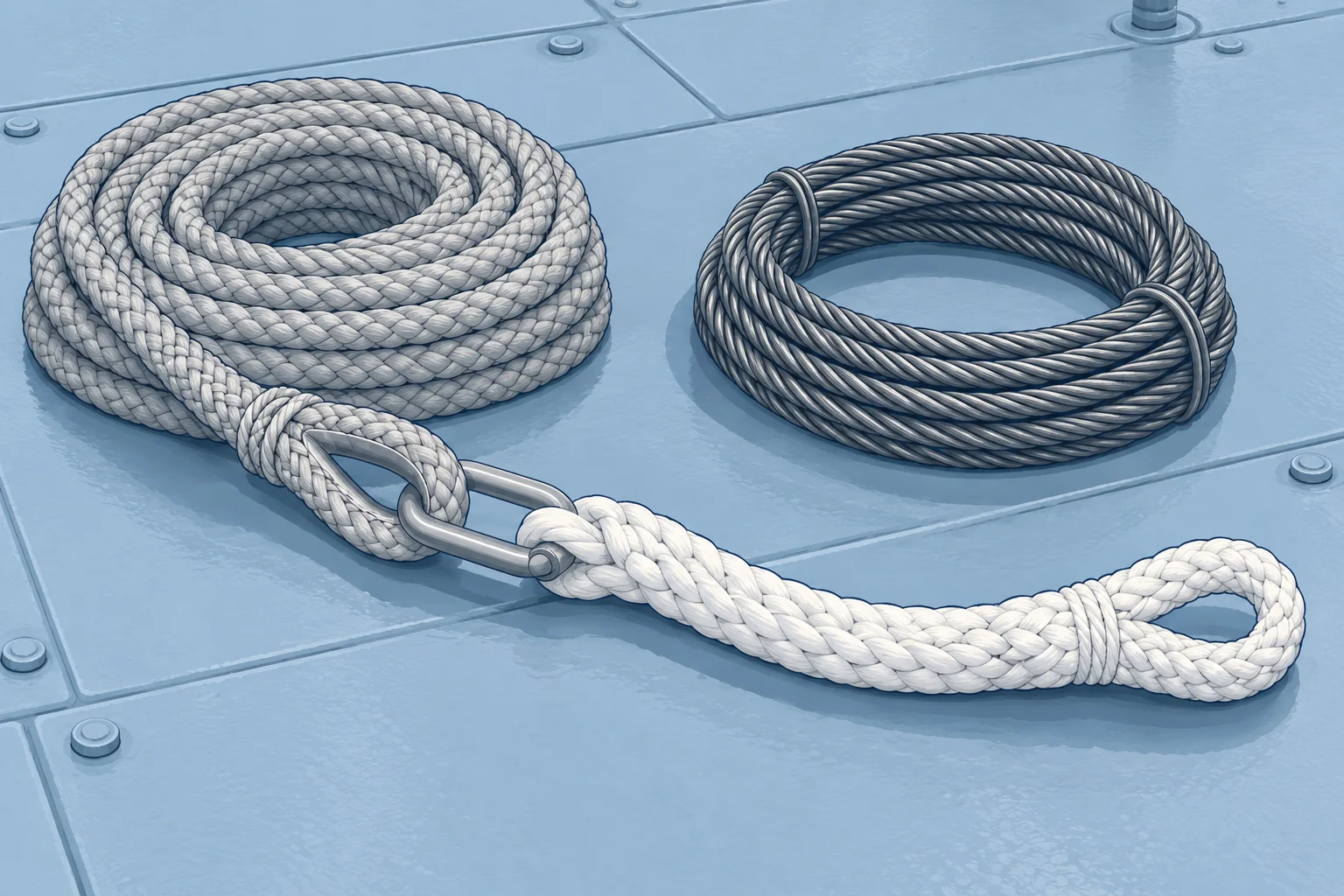
Ships use wire, high-modulus synthetic fibre (HMSF) lines, including high-modulus polyethylene (HMPE), and traditional synthetics such as polyester, nylon and mixed polyolefin. Wire and HMPE stretch little. They often have a tail, a short, more elastic rope at the outboard end, to soften surge loads. Use the connection specified for the ship's line and tail. Fibre properties and rope construction are covered in Ropes: rope materials.
The design numbers
The ship design minimum breaking load (SDMBL), called MBLSD in IMO texts, is the minimum breaking load of new, dry lines that the ship's fittings and hull structure were designed for. Every part of the system is chosen from it. The line design break force (LDBF) is the minimum force at which a new, dry, spliced line breaks; it should be 100–105 % of SDMBL. Nylon is tested wet. A tail's design break force should be 125–130 % of SDMBL.
Working load limit
The working load limit (WLL) is the most a line should carry in service: 50 % of SDMBL for synthetic lines and 55 % for wire. The brake setting is 60 % of SDMBL, above the WLL: rendering is a warning, not permission to exceed the WLL. Here, t means tonnes-force, a unit of pull. Example with an SDMBL of 70 t: synthetic line WLL 35 t, brake rendering 42 t, new line LDBF 70–73.5 t, tail 87.5–91 t.
Rules since 2024
The amendments to SOLAS II-1/3-8 entered into force on 1 January 2024. Ships of 3,000 gross tonnage and above constructed on or after that date must meet the mooring-design and line-selection requirements supported by MSC.1/Circ.1619. Smaller new ships should comply as far as reasonably practicable. Ships covered by this SOLAS regulation, including existing ships, must have mooring equipment and lines inspected and maintained, taking account of MSC.1/Circ.1620.
Inspecting lines
Look along the line for abrasion, cuts, kinks, heat damage (glazed or fused fibres) and slack or frayed splices, using the maker's retirement criteria. On a jacketed line, the cover's condition does not show the state of the load-bearing core. Each line and tail is identified and linked to its certificate and records. Store spare lines out of sunlight, water and chemicals.
2Key data
- LDBF
- 100–105 % SDMBL; new, spliced; dry except nylon tested wet
- Tail design break force
- 125–130 % of SDMBL
- WLL
- 50 % of SDMBL for synthetic lines; 55 % for wire
- Brake rendering
- 60 % of SDMBL: above the WLL; rendering is a warning
- SOLAS II-1/3-8
- Amended, in force 1 Jan 2024 (MSC.1/Circ.1619 and 1620)
- Example, SDMBL 70 t
- WLL 35 t, brake 42 t, LDBF 70–73.5 t
3Key points
- 1
SDMBL is the ship's reference strength: lines, tails, winches and fittings are all chosen from it.
- 2
LDBF 100–105 % of SDMBL; tails 125–130 %; WLL 50 % for synthetics, 55 % for wire.
- 3
Stiff HMSF or wire lines get elastic tails to soften surges, but tails change how a line fails.
- 4
Since 1 January 2024, SOLAS II-1/3-8 requires mooring equipment and lines to be inspected and maintained.
4Frequent mistakes
Wrong: A stronger replacement line is always safer.
Right: A line far above 105 % of SDMBL can overload winches and fittings before anything gives. Fit lines that match the design.
Wrong: A clean jacket means the core is sound.
Right: The jacket does not show the core's condition. Follow the maker's inspection and retirement criteria.
Wrong: The WLL is the load at which the line breaks.
Right: The WLL is the service limit, 50 % of SDMBL for synthetics. The design break force is about twice that.
5Practice case & exam keys
Your ship's SDMBL is 64 t. A new synthetic line's certificate gives an LDBF of 72 t; its nylon tail is certified at 82 t. The bosun says the extra strength must be safer. Should the line go into service?
Show the answer
No. Tell the officer before use. The line should be 64–67.2 t (100–105 % of SDMBL), so 72 t is outside the specified range. The tail's 82 t is within 80–83.2 t (125–130 %). A stronger line does not make the system safer if it no longer matches the design.
Exam keys
- SDMBL (MBLSD): the design breaking load for the lines, fittings and structure.
- LDBF 100–105 %; tail 125–130 %; WLL 50 % synthetic, 55 % wire; brake 60 %.
- SOLAS II-1/3-8: Circ.1619 design requirements for ships of 3,000 GT and above constructed on or after 1 January 2024; smaller new ships should comply as far as reasonably practicable. Inspection and maintenance under Circ.1620 include existing ships covered by this regulation.
- A jacket's condition does not prove the core's condition.
Finish this unit
When you've read it, match the terms, then answer three questions. Get them all right to finish the unit; opening the page alone doesn't count.
My notes for this unit
No notes