

The sail as a wing: lift and drag
1The lesson in plain words
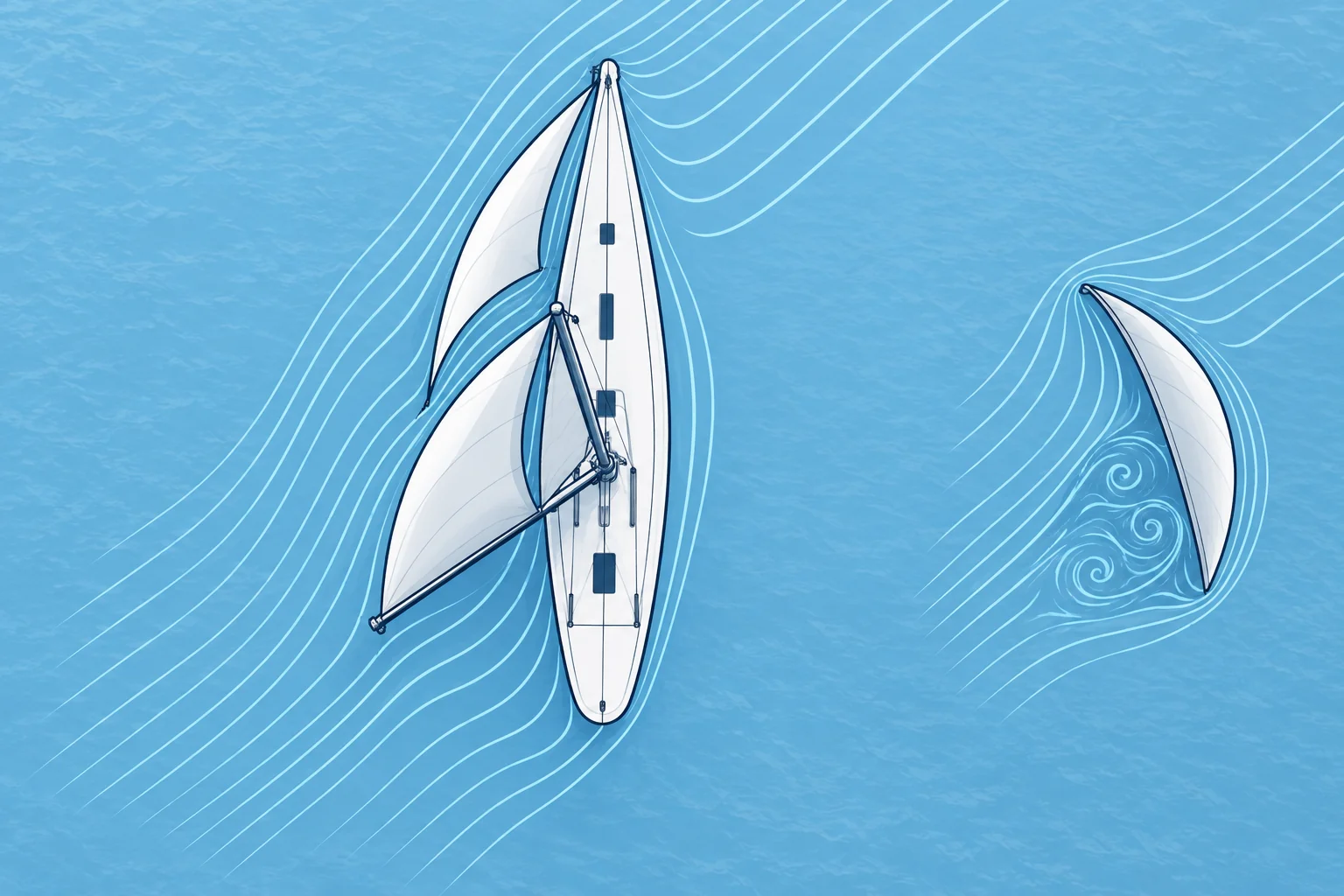
A curved sail set at a small angle to the wind bends the airflow. The air pushes back on it with lift, like a wing. Drag is the force along the wind.
Angle of attack
The angle of attack is the angle between the apparent wind and the sail's chord, the straight line from its front edge to its back edge. The front edge is the luff; the back edge is the leech. With a small angle of attack, the air flows smoothly round both sides of a curved sail. The sail turns the airflow, and the air pushes back on the sail.
Lift and drag
The sail's whole aerodynamic force is easier to understand in two parts. Lift acts at right angles to the apparent wind. Drag acts along the apparent wind, downwind. Bending the flow lowers the pressure on the leeward (downwind) side and raises it on the windward (towards the wind) side. Air passing opposite sides does not have to reach the leech together; the sail produces force by turning the airflow.
Too little angle
If you let the sail out too far (ease it), or steer too close to the wind, the angle of attack becomes too small. The luff lifts and flaps. This is luffing: the sail is no longer shaped by the wind, and its force falls away.
Too much angle
If the sail is pulled in too tight for the wind angle, the flow can no longer follow the leeward side. It breaks away and swirls. The sail stalls: lift falls, drag rises and the boat heels and slows without going faster. A stalled sail looks full and quiet, so it is easy to miss.
Running and two sails
On a run, sailing directly downwind, the sail is set across the wind. Flow is mostly stalled and the sail works mainly by drag, being pushed. The slot is the gap between the headsail (ahead of the mast) and mainsail (behind it); each sail affects airflow over the other.
2Key data
- Lift
- At right angles to the apparent wind
- Drag
- Along the apparent wind, downwind
- Luffing
- Angle of attack too small: luff lifts and flaps
- Stall
- Angle of attack too large: flow separates on the leeward side
- Run
- Sail mostly stalled, working by drag
3Key points
- 1
A sail at a small angle to the apparent wind works like a wing and makes lift.
- 2
Lift acts at right angles to the apparent wind; drag acts along it.
- 3
Sail let out too far, or boat steered too close to the wind: the sail luffs.
- 4
Too tight: the sail stalls, heels the boat and slows it. It may look fine.
- 5
On a run the sail is pushed mainly by drag.
4Frequent mistakes
Wrong: When in doubt, pull the sail in tighter; a quiet sail is a working sail.
Right: A full, quiet sail can still be stalled: too large an angle of attack makes airflow separate and reduces lift.
Wrong: Air over the curved side must meet the air underneath at the back edge, so it goes faster.
Right: That equal-time idea is wrong. The sail bends the flow, making lower pressure to leeward and higher to windward.
5Practice case & exam keys
On a beam reach, with the wind coming from the side, your crew has pulled the jib, a type of headsail, in hard. The sail looks smooth and silent, but the boat heels a lot and feels slow. Would you pull the jib in further or ease it, and why?
Show the answer
The jib is probably stalled because it is pulled in too tightly. Ease it slightly to reduce the angle of attack and see whether speed improves and heel falls. Pulling harder would increase the angle further.
Exam keys
- Angle of attack: between the apparent wind and the sail's chord.
- Lift is at right angles to the apparent wind; drag is along it.
- Luffing: angle too small. Stall: angle too large; airflow separates.
- On a run a sail works mainly by drag.
Finish this unit
When you've read it, answer three questions. Get all three right to finish the unit; opening the page alone doesn't count.
My notes for this unit
No notes