

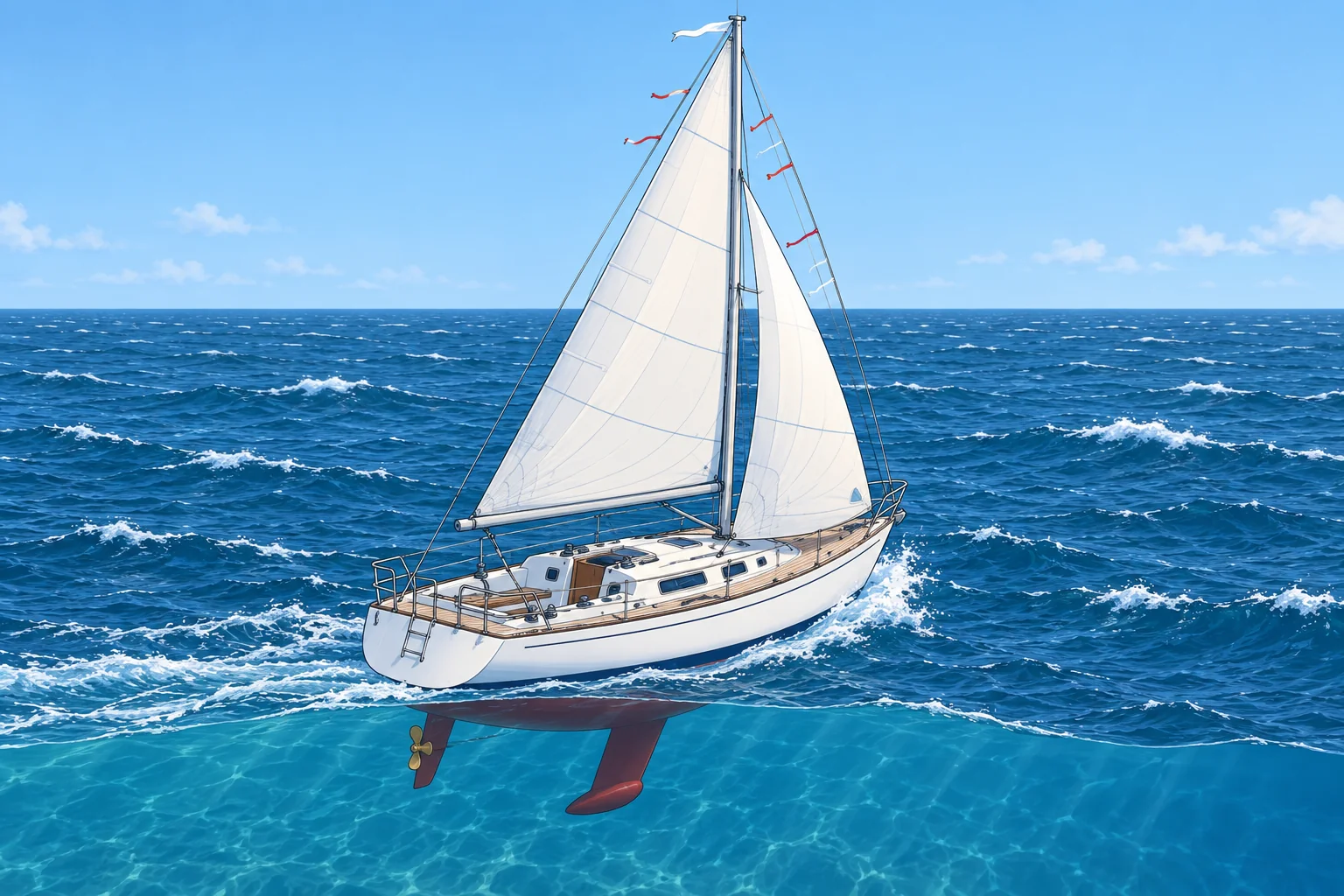
True wind and apparent wind
1The lesson in plain words
The wind you feel on a moving boat is not the wind blowing over the sea. Your sails always work in the apparent wind.
True wind
True wind here means wind relative to the water: what you feel while drifting with it. Wind direction names where it comes from: a north wind blows from the north. True wind angle is the angle between your bow and that direction.
Boat wind
When your boat moves, she makes her own breeze, equal and opposite to her speed through the water. Motor at 6 knots in a flat calm and you feel 6 knots of wind from dead ahead. One knot is one nautical mile per hour, about 1.85 km/h. Under sail, this boat wind is always there while you move, adding to the true wind.
Apparent wind
Apparent wind is the true wind and the boat wind added together. It is the wind you feel on your face, the wind the burgee (small masthead wind flag) and telltales show, and the wind your sails use. Telltales are short wool or ribbon strips that show airflow. Apparent wind comes from further forward than the true wind except when sailing directly downwind, on a dead run.
Upwind and downwind
Sailing as close to the wind as the boat sails well (close-hauled), boat wind adds to the true wind: apparent wind is stronger than true wind and comes from further ahead. With true wind well behind you, apparent wind is usually lighter. With wind just aft of the beam (across the boat), it can still be stronger than true wind. Sailing directly downwind can hide a strong wind that you only feel when you turn upwind. Check your sail area before turning upwind; reduce sail first if needed.
Speed and gusts
The faster the boat, the further forward the apparent wind moves. On a reach, sailing with the wind coming from the side, a gust (sudden stronger wind) that keeps the same true direction shifts the apparent wind aft, further back, before the boat accelerates. A lull, a drop in wind strength with the same true direction, shifts it forward before the boat slows.
Reading the examples
All angles are measured from the bow. At 45°, 12 knots becomes about 16.8 knots at 30°: stronger and further forward. At 90°, 10 knots becomes about 11.7 knots at 59°: even wind from the side feels forward. At 150°, 12 knots becomes about 7.4 knots at 126°: lighter, but still further forward.
2Key data
- Apparent wind
- True wind + boat wind (added as directions, not just as numbers)
- Boat wind
- Equal to boat speed, from dead ahead
- Beam reach example
- True 10 kn at 90° + boat 6 kn → apparent ≈ 11.7 kn at ≈ 59°
- Close-hauled example
- True 12 kn at 45° + boat 6 kn → apparent ≈ 16.8 kn at ≈ 30°
- Broad reach example
- True 12 kn at 150° + boat 6 kn → apparent ≈ 7.4 kn at ≈ 126°
3Key points
- 1
True wind is relative to the water; apparent wind is what you feel on board.
- 2
Your sails, telltales and burgee all react to the apparent wind.
- 3
Upwind, apparent wind is stronger; with true wind well aft, it is usually lighter.
- 4
Apparent wind comes from further forward than true wind, except on a dead run.
- 5
On a reach, with true wind direction and boat speed unchanged, a gust shifts apparent wind aft; a lull shifts it forward.
4Frequent mistakes
Wrong: The wind feels light on this run, so it will be light when we turn upwind.
Right: On a run slower than the true wind, boat wind reduces the apparent wind. Turning upwind makes it stronger. Check your sail area before turning upwind; reduce sail first if needed.
Wrong: The burgee shows the true wind direction.
Right: The burgee shows apparent wind. It shows this water-referenced true wind only when the boat is stationary relative to the water.
5Practice case & exam keys
You sail directly downwind in 12 knots of true wind at 6 knots. It feels like a gentle 6 knots. You plan to round a headland and sail as close to the wind as the boat sails well for an hour.
Show the answer
Running, you feel about 6 knots; close-hauled at the same speed, about 17 knots. Expect more heel after turning. Check sail area and prepare the crew first; reduce sail if the boat will be overpowered.
Exam keys
- Apparent wind = true wind + boat wind; sails work in the apparent wind.
- Apparent wind is stronger and further forward upwind; usually lighter with true wind well aft.
- On a reach, with true wind direction and boat speed unchanged, a gust shifts apparent wind aft; a lull shifts it forward.
- Wind direction is named by where it comes from.
Finish this unit
When you've read it, answer three questions. Get all three right to finish the unit; opening the page alone doesn't count.
My notes for this unit
No notes