

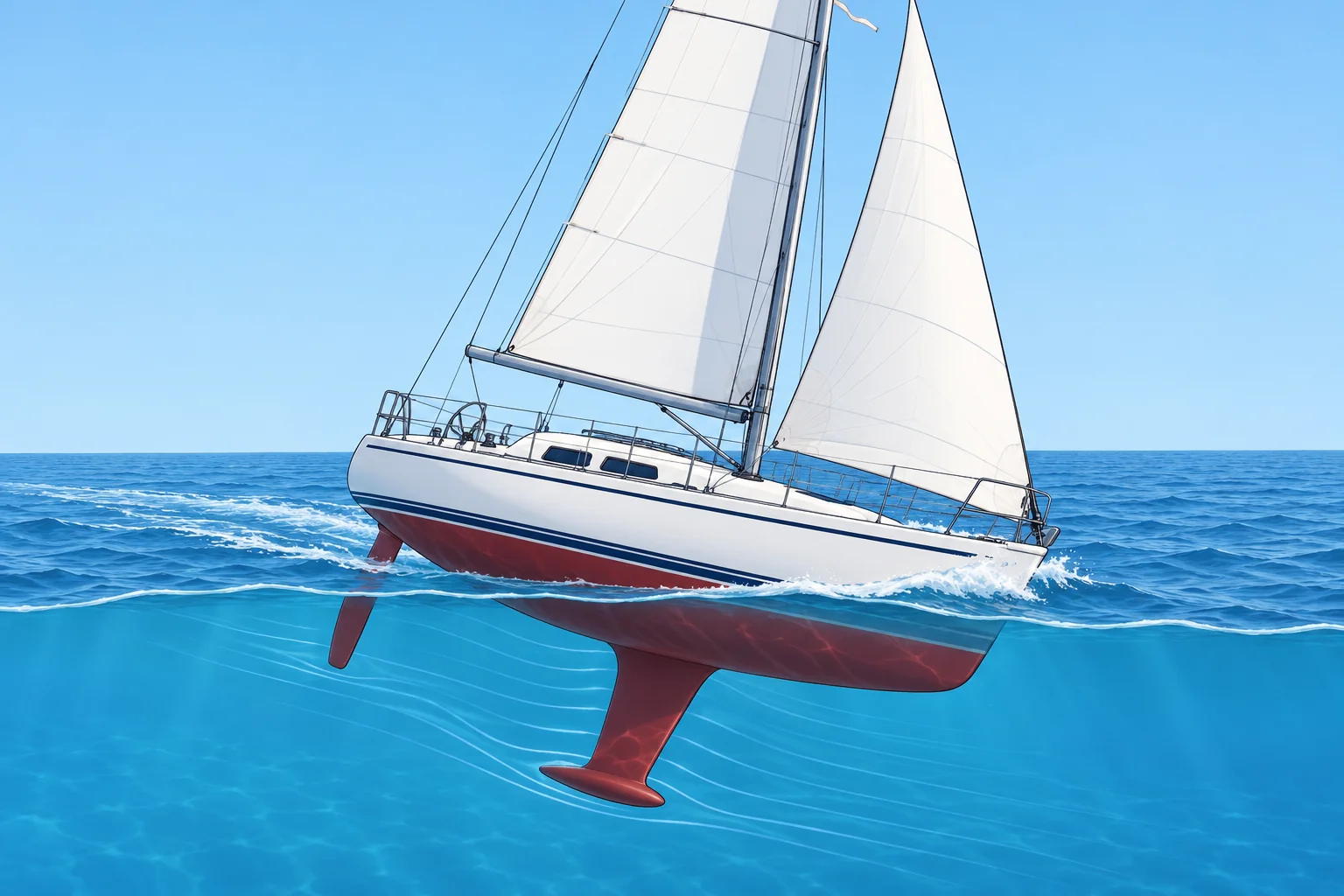
Why a boat can sail towards the wind
1The lesson in plain words
The sail's force points mostly sideways when you sail upwind. The keel resists the sideways part, so the forward part drives the boat at an angle to the wind.
Drive and heeling force
Close-hauled, the total sail force points mostly across the boat, slightly forward. Split it in two. Driving force acts along the boat's centreline, forwards. Heeling force acts sideways, pushing the boat to leeward and making her heel, lean over. Upwind the heeling force is much larger than the driving force. On a reach, more of the total force points forwards.
The keel
The keel, an underwater fin or lengthwise structure, resists sideways slip. A dinghy uses a centreboard or daggerboard, a board lowered through the hull, for the same job. The boat still slips sideways a little. This is leeway. As water flows past at this small angle, the keel or board acts like a wing. Its lift balances the sideways sail force.
Why it needs speed
A keel makes lift only when water flows past it. At low speed it grips poorly and the boat slides to leeward. After a tack, build speed before steering closer to the wind. If you pinch, steering too close to the wind, speed drops, leeway grows and you may make less ground to windward, not more.
The no-go zone
No sail can drive a boat straight into the wind. The no-go zone is the sector either side of the true wind where you cannot maintain effective sailing towards the wind. For most cruising yachts it reaches roughly 40–50° either side of the true wind; racing yachts point higher. To reach a place upwind, you sail close-hauled, as close to the wind as the boat sails well, and zigzag by tacking, turning the bow through the wind.
Points of sail
Each angle to the wind has a name: close-hauled, close reach, beam reach, broad reach and run. The Points of sail guide on this site shows them on an interactive wind clock. A cruising yacht typically changes heading by about 90° when tacking, so its upwind route is longer than the straight line.
2Key data
- No-go zone (cruising yacht)
- About 40–50° either side of the true wind
- Tacking angle (cruising yacht)
- About 90° between the two close-hauled headings
- Leeway
- A few degrees; more at low speed and when heeled
- Upwind force split
- Heeling force much larger than driving force
3Key points
- 1
Upwind, the sail force is mostly sideways: a small driving force and a large heeling force.
- 2
The keel resists sideways slip and works like an underwater wing.
- 3
The keel needs water flowing past: build speed before steering closer to the wind.
- 4
Inside the no-go zone, roughly 40–50° each side of true wind, you cannot sail effectively to windward.
- 5
To go upwind, sail close-hauled and tack in a zigzag.
4Frequent mistakes
Wrong: Pointing as high as possible always gets you upwind fastest.
Right: Pinching kills speed and increases leeway. Steer slightly away from the wind, keep the boat moving, and you gain more ground.
Wrong: The keel's main job is to stop the boat capsizing.
Right: A ballasted keel also adds stability, but its fin shape resists leeway. A dinghy's unballasted centreboard does that job too.
5Practice case & exam keys
Sailing upwind in steady wind and no current, your crew raises the centreboard halfway. You hold the same heading, but the dinghy now slips noticeably towards the leeward shore. Should you keep the board raised?
Show the answer
Lower the centreboard to its normal upwind position for your dinghy. More board area helps resist leeway. Keep the boat moving so water flows past the board.
Exam keys
- Total sail force splits into driving force (forward) and heeling force (sideways).
- Keel or centreboard resists leeway; it acts as a wing in water.
- No-go zone: about 40–50° each side of the true wind for a cruiser; tack to go upwind.
- Pinching loses speed and increases leeway.
Finish this unit
When you've read it, answer three questions. Get all three right to finish the unit; opening the page alone doesn't count.
My notes for this unit
No notes