

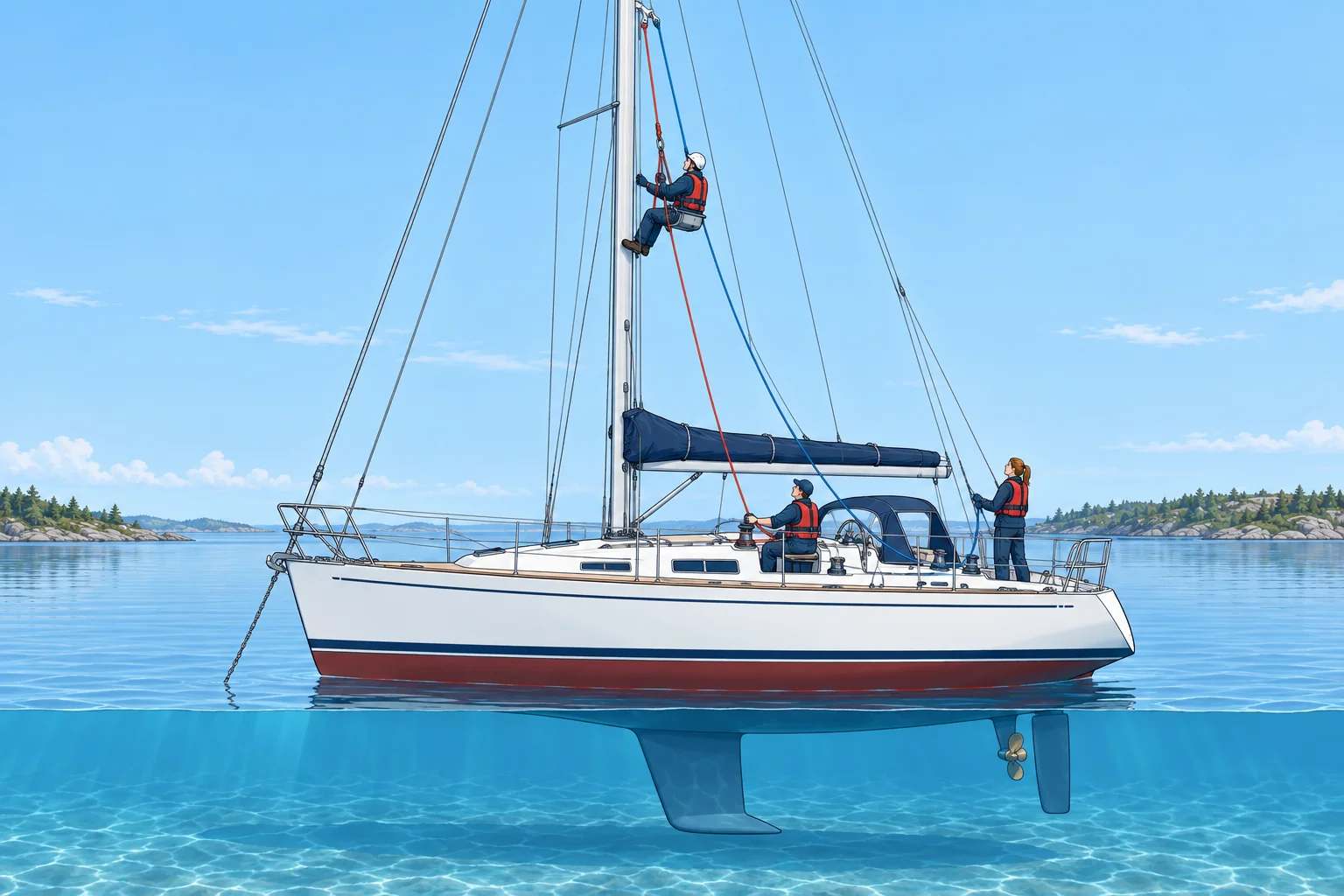
Going aloft safely: an introduction
1The lesson in plain words
Going aloft needs a trained team, a fitted chair, a harness suitable for suspension, two independent halyards, controlled winches and nobody below.
Plan it
Use binoculars from deck first. If you lack specific aloft training or are not confident, use a professional rigger. Plan any ascent in harbour or at anchor in calm water. Brief the team and tie tools and spares on with lanyards, short securing cords. Enthusiasm and calm water do not make unchecked equipment safe.
Equipment
Use a fitted bosun's chair, a suspended working seat, and a separate full-body harness approved by its maker for suspension aloft. Tie the working halyard to the chair and the independent safety halyard to the harness's rated point, following equipment instructions. Use separate, checked masthead sheaves (pulley wheels). Never use suspect equipment. A trained person must tie, secure and check suitable bowlines (fixed-loop knots) with adequate tails. Do not rely on snap shackles. Wear a helmet and non-slip shoes.
The deck team
Keep the clutch, a rope-holding device, closed while hoisting or holding. Use the maker's specified winch turns. Continuously control the tail, the free rope end leaving the winch. Never rely on the self-tailer, the winch's rope-gripping jaws, alone. One person winches; a second controls the independently secured safety line and takes up slack as you hoist. Ideally, a third watches and relays messages. Never leave the winch while someone is aloft.
Below and coming down
Nobody stands under the mast: a dropped tool can kill. Before opening the clutch, take the load on adequate winch turns and control the tail. Lower slowly, with the safety-line handler paying out at the same rate and keeping slack minimal. Follow the winch and clutch instructions.
2Step by step
Hoisting a crew member aloft (in harbour)
- 1
Check training, the fitted chair, separate full-body harness rated for suspension aloft, both halyards and their separate sheaves. Never load suspect equipment.
An unchecked lifting path or attachment can fail. Use a professional rigger if you lack specific aloft training.
- 2
Tie the working halyard to the chair and the safety halyard to the suspension-rated harness's specified attachment point, following equipment instructions. Secure tools with lanyards.
A trained person must tie, secure and check suitable bowlines with adequate tails. Do not rely on snap shackles; lanyards secure tools.
- 3
Lead the working line through the clutch to the winch. Keep the clutch closed while hoisting or holding, with adequate winch turns and the tail controlled. A dedicated safety-line handler controls the independently secured safety line.
Separate lifting paths and attachments provide backup; the safety must be independently secured, not merely held by hand.
- 4
Hoist steadily while the safety-line handler takes up slack on the independently secured safety line.
A slack safety line lets the climber fall further before it holds.
- 5
Keep everyone clear below. Before opening the clutch, take the load on adequate winch turns and control the tail. Lower slowly, with the safety-line handler paying out at the same rate and keeping slack minimal.
Control both lines throughout descent. A slack safety line allows a longer fall.
3Key data
- Lines
- Working halyard + independently secured safety; separate sheaves
- Attachment
- Working to chair; safety to separate suspension-rated harness
- Winch
- Clutch closed hoisting/holding; adequate turns; tail controlled
- Deck team
- Winch operator, safety-line handler and ideally a spotter
4Key points
- 1
Plan in calm water; check first with binoculars. Use a rigger if you lack specific aloft training.
- 2
Use a fitted chair and separate full-body harness rated for suspension aloft; two checked halyards through separate sheaves.
- 3
Working line to chair, safety to harness; trained person ties, secures and checks bowlines. Tools on lanyards.
- 4
Clutch closed hoisting/holding; adequate winch turns and controlled tail; never trust a self-tailer alone.
- 5
Nobody below; take load on winch before opening clutch; lower both lines together, with minimal safety slack.
5Frequent mistakes
Wrong: One good halyard is enough for a short trip up the mast.
Right: Use an independent safety halyard attached to a separate full-body harness rated for suspension aloft. Check both lifting paths and attachments; never use suspect equipment.
Wrong: The self-tailer will hold the climber while the winch person helps.
Right: Never leave the winch. Keep the clutch closed while hoisting or holding, with adequate turns and the tail controlled; a dedicated safety-line handler controls the independently secured safety line.
6Practice case & exam keys
At anchor in calm water, a halyard sheave needs checking at the masthead. A keen crew member wants to go up on the spinnaker halyard alone, using a snap shackle.
Show the answer
First inspect from deck with binoculars. If the crew lack specific aloft training, use a professional rigger. Do not use a suspect halyard or sheave for either line. A trained team must check two independent lifting paths and secure attachments: working line to chair, safety line to separate suspension-rated harness. Calm water and enthusiasm do not make unchecked equipment safe.
Exam keys
- Going aloft: calm water, trained team, fitted chair and separate full-body harness rated for suspension aloft; rigger if untrained.
- Two independent halyards through separate sheaves: working to chair, safety to harness; trained person checks secured bowlines.
- Clutch closed hoisting/holding; adequate winch turns; controlled tail; independently secured safety with its own safety-line handler.
- Nobody below; tools on lanyards; take load on winch before opening clutch; lower both lines together with minimal slack.
Finish this unit
When you've read it, answer three questions. Get all three right to finish the unit; opening the page alone doesn't count.
My notes for this unit
No notes