

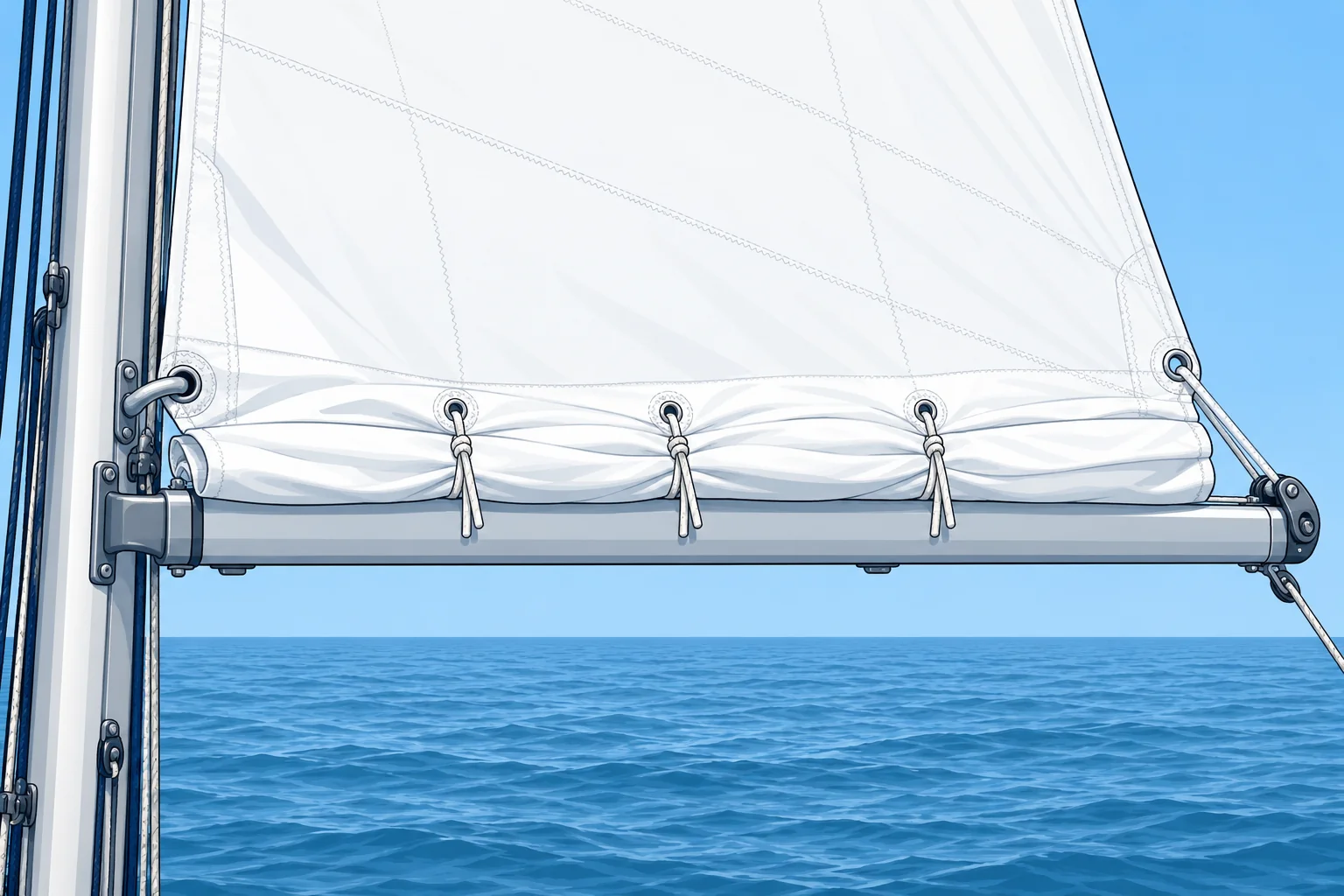
Slab reefing the mainsail
1The lesson in plain words
Slab reefing makes the main smaller. With separate controls: ease the halyard, the line that hoists the main; secure the tack, tension the halyard, then the clew.
The parts
The luff is the front edge; the leech is the aft edge. Reinforced reefing eyes are cringles. The forward tack cringle hooks onto a reefing horn at the gooseneck, the mast–boom joint, or is secured by a tack line. The reef line pulls the aft clew cringle down and aft to its designed reefed position. Small reef points gather the loose sail.
Before you start
Check the reef line runs clear through the right cringle. Sail close-hauled, as near the wind as the boat sails, with the mainsail eased; or heave to, holding a controlled near-stop. Depower the main before lowering it. Support the boom with the topping lift, a line holding up its outer end, or another support approved for your boat. Ease the kicker (vang), the tackle pulling the boom down, as the maker directs.
Single-line and two-line
Many yachts lead reefing lines to the cockpit. Single-line reefing uses a common line for tack and clew, with more friction. Two-line reefing has separate tack and clew lines. The steps below describe a reefing horn or separate lines: secure the tack, tension the halyard, then tension the clew. With single-line reefing, lower to the maker's halyard mark and use the common line to position both cringles as instructed.
Tidying up
Tie reef points loosely round the loose sail with a reef knot, not round the boom. They gather sail; they do not carry reefing loads. Reset the kicker, reset the boom support as instructed and trim. To shake out a reef means to remove it and increase sail area. First depower the main, support the boom and untie all reef points. Then follow your system's sequence for releasing the reef tack and clew and hoisting. Never hoist against a secured reef tack or a tight reef line.
2Step by step
Slab reefing with a horn or separate tack and clew lines
- 1
Depower the main: sail close-hauled with the sheet eased, or heave to. Support the boom with its fitted system; ease the kicker as the maker directs.
A depowered sail comes down easily, and the boom will not drop on the crew.
- 2
Lower the halyard to its reef mark until the tack cringle reaches the horn or its designed tack position.
A mark on the halyard saves guessing at the mast.
- 3
Hook the tack cringle onto the reefing horn, or pull down the tack line.
The new tack must be secured before the luff is re-tensioned.
- 4
Tension the halyard for a smooth luff; stop if sail slides, the fittings running in the mast track, bind.
Correct luff tension improves sail shape. Binding fittings need checking, not more force.
- 5
Tension the reef line to pull the clew down and aft to its designed reefed position. Stop if it binds; do not force fittings against the boom.
The reef line carries the clew load; reef points only gather the loose sail.
- 6
Tie reef points loosely round the sail only; re-set the kicker, reset the boom support as instructed, trim.
The loose sail is tidy, and the boom is supported as designed.
3Key data
- Horn or separate-line order
- Ease → tack down → halyard up → clew down → tie points
- Reef points
- Round the loose sail only, with a reef knot
- Shaking out
- Depower; support boom; untie points before raising sail
- Boom
- Support boom while reefing; reset support as instructed
4Key points
- 1
Depower the main first: close-hauled with the sheet eased, or hove-to.
- 2
With a horn or separate lines: ease halyard, tack down, halyard up, clew down.
- 3
The reef line takes the load; reef points only tidy the loose sail.
- 4
Tie reef points round the sail, not the boom.
- 5
To shake out, untie the points first.
5Frequent mistakes
Wrong: Tie the reef points tightly round the boom to hold the sail down.
Right: Tie them round the loose sail only. The reef line holds the clew; ties round the boom can tear the sail.
Wrong: Hoist the halyard to shake out a reef, then untie the points.
Right: Untie every point first. A forgotten tie will rip the sail as the halyard goes up.
Wrong: Reef running downwind, when the boat is calmer.
Right: Downwind, the main can press against the shrouds (mast-support wires) and spreaders (struts holding those wires away from the mast), making lowering difficult. For this procedure, depower it close-hauled or hove-to before lowering.
6Practice case & exam keys
You put in a reef, but the reefed main has a deep bag along the foot and loose, flapping folds along the luff. The reef points are straining.
Show the answer
Depower the main and support the boom. Check the tack and reef-line lead. Slacken straining reef points before adjusting tension. Tension the halyard for a smooth luff; stop if the fittings carrying the sail in the mast track bind. Tension the reef line to draw the clew down and aft to its designed position; do not force fittings against the boom. Retie reef points loosely round the sail. Reset the kicker, reset the boom support as instructed and trim.
Exam keys
- Horn/separate lines: secure tack, tension halyard, draw clew down and aft to its designed position.
- Depower first; support the boom with its fitted system; ease the kicker as instructed.
- Reef points round the loose sail only; reef knot.
- Shake out: untie points first.
Finish this unit
When you've read it, answer three questions. Get all three right to finish the unit; opening the page alone doesn't count.
My notes for this unit
No notes