

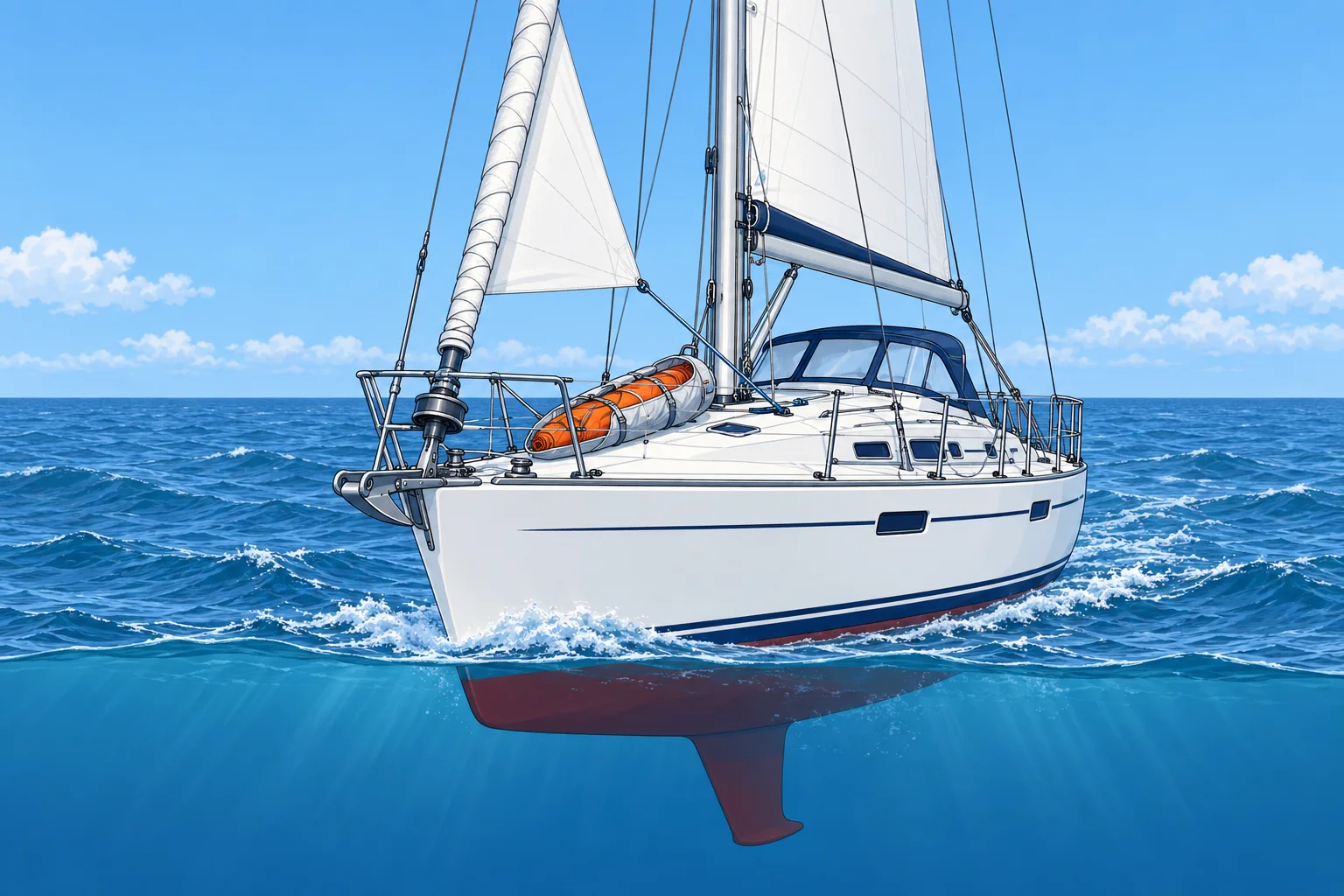
Furling headsails, in-mast mains and storm sails
1The lesson in plain words
Most cruising boats roll headsails away on a furler. Roll under control, move the sheet car, and for offshore work carry proper storm sails.
Roller furling headsail
A roller furler rolls the headsail round the forestay. Ease the sheet, the line trimming it, and pull the furling line, keeping light sheet tension. Secure the furling line, then trim. Move the car, the sliding sheet lead, forward as you reef. This increases downward pull on the clew, the aft corner, to control the upper leech, the aft edge. Unload pin-stop cars before moving them; follow the maker’s instructions for adjustable cars.
Limits of furling
A genoa, a headsail overlapping the mast, loses efficient upwind shape when deeply rolled. A foam pad along the luff, its front edge, can help it flatten. Stop if furling becomes stiff; never force it with a winch. Check for a riding turn, where one turn traps another on the drum, or a halyard wrapping round the foil, the grooved tube around the forestay.
In-mast furling
An in-mast furling mainsail rolls vertically inside the mast. Follow the maker's routine. Depower the main and ease the mainsheet and kicker as instructed. Set the specified boom angle. Keep light tension on the outhaul, the line pulling the clew along the boom, while furling steadily. A loose roll can crease and jam. Stop if resistance rises; never force a jam with a winch.
Storm sails
A storm jib is a small, strong headsail in a bright colour. A storm trysail sets on the mast in place of the mainsail and sheets independently of the boom. A heavy-weather jib is a strong headsail for strong winds. World Sailing’s Offshore Special Regulations (OSR) set storm and heavy-weather sail requirements for offshore racing.
Rig them before
Your storm jib needs attachment independent of a luff groove, the slot in the forestay foil that holds a sail's front edge. A suitable inner stay with hanks, clips that attach the sail, is one option. Arrange a suitable mast track for the trysail, with the mainsail secured and sheets independent of the boom. Check it can be set with an in-mast-furled main. Practise setting both in calm weather.
OSR sail inventory
For races using OSR 2026–2027: Category 0 needs a storm trysail. Categories 1–2 need a trysail or at least 50% mainsail-luff reduction; Category 3 needs a trysail or at least 40%. Categories 0–2 also need a storm jib. Categories 0–3 also need a heavy-weather jib. Category 4 needs at least 12.5% mainsail-luff reduction or a heavy-weather jib. Check the applicable edition and race requirements. Luff reduction means shortening the sail’s front edge, not reducing its area by that percentage.
2Key data
- Furling a genoa
- Light sheet tension; secure furling line; adjust car safely
- In-mast main
- Boom at maker's angle, light outhaul tension, never force
- OSR 2026–27, Cat 0–2
- Storm jib + heavy-weather jib; Cat 0 trysail; Cat 1–2 see below
- OSR 2026–27, mainsail alternatives
- Cat 1–2: trysail or ≥50% luff reduction; Cat 3: trysail or ≥40%
- OSR 2026–27, Cat 3–4
- Cat 3: heavy-weather jib; Cat 4: ≥12.5% luff reduction or same jib
3Key points
- 1
Roll under light sheet tension; secure the furling line, then trim.
- 2
Move the sheet car forward as you reef; unload pin-stop cars and follow the maker's guidance.
- 3
Never force a stiff furler or in-mast main with a winch; find the cause.
- 4
Storm-jib attachment must work without a luff groove; an inner stay is one option.
- 5
Practise setting storm sails in calm weather.
4Frequent mistakes
Wrong: Let the sheet fly and wind in the furling line fast.
Right: Keep light sheet tension for a compact roll and less flogging. Secure the furling line at the chosen reef.
Wrong: A heavily rolled genoa works fine as a storm jib.
Right: A heavily rolled genoa has poor shape. Use a proper storm jib with suitable attachment independent of the luff groove.
5Practice case & exam keys
The wind rises to 25 knots. You roll the genoa to half size, but the top of the sail flaps while the foot is tight, and the boat heels a lot.
Show the answer
Ease the sheet before moving a pin-stop car; use an adjustable car as its maker directs. Move the lead forward a little, then re-trim and check the upper sail. If you remain overpowered, reduce sail further and recheck helm balance. A deeply furled genoa may still have a poor shape.
Exam keys
- Furl under light sheet tension, secure the furling line and adjust the car safely.
- In-mast furling: follow maker's boom angle and outhaul routine; never force.
- OSR 2026–27: Cat 0 trysail; Cat 1–2 trysail or ≥50% luff reduction; Cat 3 trysail or ≥40%. Storm jib Cat 0–2; heavy-weather jib Cat 0–3. Cat 4 ≥12.5% luff reduction or heavy-weather jib.
- Storm-jib attachment independent of the luff groove; trysail settable with the main furled, sheets independent of the boom; practise beforehand.
Finish this unit
When you've read it, answer three questions. Get all three right to finish the unit; opening the page alone doesn't count.
My notes for this unit
No notes