

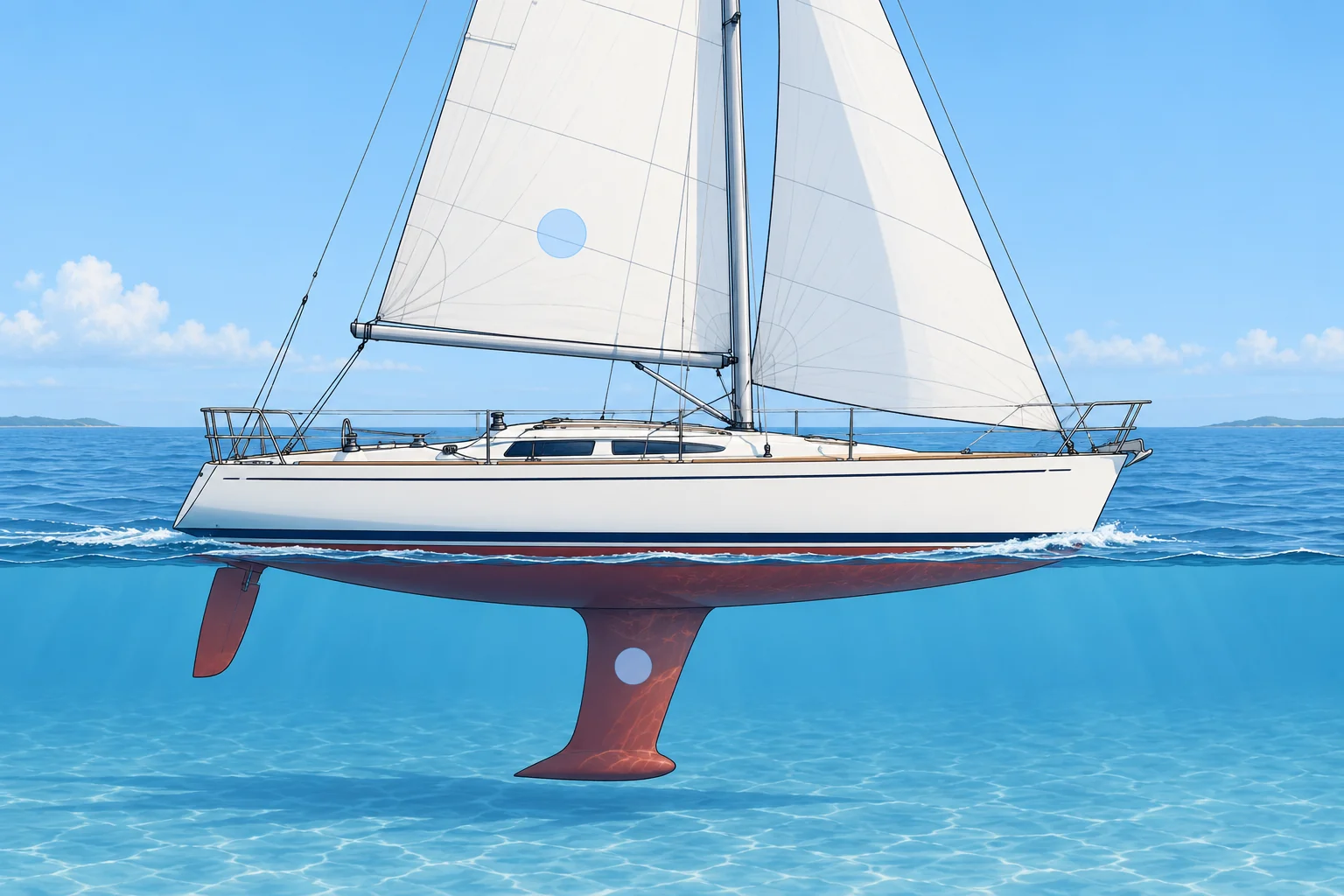
Helm balance: weather helm and lee helm
1The lesson in plain words
A well-balanced boat needs only a little rudder. Too much weather helm brakes the boat; lee helm is unsafe. Trim and reefing fix both.
Two centres
The sails act through the centre of effort (CE). The hull, keel and rudder resist sideways motion through the centre of lateral resistance (CLR). In a simple upright model, moving sail force aft relative to the CLR increases the tendency to turn towards the wind (weather helm). Moving it forward increases the tendency to turn away (lee helm). Heel also affects actual balance.
Slight weather helm is good
With a little weather helm, a few degrees of rudder, the rudder adds lift to windward and the boat gives feedback. She normally tends to head up and lose power if you release the helm. This does not guarantee a stop: keep control of the helm. Lee helm is undesirable: a boat that bears away when you let go can gybe or run off.
Why weather helm grows
Heel moves the sail force out to leeward of the hull, which turns the bow up. The heeled hull also becomes lopsided under water. A mainsail sheeted too hard, or too deep, adds more. So weather helm usually grows with the wind. A heavy helm means a large rudder angle, which brakes the boat.
Correcting it
To reduce weather helm, reduce heel and mainsail power. Ease the mainsheet or lower the traveller; flatten and twist the main; reef the main if needed; or move the crew to windward. To reduce lee helm, if the main is under-trimmed, sheet it in until airflow is right. Otherwise consider less headsail and recheck balance.
2Key data
- Simple model: CE moves aft relative to CLR
- Greater tendency to turn towards the wind: weather helm
- Simple model: CE moves forward relative to CLR
- Greater tendency to turn away from the wind: lee helm
- Good balance
- Slight weather helm, a few degrees of rudder
- Reduce weather helm
- Ease mainsheet, lower traveller, reduce heel; reef if needed
3Key points
- 1
Weather helm: the boat turns towards the wind; lee helm: away from it.
- 2
Slight weather helm is good; a heavy helm is a brake.
- 3
Heel and an over-sheeted main increase weather helm.
- 4
Reduce weather helm: ease the mainsheet, lower the traveller, flatten the main and reduce heel; reef if needed.
- 5
Lee helm: if the main is under-trimmed, sheet in until airflow is right; otherwise consider less headsail and recheck balance.
4Frequent mistakes
Wrong: Lee helm is safer because the boat will not round up.
Right: Lee helm encourages bearing away and can lead to a gybe. Slight weather helm is the preferred balance; keep control of the helm.
Wrong: Reefing the headsail is the best cure for weather helm.
Right: Reducing headsail shifts sail force aft but also reduces heel. The net effect varies; reassess balance after reducing either sail.
5Practice case & exam keys
Close-hauled in a building breeze, you need about 15° of rudder to hold course, and the boat rounds up in every gust. The genoa is full size and the main is sheeted hard with the traveller in the middle.
Show the answer
This is heavy weather helm. Lower the traveller to leeward and ease the mainsheet slightly in the gusts. Flatten the main with the outhaul, cunningham and backstay where your rig allows. Move the crew to windward. If the helm is still heavy, reef the main. The aim is a few degrees of rudder.
Exam keys
- Simple upright model: moving CE aft relative to CLR increases weather-helm tendency; moving it forward increases lee-helm tendency. Heel also matters.
- Slight weather helm is the preferred, efficient balance; keep control of the helm.
- Heel and an over-sheeted main increase weather helm.
- Cure: ease mainsheet, lower traveller, flatten, reduce heel; reef if needed.
Finish this unit
When you've read it, answer three questions. Get all three right to finish the unit; opening the page alone doesn't count.
My notes for this unit
No notes