

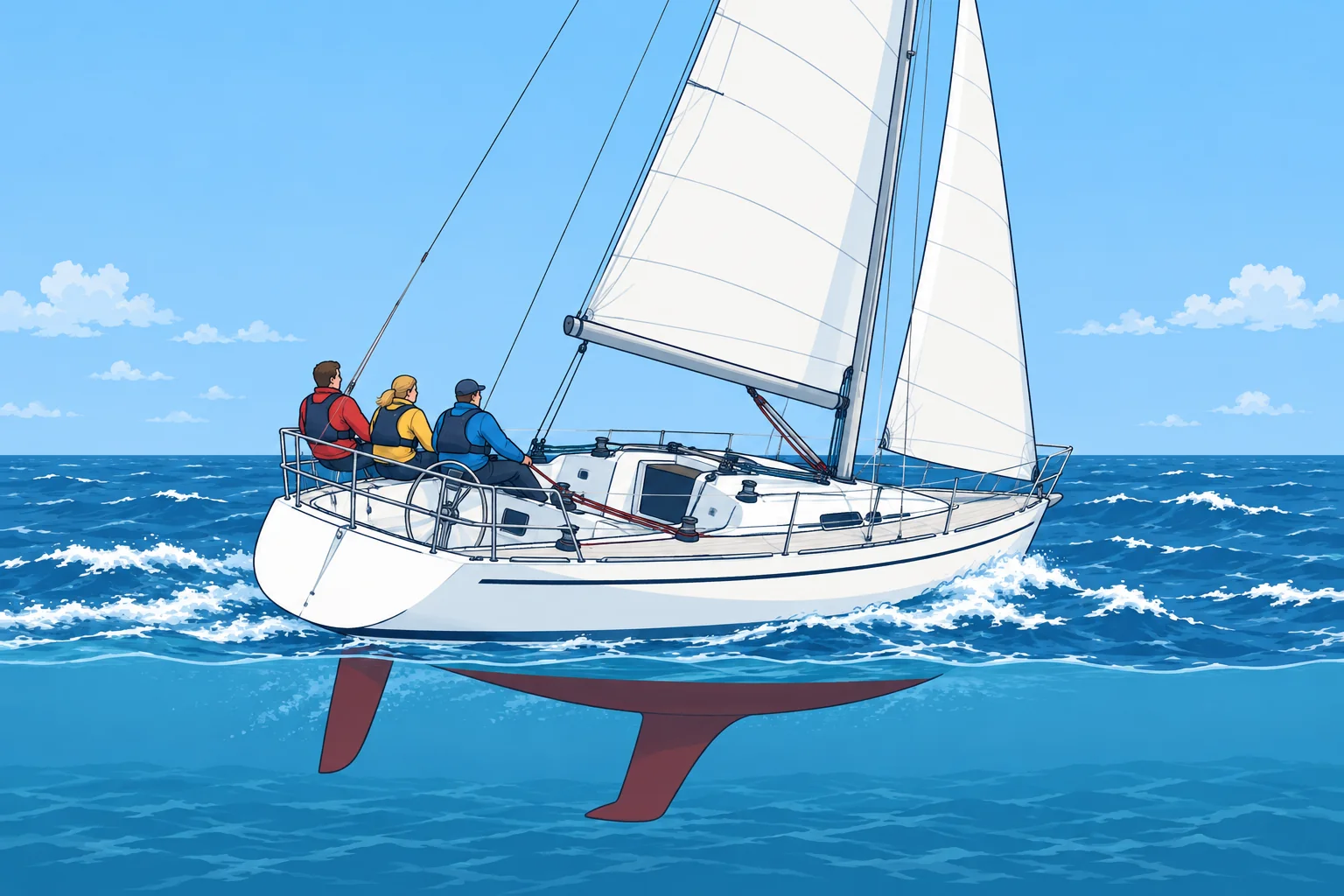
Depowering: flatten, twist, then reef
1The lesson in plain words
Ease promptly in an overpowering gust. As wind builds, flatten, adjust twist and traveller, then reef when needed.
Why depower
Above a certain wind strength, more sail force only adds heel, leeway and weather helm. Speed no longer rises. Your job is to keep the boat on her feet, at a steady heel, with a light helm. Ease promptly if a gust overpowers you. For a gradual increase, adjust trim while the boat remains under control; reef early if control or balance is poor.
Flatten
A flatter sail makes less force and less drag. On the main, tighten the outhaul and cunningham; add backstay if your rig allows. On the headsail, use halyard tension to keep the draft forward; use backstay adjustment, where effective, to reduce forestay sag. Move the car slightly aft to flatten the foot and open the top. Flattening reduces heel with little speed loss.
Twist and ease
Opening the top of the sails spills wind where it heels the boat most. For main twist, ease the mainsheet with the kicker free enough to let the boom rise. For headsail twist, move the jib car aft. Drop the traveller to leeward in gusts and bring it back up in the lulls. Play the mainsheet or traveller: ease in gusts and re-trim in lulls to keep heel steady.
Reduce sail
If you are easing the main most of the time, or control or balance is poor, reduce sail area. A common upwind order is to reef the main; reduce headsail too if still needed. Recheck power and helm balance. A boat with the right sail area sails faster and more comfortably than one carrying too much sail with a flogging main.
Waves and reaching
In waves, keep slightly more depth for drive. On a reach, use the kicker to control twist and ease the mainsheet in gusts, keeping the boom clear of the shrouds. Reduce sail if control remains poor.
2Step by step
Depowering upwind: gust response and gradual adjustments
- 1
Ease the mainsheet or lower the traveller promptly if a gust overpowers you.
Easing restores control immediately.
- 2
Once control is restored, flatten between gusts with outhaul and luff tension; add backstay where effective and within the rig maker's limits.
Flatter sails make less heeling force at little cost to speed.
- 3
Move the jib car aft for headsail twist. For main twist, ease the mainsheet with the kicker free enough to let the boom rise. Play the sheet or traveller as needed in gusts.
Twist spills wind high up. Easing in gusts keeps heel and helm steady.
- 4
Reef the main if you are easing most of the time or control or balance is poor.
Too much sail is slower and harder on the rig and crew.
- 5
Reduce headsail too if still needed; re-check helm balance.
Only reduce further if power or balance calls for it.
3Key points
- 1
Above a certain wind, more power only adds heel and leeway.
- 2
Between gusts, flatten with outhaul, cunningham, halyard and backstay where effective.
- 3
Headsail twist: car aft. Main twist: ease mainsheet with kicker free enough to let the boom rise.
- 4
Ease promptly if overpowered; play the traveller or mainsheet in gusts to keep heel steady.
- 5
Easing the main most of the time? Reef.
4Frequent mistakes
Wrong: Let the main flog permanently to keep the boat upright.
Right: A constantly flogging main is slow and damages the sail. Ease promptly in gusts; reef if you are easing most of the time or control or balance is poor.
Wrong: Flatten the sails as much as possible in a big sea.
Right: Waves need power. Keep slightly more depth and twist so the boat can drive through them.
5Practice case & exam keys
Close-hauled in 16 knots, gusting 22, your 10 m sloop heels to 28° in each gust. All controls are as they were in 10 knots: outhaul eased, cunningham off, backstay off, traveller centred.
Show the answer
Ease the main to control the gusts, then flatten between gusts: tighten the outhaul, pull on the cunningham and add backstay within the rig maker's limits. Move the jib car slightly aft to add twist. Lower the traveller and play it or the mainsheet in gusts. If easing is needed most of the time, or control remains poor, reef the main; reduce headsail too if still needed. Recheck balance.
Exam keys
- Ease promptly in overpowering gusts. As wind builds under control: flatten, adjust twist and traveller; reef the main, reducing headsail too if needed.
- Flatten with outhaul and luff tension; add backstay where effective. Headsail halyard moves draft forward; backstay may reduce forestay sag.
- Headsail twist: car aft. Main twist: ease mainsheet with kicker free enough to let the boom rise.
- Constant easing or poor control means reef early.
Finish this unit
When you've read it, answer three questions. Get all three right to finish the unit; opening the page alone doesn't count.
My notes for this unit
No notes