

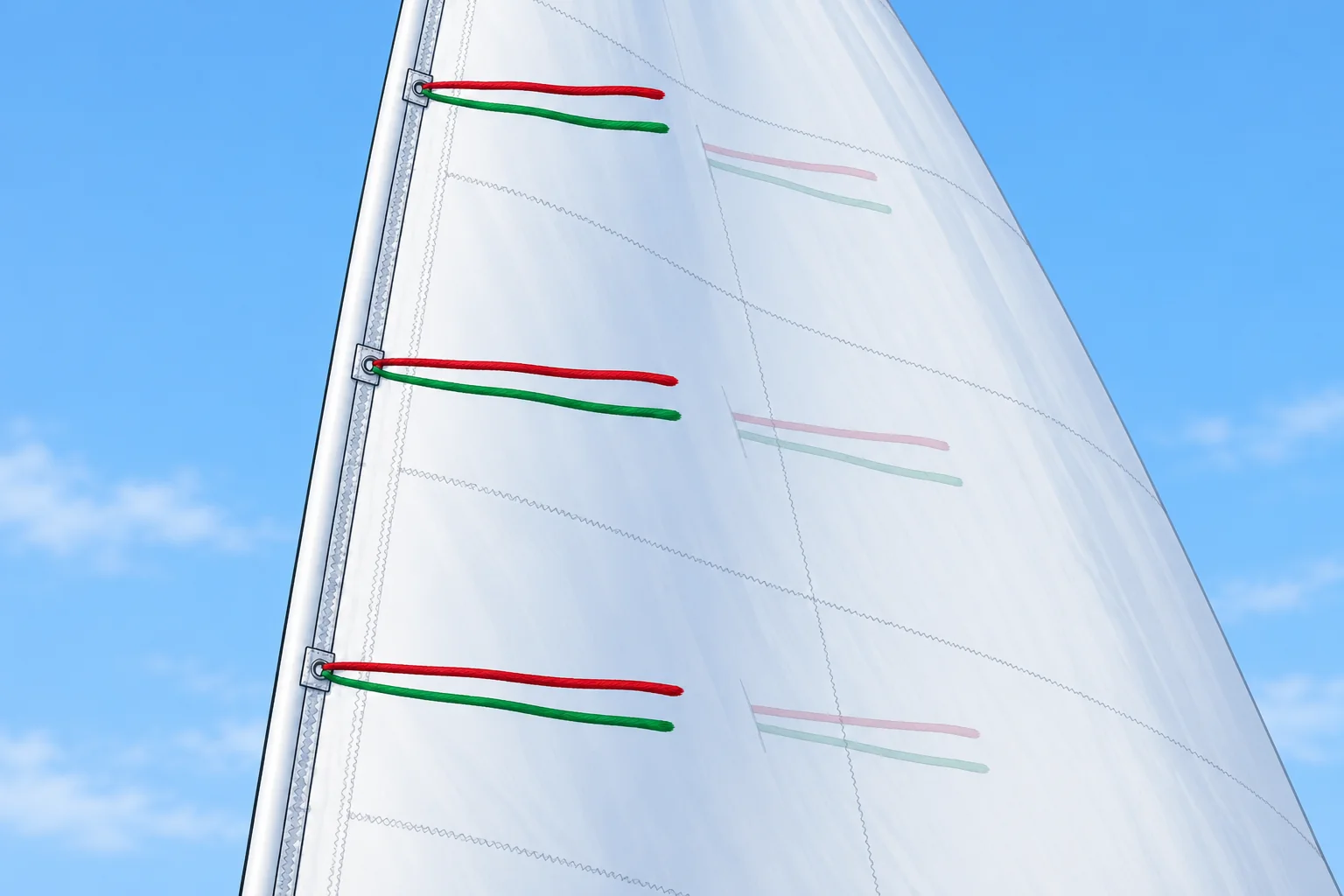
Reading telltales and twist
1The lesson in plain words
Telltales show the airflow on each side of a sail. Read them top to bottom to judge the sheet, the course and the sail's twist.
Luff telltales
Luff telltales are short strips just behind the headsail front edge (luff), usually at three heights. Both sides should stream aft. If the windward strip, on the side facing the wind, lifts, sheet in (pull in the sail control rope) or bear away (turn away from the wind). If the leeward strip, on the sheltered side, droops or spins, the sail is stalled: ease the sheet (let it out) or head up (turn towards the wind).
Steer or trim
Upwind, you usually keep the sheet set and steer to the telltales. On a reach, with the wind coming from the side, you usually hold your course and adjust the sheet.
Twist
Twist is how much the top of a sail opens compared with the bottom. Some twist lets the upper sail match the apparent wind, the wind you feel aboard, which usually comes from further aft aloft. To check it upwind, keep the sheet fixed and head up slowly. Watch the windward luff telltales: upper ones lifting first means too much twist; lower ones first means too little. Aim for them to lift together.
Leech telltales
On the mainsail, leech telltales fly from the back edge, often at batten ends; battens stiffen the sail. Streaming aft suggests clean flow. Hidden behind the sail may mean the leech is too tight. When sailing steadily upwind, about 50% streaming at the top is a common guide. In light air or while accelerating, aim for more continuous streaming. On a reach, the kicker holds the boom down and controls twist. On a deep run, these telltales may not stream reliably.
Shape words
Sailmakers describe shape with three terms. Draft or depth is how curved the sail is, its belly. Draft position is where along the sail the deepest point lies. Twist is the opening from bottom to top. A deep sail gives power for light wind and waves; a flat sail gives less drag and heel in strong wind.
2Key data
- Windward luff telltale lifts
- Sheet in, or bear away
- Leeward luff telltale stalls
- Ease the sheet, or head up
- Heading up slowly: upper windward luff telltales lift first
- Too much twist: reduce it
- Heading up slowly: lower windward luff telltales lift first
- Too little twist: add it
- Main top leech telltale upwind
- About 50%; more in light air or while accelerating
3Key points
- 1
Both luff telltales streaming aft: flow is right.
- 2
Windward lifting: sheet in or bear away. Leeward stalling: ease or head up.
- 3
Twist is the top of the sail opening relative to the bottom.
- 4
Heading up slowly: upper windward luff telltales lift first = too much twist; lower first = too little.
- 5
Main top telltale: about 50% streaming upwind; more in light air or while accelerating.
4Frequent mistakes
Wrong: A quiet, full sail with no flapping is trimmed perfectly.
Right: It may be stalled. Check the leeward telltales; ease until the luff just lifts, then sheet in a little.
Wrong: Twist is a fault; the sail should be the same angle top to bottom.
Right: Wind is stronger and further aft aloft. The right amount of twist matches the sail to it.
5Practice case & exam keys
Close-hauled, sailing as close to the wind as the sails allow, all three windward jib telltales lift. You bear away until they stream. With the sheet fixed, you then head up slowly: the upper windward telltale lifts before the lower ones. What do you adjust?
Show the answer
Bearing away restored flow. In the slow heading-up test, the upper telltale lifting first shows too much twist. Move the jib car, the sheet's sliding lead block, slightly forward. Reset the sheet and repeat the test. Aim for all three heights to lift together.
Exam keys
- Windward telltale lifts: sheet in or bear away. Leeward stalls: ease or head up.
- Heading up slowly with the sheet fixed: upper windward luff telltales lift first = too much twist; lower first = too little.
- Main top telltale: about 50% streaming upwind; more in light air or while accelerating.
- Shape: depth, draft position, twist.
Finish this unit
When you've read it, answer three questions. Get all three right to finish the unit; opening the page alone doesn't count.
My notes for this unit
No notes